
Movies have a way of making the automotive world look incredibly glamorous. From the high-octane action of the Fast and Furious series to the nostalgic charm of Thunder Road (released back in 1958), fast cars have always been a staple of cinema. The allure isn’t just in the actors; it’s in the vehicles themselves—rolling masterpieces of engineering and design.
This fascination often sparks a deeper question: How do these incredible machines come to life? If you’re passionate about being part of the team that designs, builds, and refines the next generation of passenger cars, trucks, motorcycles, or even racing vehicles, you’re in the right place. A career in automotive engineering is the path to turning that passion into a profession.
This comprehensive guide will walk you through the different types of automotive degrees, the critical difference between an automotive engineer and a mechanic, and provide a curated list of the best colleges and universities offering top-tier programs in this dynamic field.
Types of Automotive Degrees: Finding Your Path
Before diving into the list of schools, it’s crucial to understand the educational landscape. The degree you pursue will directly influence your career trajectory in the automotive industry. Options range from hands-on certificates to advanced engineering degrees.
Certificates and Diplomas
These programs are typically designed for individuals aiming to become skilled technicians. They focus on the practical aspects of vehicle repair, diagnostics, and maintenance, preparing graduates for roles in automotive shops and service centers.
Associate Degrees
An associate degree in automotive technology offers a blend of hands-on training and foundational technical knowledge. It’s a common starting point for those looking to enter the workforce quickly as a technician, with the option to later pursue a bachelor’s degree.
Bachelor’s Degrees
This is where the field of automotive engineering truly takes shape. A four-year degree provides a deep dive into the design, analysis, and manufacturing of vehicles. There are two primary paths at this level:
- Bachelor of Science in Automotive Engineering: This specialized degree is entirely focused on the design, development, and operation of vehicles like cars, trucks, and motorcycles. It’s a direct path to a career in automotive design and research.
- Bachelor of Science in Mechanical Engineering: This is a broader degree that covers all mechanical systems. While it provides a solid foundation for an automotive career, it also opens doors to other industries like aerospace, robotics, and energy. Many universities offer concentrations or minors in automotive topics within their mechanical engineering programs, allowing for specialization.
Master’s and Doctoral Degrees
For those seeking leadership, research, or advanced design roles, a graduate degree is essential. Master’s and PhD programs allow engineers to specialize in cutting-edge areas like electric vehicle (EV) powertrains, autonomous systems, or advanced materials.
Automotive Engineer vs. Auto Mechanic: Understanding the Roles
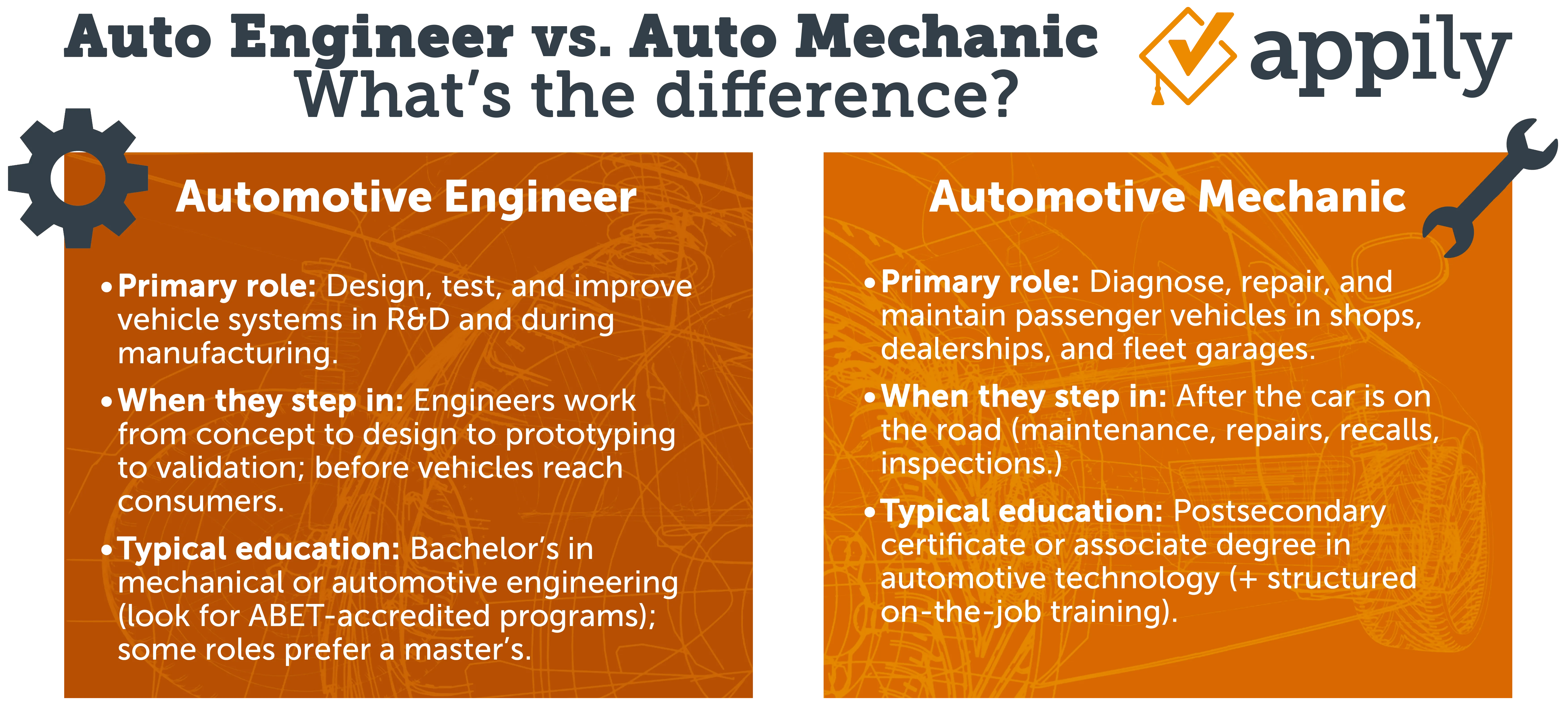
A common point of confusion is the distinction between an automotive engineer and an auto mechanic. While both are vital to the automotive ecosystem, their roles are fundamentally different and occur at different stages of a vehicle’s life.
- Automotive Engineer: These professionals work on the front end of the process. They are involved in the research, design, development, and testing of vehicles and their systems. Their work happens in offices, labs, and test tracks, focusing on innovation, performance, safety, and efficiency before a vehicle reaches the consumer.
- Auto Mechanic: Also known as service technicians, mechanics work on the back end. Once a vehicle is on the road, mechanics take over, performing repairs, routine maintenance, and diagnostics to keep it running safely and reliably. Their work is hands-on and happens in shops, dealerships, and service centers.
Best Colleges for Automotive Engineering and Mechanics Programs
The following institutions are recognized for their exceptional programs in automotive engineering, technology, and mechanics. They are organized to help you explore a range of options, from specialized technical colleges to major research universities.
Brigham Young University–Idaho
Rexburg, Idaho
BYU-Idaho offers a robust selection of programs through its Automotive Technology Department. Students can pursue a Bachelor of Science in Automotive Engineering Technology, Advanced Vehicle Systems, or Automotive Technology Management. The program is ASE-certified and emphasizes hands-on learning in labs and on test courses. Students can also join the SAE Supermileage Team, which competes annually in Michigan.
Clemson University
Clemson, South Carolina
Clemson University is a pioneer in automotive engineering education. Its students participate in “Deep Orange,” a unique project-based curriculum that immerses them in the role of an OEM (Original Equipment Manufacturer) engineer. The program extends to the Clemson University International Center for Automotive Research (CU-ICAR) in Greenville, where students can pursue a Master of Science and a PhD in Automotive Engineering, working directly with industry partners.
Ferris State University
Big Rapids, Michigan
Ferris State University offers a comprehensive suite of programs, including a Bachelor of Science in Automotive Engineering Technology and a Bachelor of Science in Automotive Management. Students gain practical experience through laboratory work in metallurgy, emissions testing, and dynamometer testing, along with a required internship. FSU also offers certificate programs in motorsports and machinery.
Idaho State University
Pocatello, Idaho
For those focused on the technical side, Idaho State University provides excellent programs. Students can earn an Associate of Applied Science in Automotive Technology or an Advanced Technical Certificate. ISU also offers specialized programs in Automotive Collision Repair and Refinishing, preparing graduates for a variety of hands-on roles.
Indiana State University
Terre Haute, Indiana
The Bachelor of Science in Automotive Engineering Technology at Indiana State University prepares students for careers focused on technical and managerial skills. The curriculum covers areas such as vehicle testing, design support, NVH (Noise, Vibration, and Harshness) analysis, and engine research.
Kettering University
Flint, Michigan
Kettering University is renowned for its co-op program, which allows students to graduate with up to two and a half years of professional experience. Students can earn a Bachelor of Science in Mechanical Engineering with concentrations like Automotive Engineering Design, Alternative Energy, and Machine Design. The university is home to specialized labs, including a Crash Safety Center and an Advanced Engine Research Lab.
McPherson College
McPherson, Kansas
McPherson College offers a truly unique program: it is the only institution in the nation to offer a four-year degree in Automotive Restoration. Their curriculum focuses on Historic Automotive Technology, Restoration Design, and Automotive Communications. Students work in a 33,000-square-foot facility with specialized tools and equipment.
Minnesota State University–Mankato
Mankato, Minnesota
The Bachelor of Science in Automotive Engineering Technology (AET) at Minnesota State University-Mankato is designed for careers in product research, design, manufacturing, and technical sales. Students can gain extracurricular experience through the MSU Drag Race Team and the Society of Automotive Engineers (SAE).
Montana State University–Northern
Havre, Montana
MSU-Northern offers a highly respected Automotive Technology program leading to a bachelor’s or associate degree. Students learn from Master ASE-certified technicians and can participate in industry-sponsored training for Ford, Subaru, and Maintenance and Light Repair. The university also offers an ABET-accredited Mechanical Engineering degree.
Pennsylvania College of Technology
Williamsport, Pennsylvania
This college offers a wide array of options, including three bachelor’s degrees: Automotive Technology Management, Automotive Service, Sales, and Marketing, and Automotive Technology. The Automotive Technology degree features individualized majors for Ford ASSET, Honda PACT, and MOPAR CAP through corporate partnerships. Students can earn up to eight industry certifications, including ASE, during their studies.
Pittsburg State University
Pittsburg, Kansas
The Department of Technology at Pittsburg State University offers a Bachelor of Science in Automotive Technology with an emphasis in Automotive Mechanical Design. Students benefit from 32,000 square feet of lab space, 40 donated vehicles, and hands-on learning experiences. The school’s SAE Baja team competes against schools from around the globe.
Purdue University
Indianapolis, Indiana
Purdue University was the first in the U.S. to offer a Bachelor of Science in Motorsports Engineering. This unique program blends a core engineering curriculum with specialized courses in vehicle dynamics, aerodynamics, and data acquisition. Students can also pursue a dual degree in Motorsports and Mechanical Engineering.
Southern Adventist University
Collegedale, Tennessee
Southern Adventist University offers a unique advantage for future mechanics. The university has a full-service auto shop that repairs vehicles for the local community, giving students extensive hands-on, paid experience. All students have the opportunity to take the ASE test and become certified professionals.
Southern Illinois University–Carbondale
Carbondale, Illinois
The Bachelor of Science in Automotive Technology at SIU–Carbondale combines theoretical learning with practical application. The program boasts a fleet of 90 late-model training vehicles and a state-of-the-art Transportation Education Center. Students can also join the Women in Automotive Transportation Technology (WATT) group and the Off-Road Club.
SUNY Morrisville
Morrisville, New York
SUNY Morrisville is one of the few institutions offering a Bachelor of Technology (B.Tech.) in Automotive Technology. This program is designed to prepare students for technical and supervisory positions in the automotive industry, blending advanced technical skills with management principles.
University of Central Missouri
Warrensburg, Missouri
The Bachelor of Science in Automotive Technology Management at UCM focuses on three key areas: Automotive Technology, Design Technology, and Service Management. Students spend significant time in lab settings, working on university-owned vehicles to gain practical experience.
University of Northwestern Ohio
Lima, Ohio
UNOH offers a comprehensive range of programs through its College of Applied Technologies. Students can earn diplomas, associate degrees, and bachelor’s degrees in Automotive Technology, with classes taught by ASE- and Master ASE-certified instructors. The university also offers specializations in Automotive Management and High-Performance Automotive Technology.
University of Michigan–Ann Arbor
Ann Arbor, Michigan
The University of Michigan’s Mechanical Engineering program is globally recognized and ABET-accredited. While the undergraduate degree is broad, it includes courses essential for automotive knowledge. The university is a hub for automotive research and offers numerous student design teams, providing a direct pathway into the industry.
The University of Texas at Arlington
Arlington, Texas
UT Arlington offers a Bachelor of Science in Mechanical Engineering with a focus on designing cars, autonomous vehicles, and robotics. Students can gain work experience through the Co-op/Internship Office or join the UTA Racing Formula SAE team. The university also offers an Automotive Engineering Certificate through the Arnold E. Petsche Center for Automotive Engineering.
Utah Valley University
Orem, Utah
UVU’s Department of Transportation Technologies offers a wide range of programs, including associate degrees, certificates, and diplomas in Auto Tech, Collision Mechanics, Street Rod, and Power Sports. The university hosts an annual Auto Expo to fund scholarships for its students.
Walla Walla University
College Place, Washington
Walla Walla University offers a Bachelor of Science in Automotive Technology or Automotive Management. Students gain paid, hands-on experience at University Auto, the on-campus repair shop. The university also offers an ABET-accredited Mechanical Engineering degree with “Depth Electives” in areas like Alternative Energy Systems.
Weber State University
Ogden, Utah
Weber State University’s Department of Automotive Technology offers a variety of degrees and certificates, including bachelor’s degrees in Field Service Operations and Advanced Vehicle Systems, as well as associate degrees and certificates in Automotive Service Technology and Industry Hybrids.
Is an Automotive Degree the Right Path for You?
Choosing a career in automotive engineering or technology is about more than just a love for cars. It’s about a passion for problem-solving, innovation, and creating the future of mobility. If you’re drawn to understanding how complex systems work, enjoy hands-on challenges, and want to be at the forefront of advancements in electric vehicles and autonomous driving, then an automotive-focused education could be your ideal launchpad.
The institutions listed above represent some of the best places to start that journey, offering a blend of rigorous academics, practical experience, and direct industry connections. Whether your goal is to design the next generation of supercars, develop sustainable EV technology, or master the art of vehicle restoration, the right program is out there waiting for you.