
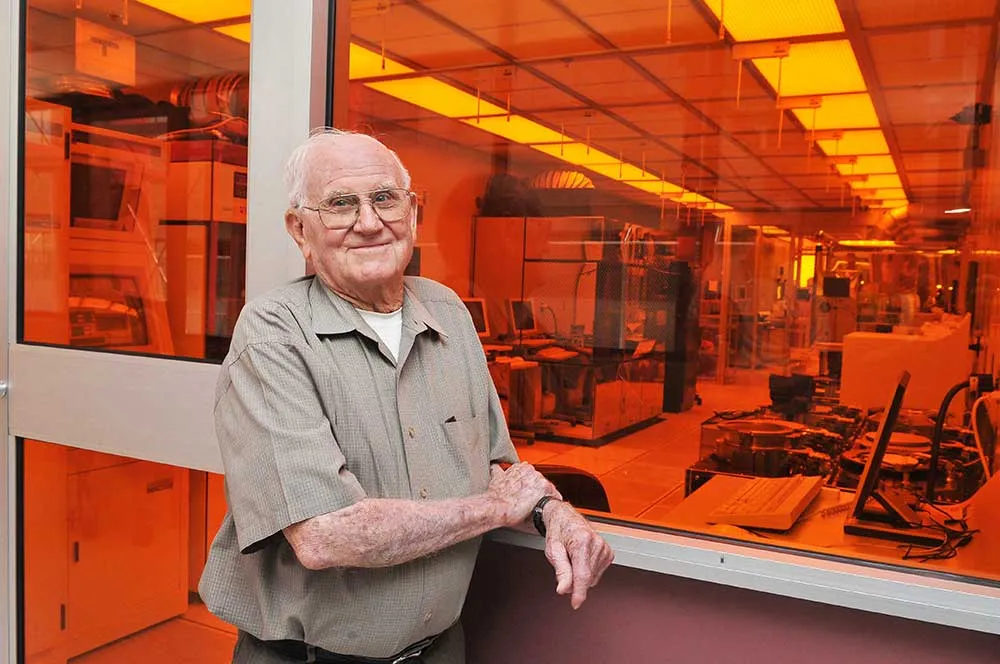
Long before pharmaceutical labs, semiconductor factories, and hospital operating rooms relied on ultra-pure air, manufacturing plants across the country struggled with a stubborn problem: invisible dust was ruining precision components. The breakthrough that solved this issue came from an unlikely source — a physicist raised on a West Texas cotton farm who sketched the blueprint for modern clean room technology on an airplane napkin. His name was Willis Whitfield, and his invention still protects sensitive manufacturing environments worldwide more than sixty years later.
The Problem That Started It All
In 1959, engineers at Sandia National Laboratories faced a frustrating challenge. Complex parts, including components destined for the nuclear weapons stockpile, kept failing quality checks. The culprit wasn’t a design flaw — it was airborne particulates contaminating the manufacturing process. Because Sandia’s mission depended on producing flawless components while advancing the boundaries of science and engineering, leadership assembled a team from the advanced manufacturing section to investigate. Willis Whitfield was among them.
The team spent months visiting manufacturers across the country to study existing clean room technology firsthand. What they found was troubling. Even the best-performing clean rooms of that era averaged more than a million particles per cubic foot of air — nowhere near clean enough for the precision work being demanded of them.
A Blueprint Sketched at 30,000 Feet
The turning point came during a flight home from one of those research trips. Whitfield pulled out a tablet and sketched a complete schematic for a new kind of clean room. According to his son Jim, who was six years old at the time, the drawing took only minutes but captured the fundamental principle still used in clean room technology today.
That principle is known as laminar flow — a continuous, gentle sweep of highly filtered air through a room. Whitfield described it simply as letting the air itself act as the janitor. The system pushes airborne particles down toward the floor, filters them out, and recirculates clean air back into the space in a steady, slow-moving current.
The results were staggering. When Whitfield built his 1961 prototype, testing showed an average of just 750 dust particles per cubic foot of air — roughly 1,000 times cleaner than the standard clean rooms manufacturers were using at the time.
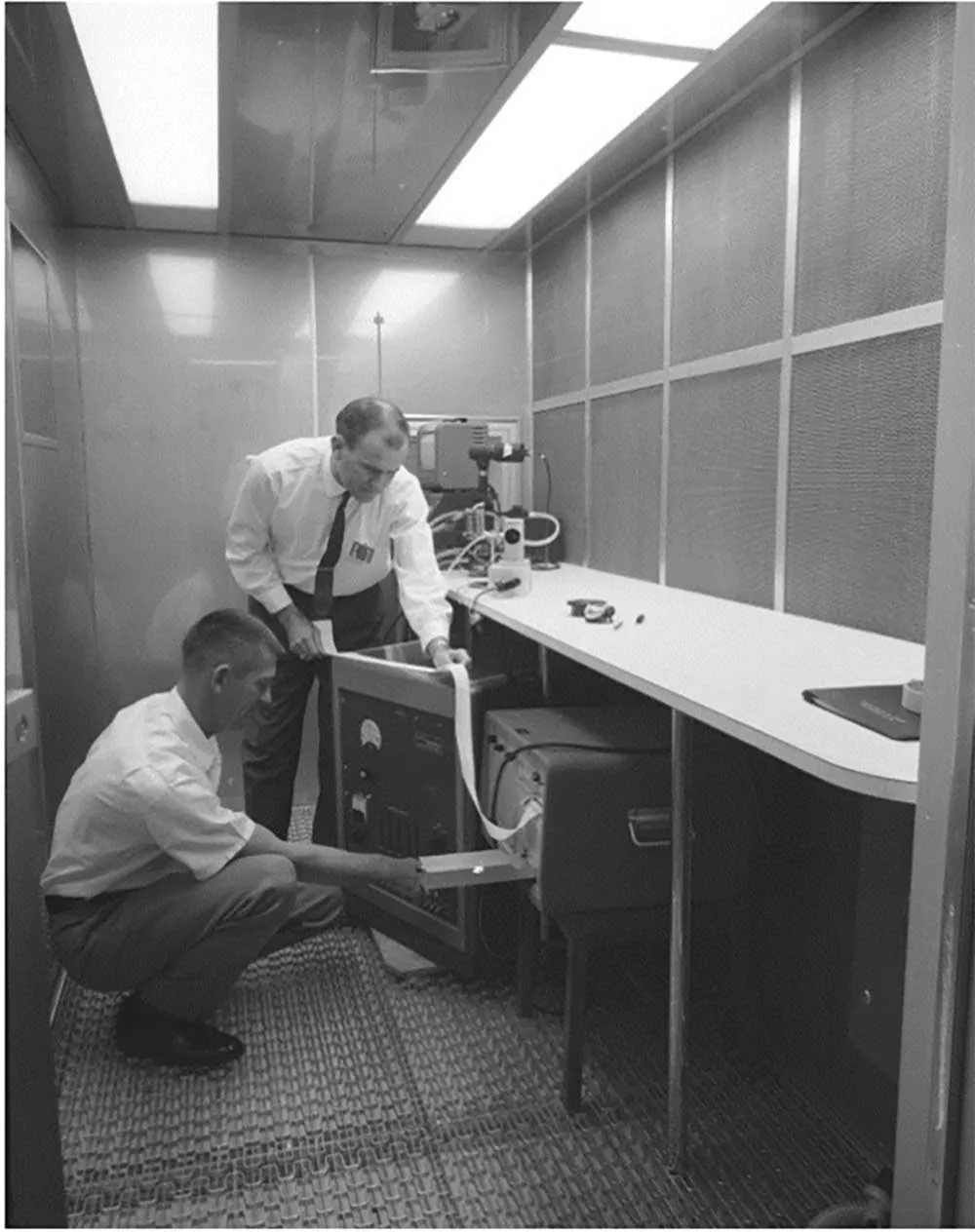
The numbers were so dramatically better that some colleagues initially doubted them. Sandia historian Rebecca Ullrich noted that people at industry meetings openly questioned Whitfield’s claims, and others had to vouch for his credibility before the results were accepted. Once the design’s legitimacy was confirmed, adoption spread rapidly. By the mid-1960s, formal industry standards were in place, and manufacturers across multiple sectors had begun incorporating laminar-flow clean room technology into their facilities. Historians consider it one of Sandia’s earliest and most transformative technology transfers.
The invention was formally recognized when the Atomic Energy Commission filed a patent application in Whitfield’s name. On November 24, 1964, the United States issued Patent No. 3,158,457, titled “Ultra Clean Room.” Early adopters of the technology included major corporations such as RCA, General Motors, Western Electric, Bell Laboratories, and Lovelace Medical Centers. Today, laminar-flow clean rooms remain essential in electronics manufacturing, pharmaceutical production, and hospital operating and recovery rooms, where minimizing airborne contamination directly reduces infection risk.
A Humble Inventor Who Shared the Credit
Despite becoming one of Sandia’s most celebrated innovators, Whitfield remained notably modest about his achievement. Rebecca Ullrich recalled that he consistently insisted on crediting the colleagues who helped refine and test the concept, even though the original idea was his own. That team included Claude Marsh, James McDowell, James Mashburn, William Neitzel, Irving Kodel, Longinos Trujillo, and Harold Baxter.

His son Jim has fond memories of the period surrounding the invention, even if he didn’t grasp its significance at the time. He recalls his father coming home and telling his mother they’d received a raise — a moment six-year-old Jim misheard as something about “raisins,” leaving him confused about why the news brought such excitement. As he grew older, Jim came to appreciate his father’s gift for reducing complicated problems to their essentials, a trait he attributes to Whitfield’s upbringing as a resourceful farm boy who built what he needed rather than waiting for someone else to invent it.
Jim eventually followed a similar path, studying physics, mathematics, and electrical engineering before spending 25 years at Motorola, where he worked inside clean rooms built on his father’s design. He has described the experience of walking into those rooms as deeply personal, silently thanking his father each time he entered a space built on his invention.
Beyond the Clean Room
Whitfield’s three-decade career at Sandia extended well beyond his signature invention. He also worked on methods for purifying sewage into clean water, early exploration that contributed to Sandia’s long-running focus on energy and solar research. Later in his career, he contributed to NASA’s efforts to sterilize spacecraft before launch, helping prevent contamination of other planetary bodies during exploration missions.
A Lasting Legacy
Willis Whitfield died in 2012 at age 92, shortly after his invention marked its 50th anniversary. Two years later, in 2014, he was inducted into the National Inventors Hall of Fame alongside figures such as Thomas Edison, the Wright brothers, and Albert Einstein. He remains the only Sandia scientist honored with a full-sized bronze statue, which stands outside the facility where clean room technology continues to enable precision manufacturing today.
Whitfield’s story is a reminder that some of the most consequential engineering breakthroughs come not from complex theory, but from practical problem-solving grounded in everyday ingenuity — the same instincts that once kept a West Texas farm running smoothly.