
Understanding quantifiers in English is essential for anyone who wants to speak and write with precision. Quantifiers are the words we use to describe how much or how many of something exists, and they show up constantly in everyday conversation, business writing, and academic English. Whether you are asking how much time you have left or describing how many people attended a meeting, quantifiers help you communicate quantity clearly and naturally.
This guide breaks down what quantifiers are, how they work with countable and uncountable nouns, and how to avoid the mistakes that even advanced English learners commonly make.
What Is a Quantifier?
A quantifier is a word or phrase placed before a noun to indicate the amount or number of that noun. Quantifiers can express an exact quantity or a vague, approximate one, and they are one of the building blocks of English grammar.
Some of the most frequently used quantifiers include:
- some
- many
- a lot of
- a few
Examples in context:
- There are some books on the desk.
- He has more friends than his sister.
- How much money have you got?
- There is a large quantity of fish in this river.
- He’s got only a few dollars left.
How Quantifiers Are Used
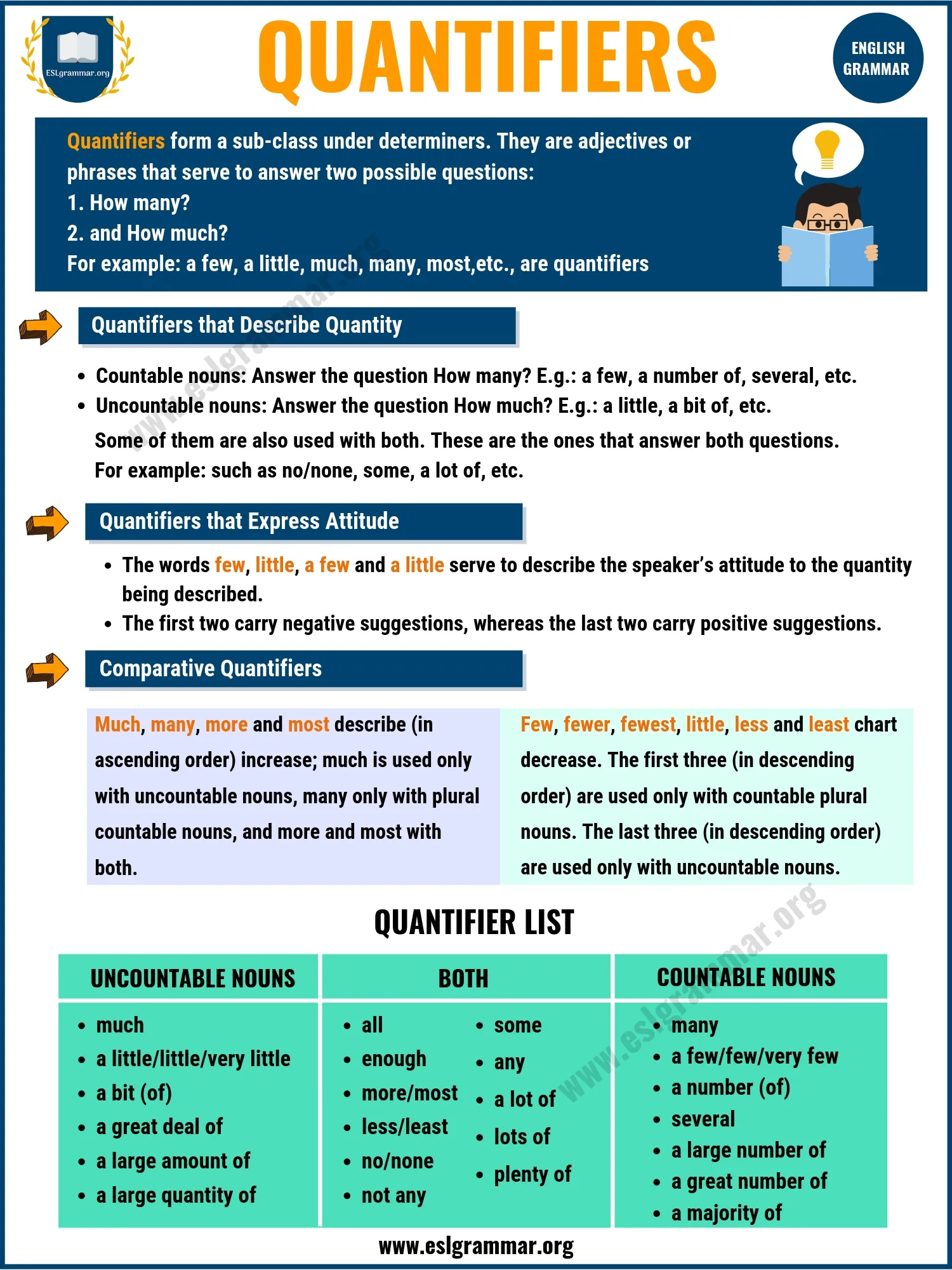
Quantifiers generally fall into three functional categories: those that describe quantity directly, those that express an attitude toward the amount, and those used for comparison.
1. Quantifiers That Describe Quantity
These quantifiers simply answer the question “how much?” or “how many?” The key is knowing whether the noun that follows is countable (can be counted individually, like books or chairs) or uncountable (cannot be split into individual units, like water or time).
With countable nouns (how many?):
- a few
- a number of
- several
With uncountable nouns (how much?):
- a little
- a bit of
- much
With both countable and uncountable nouns:
- some
- any
- a lot of
- lots of
- plenty of
2. Quantifiers That Express Attitude
Interestingly, some quantifiers carry an emotional or evaluative tone rather than just stating a number. Few and little tend to sound negative or limiting, while a few and a little sound more positive.
Compare these two sentences:
- I have little time. → This means almost no time at all.
- I have a little time. → This means I have some time, and it’s probably enough.
This small grammatical difference can completely change the meaning of a sentence, so it’s worth practicing until it feels natural.
Enough deserves special mention here. It means “the necessary or sufficient amount” and is placed directly before the noun it modifies.
Examples:
- There is enough time.
- You have enough money.
- Is there enough food?
3. Comparative Quantifiers
Just like adjectives, several quantifiers have comparative and superlative forms. These are extremely useful when comparing amounts between two or more things.
| Base Form | Comparative | Superlative | Used With |
|---|---|---|---|
| much | more | most | uncountable nouns |
| many | more | most | countable nouns |
| few | fewer | fewest | countable nouns |
| little | less | least | uncountable nouns |
Examples:
- I have much time → more time → the most time.
- I have many apples → more apples → the most apples.
- He has few friends → fewer friends → the fewest friends.
- He has little time → less time → the least time.
A common mistake among English learners is using less with countable nouns (e.g., “less people”) instead of the correct fewer (“fewer people”). Keeping this distinction in mind will make your writing sound noticeably more polished.
Complete List of Quantifiers by Noun Type
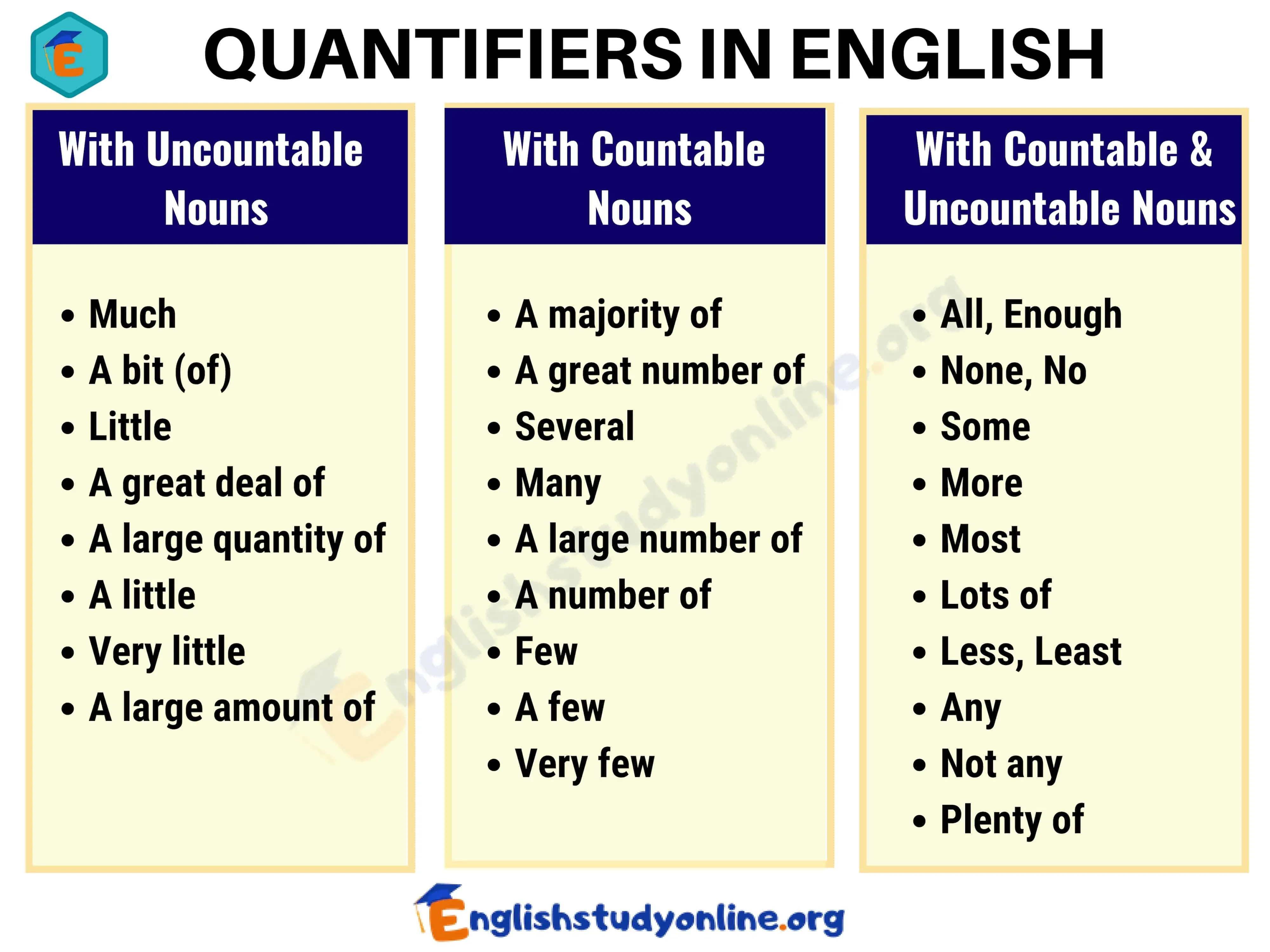
To make these rules easier to remember, here is a reference list organized by the type of noun each quantifier pairs with.
Quantifiers Used With Uncountable Nouns
- much
- a bit (of)
- little
- less
- least
- a great deal of
- a large amount of
- a little
- very little
- a large quantity of
Quantifiers Used With Countable Nouns
- a majority of
- a great number of
- several
- many
- a large number of
- a number of
- few
- a few
- very few
Quantifiers Used With Both Countable and Uncountable Nouns
- all
- enough
- none of
- no
- some
- more
- most
- a lot of
- lots of
- any
- not any
- plenty of
Recognizing which category a noun falls into is often the first step to choosing the right quantifier. For example, information, advice, and furniture are uncountable in English (even though they may be countable in other languages), so they pair with much, a little, or a bit of rather than many or a few.
Practice Exercises: Test Your Understanding
The best way to master quantifiers is through consistent practice. Try the exercises below and check your answers against the key provided.
Exercise 1 – Fill in the Blanks
Choose the best quantifier for each sentence.
- We don’t have __ time to finish this today. (much / many)
- There are __ apples in the basket. (a little / a few)
- She has __ friends in this city, so she feels lonely. (few / a few)
- Can you give me __ water, please? (a few / a little)
- I have __ homework tonight, so I can’t go out. (many / much)
- There is __ sugar left. We need to buy more. (little / few)
- We’ve got __ chairs for everyone. No one has to stand. (enough / too)
- Do you have __ questions before we start? (any / some)
- He has __ money than I do. (more / most)
- This year, we spent __ money on travel than last year. (less / fewer)
Answer Key:
- much 2. a few 3. few 4. a little 5. much 6. little 7. enough 8. any 9. more 10. less
Exercise 2 – Multiple Choice
- There isn’t __ milk in the fridge. a) many b) much c) a few
- We have __ chairs, but not enough for everyone. a) little b) a few c) much
- __ students in my class speak three languages. a) Much b) A little c) Many
- I have __ patience for rude behavior. a) little b) a few c) many
- Do you have __ money with you? a) any b) many c) few
- We need __ information before we decide. a) a few b) more c) many
- He has __ friends than his brother. a) most b) more c) many
- There are __ people here today than yesterday. a) less b) fewer c) little
- She ate __ cookies, so there are only two left. a) most b) much c) little
- We have __ time, so let’s start now. a) enough b) many c) few
Answer Key:
- b 2. b 3. c 4. a 5. a 6. b 7. b 8. b 9. a 10. a
Exercise 3 – Correct the Mistakes
Each sentence contains a quantifier error. Rewrite it correctly.
- There are much cars in the parking lot.
- I don’t have many time today.
- Can I have few water, please?
- She has a little friends at work.
- There is fewer traffic on Sundays.
- Do you have some questions? (in a neutral question context)
- We have less students this year than last year.
- None students were late today.
- I have the fewest money than my friends.
- There isn’t no bread left.
Answer Key:
- There are many cars in the parking lot.
- I don’t have much time today.
- Can I have a little water, please?
- She has a few friends at work.
- There is less traffic on Sundays.
- Do you have any questions?
- We have fewer students this year than last year.
- No students were late today. (Or: None of the students were late today.)
- I have the least money among my friends.
- There isn’t any bread left. (Or: There is no bread left.)
Final Thoughts
Quantifiers may seem like small words, but mastering them makes a real difference in how clearly and confidently you communicate in English. The key takeaways are simple: identify whether your noun is countable or uncountable, choose a quantifier that matches, and pay attention to the subtle tone differences between words like few versus a few, or little versus a little.
Keep practicing with real sentences from your daily life — describing how much coffee you drank, how many emails you answered, or how much free time you had this week. The more you use quantifiers naturally, the faster they will become second nature. Try writing five sentences of your own using different quantifiers today, and revisit this guide whenever you need a quick grammar refresher.