
Few albums in the history of oldies music carry the emotional weight and spiritual sincerity of His Hand In Mine, Elvis Presley’s landmark gospel record released on November 23, 1960. At a time when the King of Rock ‘n’ Roll was redefining popular music, this album revealed an entirely different dimension of the artist — one rooted in faith, loss, and the sacred sounds of America’s oldest musical traditions.
The Fulfillment of a Lifelong Dream
Long before Elvis became a cultural phenomenon, he dreamed of being a gospel singer. Growing up in the Deep South, he was immersed in the sounds of the church, the choir loft, and the revival meeting. His Hand In Mine was the realization of that original calling — a deeply personal project that represented not merely a stylistic detour, but a return to his most authentic musical roots.
More than any other recording in his catalog, this album was conceived as a tribute to his mother, Gladys Presley, who had passed away in August 1958. Her death had left Elvis in a profound state of grief, an emotional wound that, by many accounts, never fully healed. The album stands as his most intimate musical offering — a son’s quiet testament to a mother’s enduring love and faith.
Influences: The Statesmen, The Blackwood Brothers, and the Golden Gate Quartet
To understand His Hand In Mine, one must understand the gospel quartets that shaped Elvis and his family. The album is, in many respects, a musical homage to three legendary ensembles of Southern gospel and jubilee tradition.
The Statesmen Quartet were favorites of both Elvis and his father, Vernon Presley. Known for their theatrical performances and powerful vocal harmonies, the Statesmen represented the high-energy, emotionally charged side of Southern gospel — an energy that clearly influenced Elvis’s own exuberant stage presence.
The Blackwood Brothers, on the other hand, were Gladys Presley’s beloved group. Their smoother, more devotional style brought a sense of warmth and comfort to the music, and Elvis’s choice to honor them through this album was a direct act of remembrance for his mother.
A more than passing glance was also cast toward the Golden Gate Quartet, masters of the jubilee style — a form of African American gospel that blended tight vocal harmonies with rhythmic, almost percussive energy. Their influence can be heard in the album’s more spirited, upbeat tracks.
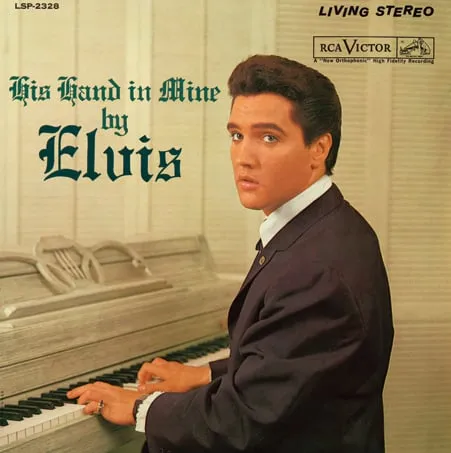
The Tracklist: Twelve Songs of Faith and Devotion
His Hand In Mine features twelve gospel and spiritual standards, each chosen with care and reverence:
- His Hand In Mine — the title track, a quiet declaration of trust and surrender
- I’m Gonna Walk Dem Golden Stairs — a jubilee-style celebration of the afterlife
- In My Father’s House — a hymn rooted in New Testament imagery
- Milky White Way — one of Elvis’s most joyful gospel performances
- Known Only To Him — a tender, introspective ballad
- I Believe In The Man In The Sky — a straightforward expression of faith
- Joshua Fit The Battle — a spirited retelling of the biblical story of Jericho
- He Knows Just What I Need — a devotional piece drawn from quartet tradition
- Swing Down Sweet Chariot — a rousing spiritual with deep roots in African American church music
- Mansion Over The Hilltop — a classic gospel standard about heavenly reward
- If We Never Meet Again — a moving farewell hymn of eternal hope
- Working On The Building — an upbeat traditional spiritual that closes the album with energy and conviction
A Catalog Staple That Endured Beyond Initial Sales
When His Hand In Mine was released, its commercial performance was modest compared to Elvis’s pop albums of the era. The mainstream music market of 1960 was hungry for rock and roll, teen anthems, and pop ballads — not gospel hymns. Yet the album’s initial sales figures told only part of the story.
Much like Elvis’s beloved Elvis’ Christmas Album (1957), His Hand In Mine proved to be far more than a commercial product. Over the decades, it became a staple of the Elvis Presley catalog — an album that listeners returned to again and again, not for novelty, but for solace. Its themes of faith, loss, and the hope of reunion spoke to something timeless in the human experience, transcending the pop charts and settling into the cultural memory of American music.
Why His Hand In Mine Matters in the Landscape of Oldies Music
In the broader context of pre-1975 American music, His Hand In Mine occupies a unique and irreplaceable position. It demonstrates that the artists of the golden era were not simply entertainers — they were storytellers, spiritual seekers, and cultural bridges between traditions.
Elvis’s decision to record a full gospel album at the height of his commercial fame was itself a statement. It said that the music he had grown up with — the music of the church, the quartet, and the Southern revival — was not something to be left behind in the pursuit of stardom. It was something to be honored, preserved, and shared with the world.
For listeners today who are discovering the richness of classic American music, His Hand In Mine offers an essential entry point into the gospel and spiritual traditions that underpinned so much of what came after — from soul and R&B to country and rock. Understanding this album means understanding the roots of American popular music itself.
A Son’s Gift to His Mother, and to History
At its core, His Hand In Mine is a love letter — from a son to his mother, from an artist to his faith, and from one of the twentieth century’s most iconic performers to the musical community that formed him. It is an album that rewards patient listening, offering not the visceral thrill of early rock and roll, but something quieter and perhaps more lasting: the comfort of sincere belief, beautifully expressed.
Whether you are a longtime devotee of oldies music or a newcomer exploring America’s rich musical heritage, His Hand In Mine stands as proof that the greatest artists are always, at some level, reaching back toward something sacred. Explore this timeless recording, and let its melodies remind you of the deep spiritual well from which so much of American music continues to draw.