
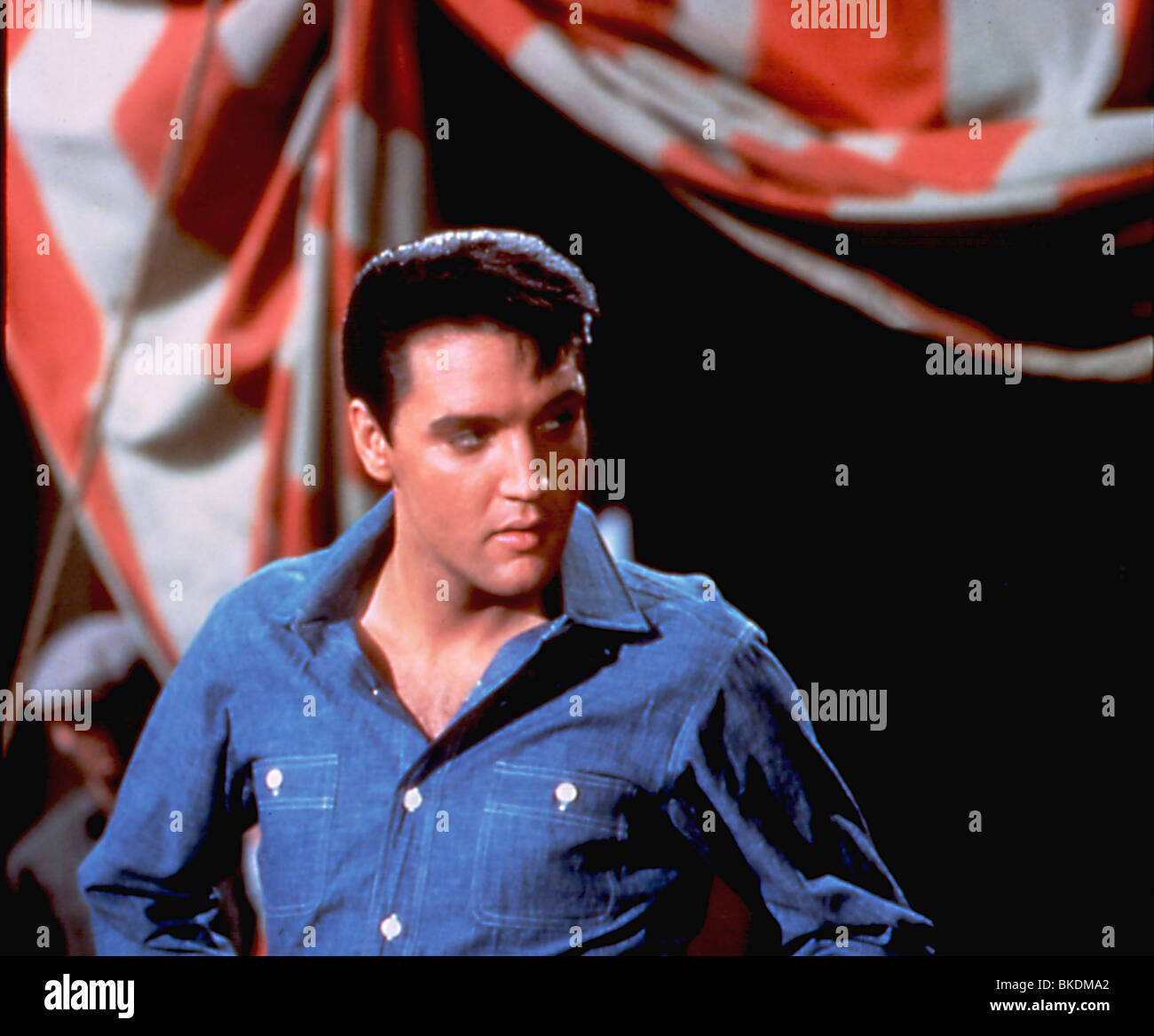
Released during the holiday season of 1964, Roustabout marked Elvis Presley’s sixteenth feature film and arrived with a mix of anticipation and apprehension for fans. As Presley’s third movie of the year, following the disappointing Kissin’ Cousins and the magnificent Viva Las Vegas, the question on many fans’ minds was which direction Roustabout would lean. Ultimately, the film settles somewhere in the middle, offering a blend of familiar tropes and new settings within the vibrant world of a traveling carnival.
Charlie Rogers: The Troubled Young Man Archetype
In Roustabout, Elvis portrays Charlie Rogers, a character who initially embodies the “angry young man” persona seen in six of his first seven films. At 30 years old, Presley plays an immature ruffian with a chip on his shoulder, a role reminiscent of his earlier performances in King Creole (1958) and Wild in the Country (1961). Rogers’ aggressive demeanor is evident from the film’s opening, where he heckles college students and later engages in a physical altercation in the parking lot. His interactions with female characters are marked by a certain boorishness, often met with a slap and his signature defiant sneer, a look he had perfected in his early films.
The “Bad Boy” Persona
Donning black leather and sporting a perpetual sneer, Elvis’s character effectively captures the “bad boy” image. His dialogue reinforces this persona, with defiant responses like, “So what else is new?” when warned of potential trouble. He even dismisses Barbara Stanwyck’s character’s passion for the carnival life, stating, “You’ve got your religion; I’ve got mine.” Stanwyck’s retort, “You’re a cruel boy, Charlie,” perfectly encapsulates his attitude for much of the film. However, as the narrative progresses, Charlie softens, and the film concludes with him on amicable terms with the carnival workers who had previously held him in disdain.
Critical Reception and Box Office Performance
While The New York Times did not review Roustabout, Variety offered its assessment on November 11, 1964. The publication acknowledged the film’s gaudy staging and cliché-ridden script but predicted its financial success, attributing it to Presley’s star power, the co-billing of Barbara Stanwyck, and the visual appeal of the Technicolor and Techniscope presentation for its eleven songs. Variety criticized the “hoary script” by Anthony Lawrence and Alan Weiss, describing it as “loaded with clichés outdated in Tom Swift days.” The review highlighted plot points such as the carnival facing financial difficulties, Presley’s desertion after a fight and a misunderstanding, a lost wallet that leads to him being blamed, a “dark-haired vamp,” and the obligatory “phony spirit of carny camaraderie.” The review also found the showdown fight and the musical finale to be “almost too inane to consider.”
Wasted Talent and Supporting Performances
Despite the criticisms of the script, the film’s characters manage to generate some tension, particularly in the first third as Charlie’s “heel” reputation is established. Barbara Stanwyck’s character enters mid-film to address the carnival’s financial issues. The incident with the lost wallet, occurring about an hour into the story, turns the carnival workers against Elvis, leading to a physical confrontation. Variety commended the supporting cast, noting that Stanwyck’s talents, despite her distinguished career with four Academy Award nominations, were “totally wasted.” Joan Freeman, while having limited screen time, performs “prettily” as she wrings her hands during conflicts. Notable smaller roles included Pat Buttram as the owner of a rival carnival and Steve Brodie as an obnoxious customer. Brodie, in particular, stands out as a baseball pitcher whose game leads to humorous interactions and eventual fights with Presley, a role similar to his performance in Blue Hawaii.
The Musical Score: A Mixed Bag
The musical soundtrack of Roustabout proved to be a mixed bag for this reviewer. As Charlie Rogers is a singer in the film, all ten songs performed by Elvis, with the possible exception of the finale, fit organically within the narrative. The four carnival stage numbers—”One Track Mind,” “Hard Knocks,” “Little Egypt,” and “Big Love, Big Heartache”—effectively place Elvis in the spotlight against dark, atmospheric backgrounds. The staging of “Little Egypt” is considered the musical highlight of the film.
Variety praised the score, noting that composer-conductor Joseph J. Lilley’s music and the featured songs were the “best part” of the Hal Wallis production. They highlighted Presley’s pleasant delivery of the songs, suggesting that “I Never Had It So Good,” “One Track Heart,” and “Hard Knocks” all had “hit possibilities.” The production numbers, staged by Earl Barton, and the vocal accompaniment by The Jordanaires, were also seen as adding value to the music. However, the reviewer notes a discrepancy, stating that “I Never Had It So Good” is not the title of any song performed by Elvis in the film.
Enduring Charm and Legacy
While Roustabout did not achieve the same box office success as its predecessor, Viva Las Vegas, it benefited from Barbara Stanwyck’s presence, which lent a degree of legitimacy. However, Stanwyck’s star power did not expand Presley’s core audience in the way Ann-Margret’s did in Viva Las Vegas. Upon its release in 1964, the film was met with some disappointment. Yet, with the passage of time and a less critical focus on the music, the overall movie is now viewed as solid, albeit light, entertainment. This reevaluation may also stem from the knowledge of the declining quality of many subsequent Elvis movies. Roustabout remains a significant entry in Elvis Presley’s filmography, showcasing his enduring appeal even within formulaic narratives.
References
- Hanson, A. (2008, June). Roustabout Elvis Movie #16. Elvis History Blog. Retrieved from http://www.elvis-history-blog.com/roustabout.html