
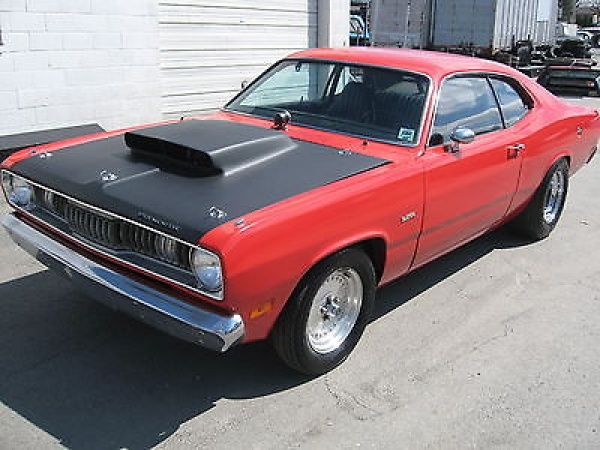
Building something a little sportier on an economy car platform was a tried-and-true strategy in 1960s Detroit. The most famous example was the transformation of the modest Ford Falcon’s bones into the legendary Ford Mustang. Eager for a “glow-up” of its own, Chrysler turned to its entry-level champion—the Plymouth Valiant—to accomplish the same goal at the beginning of the 1970s.
The result was the Plymouth Duster, a stylish and affordable performance coupe that could serve as a sensible commuter or be optioned into a high-octane muscle machine. Developed on a shoestring budget, the Duster eventually spawned a Dodge equivalent and earned its place in the history of the twilight years of America’s golden age of muscle cars.
The Rise of the Compact Muscle Car
At the end of the 1960s, almost every American automaker was poised to launch a new compact car. The market was filling up with names like the Ford Maverick, Mercury Comet, Chevrolet Nova (Chevy II), Pontiac Ventura, and the AMC Hornet. Although the small and staid Plymouth Valiant was already on sale, Chrysler sensed an opportunity to expand its affordable range with something more visually exciting than the conservatively styled sedan.
Chrysler had raided the Valiant’s parts bin once before to create the original Barracuda. However, by 1970, the Barracuda had transitioned to the larger E-body platform. This move left a void in the lineup for a replacement “econo-coupe.” Stylists Gene Weiss and Milt Antonick realized they could mix and match components from the Valiant’s A-body platform to create a car that looked entirely fresh without a massive capital investment.
Thus, the Plymouth Duster was born. Featuring a relatively long hood and extended C-pillars, it offered a more muscular appearance than the fastback lines of the Maverick or Nova. Arriving in 1970, the Duster remained a staple of the Plymouth lineup until 1976, when the Plymouth Volare eventually replaced it.
“Junkyard Styling” and Design Ingenuity
Weiss and Antonick famously referred to the design philosophy behind the Plymouth Duster as “junkyard styling.” This moniker reflected the paltry $15 million budget allocated for the coupe’s creation—a fraction of what was usually spent on a new model.
To save costs, much of the interior was lifted directly from the Valiant, though buyers could opt for bucket seats and a center console. The exterior used a short roof, a stretched rear deck, and pushed-out rear fenders to disguise its humble Valiant proportions.
Engineering Challenges
Because the design team reused as many Valiant body panels as possible, the Duster featured more creases in the sheet metal than typical Chrysler coupes of the era. This “patchwork” approach created unique engineering hurdles:
- Window Curvature: The side glass had to be significantly angled to meet the narrow dimensions of the roof. This required substantial ingenuity and meant passengers had to tolerate windows sitting very close to their heads.
- Rear Proportions: The “buff” rear quarter panels didn’t perfectly align with the narrower width of the Valiant-sourced rear end, a quirk visible to those with a keen eye for automotive design.
The Rapid Transit System and Muscle Heritage
Despite its budget origins, the Duster was drafted into the Plymouth Rapid Transit System marketing campaign. It stood alongside heavy hitters like the ‘Cuda and the Road Runner. This meant the Duster was available with high-impact “High-Impact” colors, bold tape stripes, and prominent engine-size callouts.
While Chrysler couldn’t afford to license the Tasmanian Devil from Warner Brothers (as they had with the Road Runner), they created their own “duster” sand swirl logo. This graphic became a defining element of the top-tier Duster variants, signaling that this was more than just a dressed-up economy car.
Evolution Through the 1970s
The Duster evolved through the decade with incremental updates. In 1973, the car received a refresh featuring new chrome trim, revised taillights, a new grille, and a distinctive hood bulge. Functionality improved as well, with the introduction of an available fold-flat rear seat.
By 1974, the landscape of the American auto industry had shifted. Tightening EPA regulations and rising insurance costs began to phase out affordable muscle cars. In response, the Duster began to lean in a more conservative direction, focusing on style and economy rather than raw street performance until its production ended in 1976.
Conclusion
The Plymouth Duster remains a masterclass in automotive resourcefulness. By transforming a budget-friendly commuter into a stylish performance icon, Chrysler proved that “junkyard styling” could capture the heart of the American public. Whether you remember it as a fuel-sipping daily driver or a small-block V8 terror on the drag strip, the Duster’s legacy as a versatile A-body classic is secure.
What are your thoughts on the Plymouth Duster? Do you prefer the early high-performance versions or the later stylish commuters? Share your stories and opinions in the comments below!
References
- Chrysler Corporation Historical Archives (1970-1976).
- Plymouth Rapid Transit System Marketing Materials.
- A-Body Platform Development Logs: Gene Weiss and Milt Antonick.