
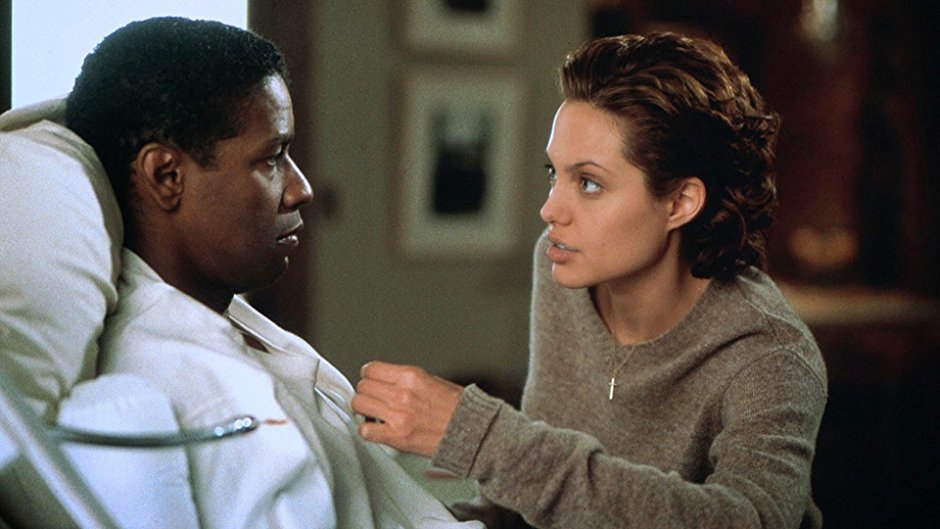
The 1990s offered a rich tapestry of gritty crime dramas, with films like The Silence of the Lambs and S7ven defining the era’s fascination with unsettling homicide investigations. As the decade drew to a close, Phillip Noyce’s The Bone Collector, now available on Peacock, emerged as a standout in this genre. This cinematic adaptation, based on Jeffrey Deaver’s 1997 novel, features Denzel Washington as Lincoln Rhyme, a brilliant New York detective whose career is abruptly halted by a severe accident that leaves him nearly quadriplegic. Denzel Washington is portrayed as a man on the verge of assisted suicide when he’s drawn back into the world of crime to consult on a series of macabre murders linked to obscure historical details of Manhattan.
Rhyme reluctantly agrees to take on the case, enlisting the assistance of Amelia Donaghy, a young police officer played by Angelina Jolie. Donaghy is burdened by guilt stemming from her father’s suicide and becomes Rhyme’s eyes and hands at the crime scenes. The film’s origins trace back to producer Marty Bregman, a man who defied childhood polio to become a successful Hollywood figure. Noyce notes that Bregman’s personal journey made him deeply invested in the story of overcoming physical adversity.
From Novel to Screen: Crafting the Narrative
Marty Bregman, a producer known for his collaborations with Al Pacino on films such as Serpico and Scarface, was instrumental in bringing The Bone Collector to fruition. Initially, the screenplay was developed with Pacino in mind for the role of Lincoln Rhyme. Screenwriter Jeremy Iacone drew inspiration from Deaver’s novel, adapting its complex plot for the screen. Iacone condensed the narrative to focus on three key murders, emphasizing the psychological dynamic between Rhyme and Donaghy. He viewed them as two “wounded, crippled people”—Rhyme physically, and Donaghy emotionally—whose shared investigation would lead to a form of mutual healing.
Casting Choices and Production Challenges
The casting process for The Bone Collector involved several notable names before Noyce settled on Denzel Washington and Angelina Jolie. After Al Pacino opted for another project, Universal Pictures suggested Harrison Ford and Sean Connery for Rhyme, and Demi Moore and Nicole Kidman for Donaghy. However, Noyce was resolute in his vision, advocating strongly for Washington and a then-lesser-known Jolie. Facing financial concerns from the studio, Noyce proposed a unique deal: he would personally cover any budget overruns, but if the production came in under budget, he would receive half the savings. This arrangement incentivized efficiency, and the film was completed significantly under the projected budget, much to Noyce’s satisfaction.
Noyce believed that exceptional acting would be crucial to distinguish The Bone Collector from other serial killer thrillers. He also prioritized authenticity, consulting with quadriplegic individuals, NYPD officers, and forensic experts during a two-week rehearsal period. This commitment to realism aimed to ground the sensational story in credible portrayals of police work.
A photo of Angelina Jolie in The Bone Collector (1999). Photo: Universal/courtesy Everett Collection
Filming in Canada and Artistic Decisions
Cinematographer Dean Semler, a long-time collaborator of Noyce, joined the production. Semler made a distinctive choice regarding film stock, opting for Fuji after a serendipitous encounter with a Fuji blimp. While principal photography was partially filmed on location in Manhattan for exterior shots, the majority of the film was shot in Canada. Production designer Nigel Phelps recreated Rhyme’s apartment and advanced medical equipment on a soundstage in Montreal. The intentionally dark and artifact-filled set design, as described in Iacone’s script, initially alarmed a studio executive who visited the set. The executive’s concern that the set was “so dark” prompted a brief period of indecision, but the script’s description ultimately validated Phelps’s design. The confined nature of the soundstage presented challenges, forcing the crew to continually seek innovative camera angles, with Noyce even offering a reward for any new perspectives discovered.
Noyce fondly recalls the daily experience of working with Washington and Jolie, calling it “memorable” and a privilege to witness “one of the greats” and “a soon-to-be-acclaimed queen of acting.” Semler later worked with Jolie again as director of photography on her directorial debut, The Land of Blood and Honey.
A photo of Angelina Jolie in The Bone Collector (1999). Photo: Universal/courtesy Everett Collection
The Enduring Legacy of The Bone Collector
Although Jeffrey Deaver continued the Lincoln Rhyme series with numerous sequels, a film sequel to The Bone Collector never materialized. In 2020, NBC attempted to revive the franchise as a television series, Lincoln Rhyme: Hunt for the Bone Collector, which ran for one season. Noyce provided some consultation for the series but declined to direct the pilot, feeling that fundamental errors in casting and an attempt to lighten the tone detracted from the material’s potential. Despite not spawning a direct film sequel, The Bone Collector remains a noteworthy entry in the late 90s thriller landscape.
The Bone Collector is now streaming on Peacock.