
When comparing RTX vs GTX [keyword], you are not just evaluating two GPU product lines. You are comparing two fundamentally different approaches to graphics processing designed by NVIDIA for different eras of computing.
GTX GPUs represent the traditional rasterization era, where performance is driven mainly by CUDA shader cores. RTX GPUs, on the other hand, introduce dedicated hardware for ray tracing and AI acceleration, reshaping how modern games, creative tools, and AI workloads run in 2026.
This article breaks down RTX vs GTX in a technical yet practical way—covering architecture, gaming performance, AI workloads, and long-term value—so you can clearly understand which GPU fits your needs today.
What is GTX? Traditional GPU Design
GTX refers to NVIDIA’s older generation of gaming GPUs built primarily around rasterization rendering. In this architecture, CUDA cores handle nearly all graphical computations, including shading, geometry processing, and pixel rendering.
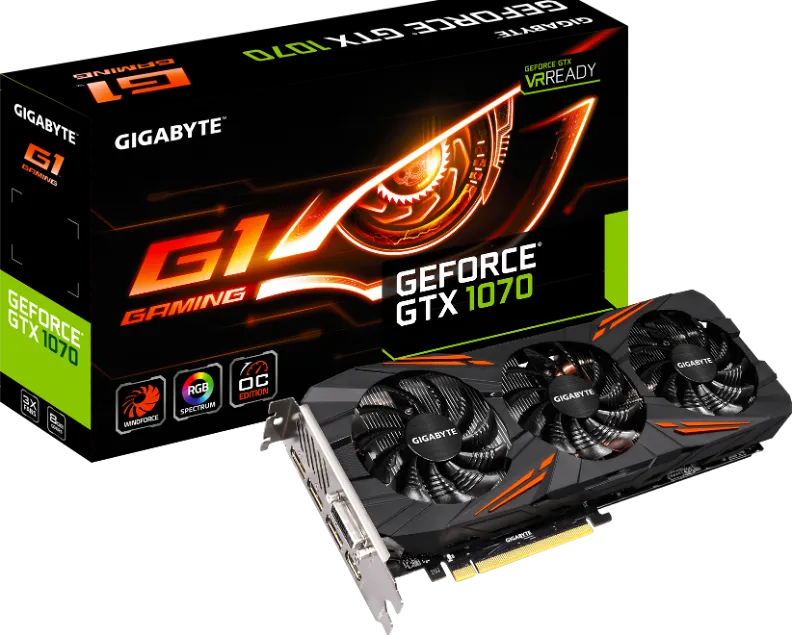
GTX GPUs are still capable of running many modern games, especially at 1080p resolution. However, they lack dedicated hardware for ray tracing and AI-based rendering enhancements.
Key characteristics of GTX:
- Rasterization-based rendering pipeline
- CUDA cores handle all graphics workloads
- No dedicated RT or Tensor cores
- Limited modern AI and rendering features
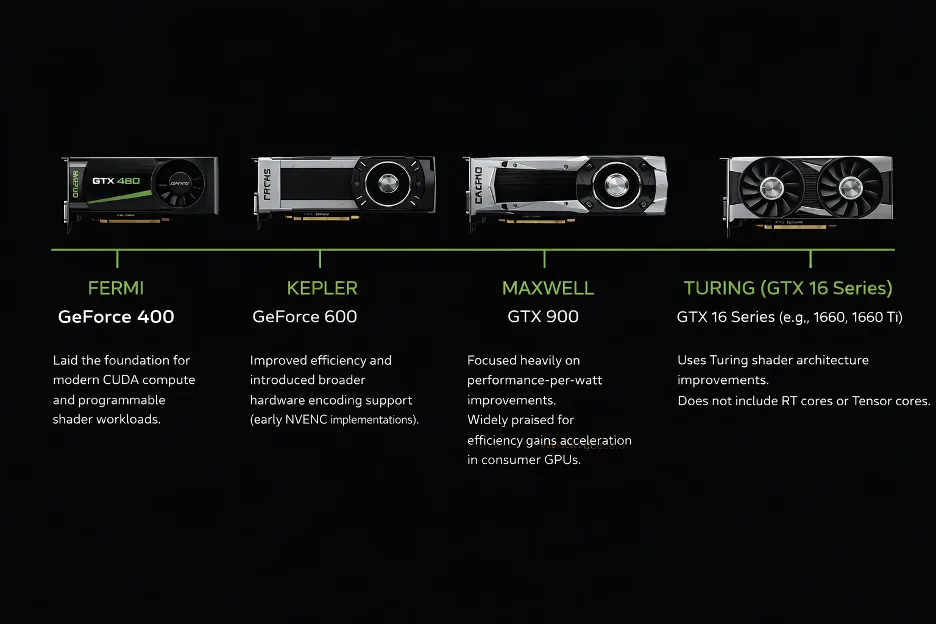
GTX remains relevant for budget gaming systems, particularly for esports titles and older AAA games that rely mostly on raster performance rather than advanced lighting or AI features.
What is RTX? Modern AI-Driven GPU Architecture
RTX represents a major shift in GPU design. Instead of relying only on CUDA cores, RTX GPUs introduce two additional specialized hardware units:
- RT cores for real-time ray tracing
- Tensor cores for AI acceleration (DLSS and machine learning workloads)
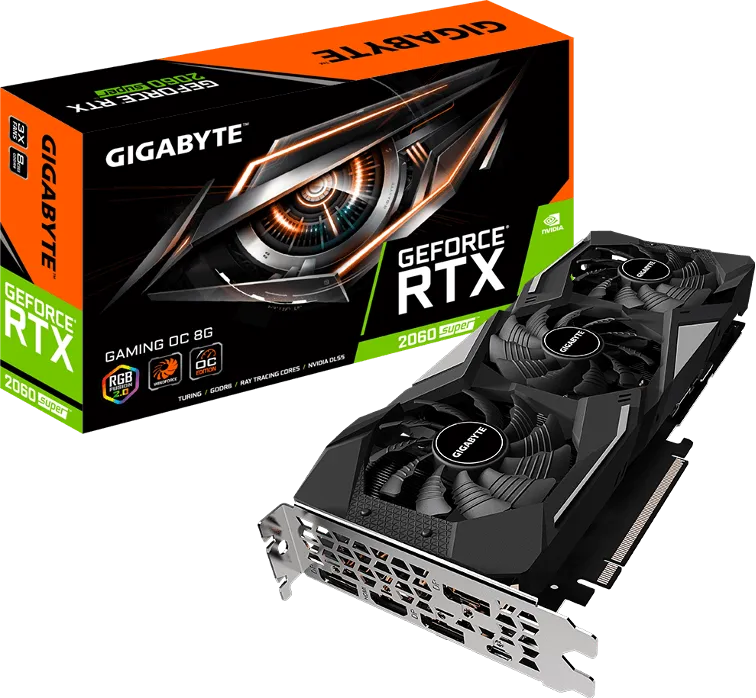
This combination enables technologies such as DLSS (Deep Learning Super Sampling), AI frame generation, and advanced rendering techniques used in modern game engines.
RTX generations include:
- RTX 20 series (Turing)
- RTX 30 series (Ampere)
- RTX 40 series (Ada Lovelace)
- RTX 50 series (Blackwell)
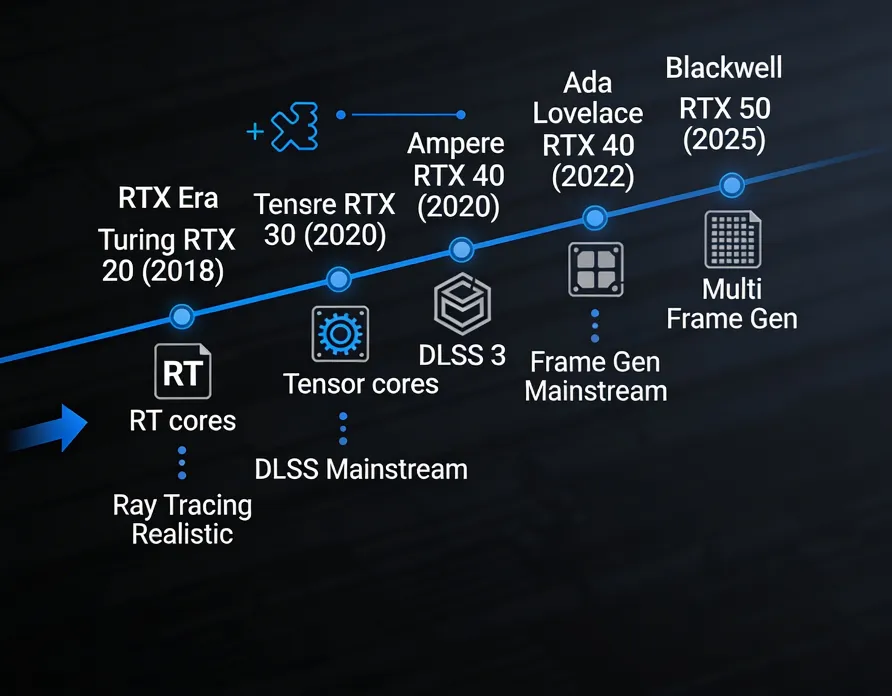 RTX generational improvements and feature expansion over time
RTX is designed not only for gaming but also for AI workloads, content creation, and future-facing rendering technologies.
RTX vs GTX Architecture Differences
The real difference between RTX vs GTX is not just performance—it is specialization.
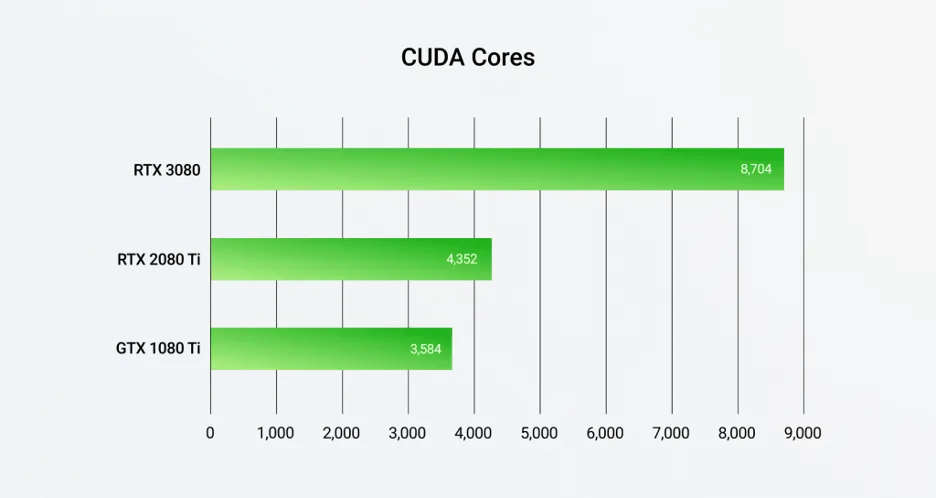
CUDA Cores (Shared Foundation)
Both GTX and RTX GPUs use CUDA cores for:
- Rasterization rendering
- Shader execution
- General compute workloads
However, RTX does not replace CUDA cores. Instead, it adds new hardware layers on top of them.
RT Cores: Ray Tracing Acceleration
Ray tracing simulates how light behaves in real environments by calculating ray-object intersections.
RTX GPUs accelerate this process using RT cores, which handle:
- BVH traversal (Bounding Volume Hierarchy)
- Ray-box intersection tests
- Ray-triangle calculations
GTX GPUs lack RT cores, so ray tracing is processed using CUDA cores, which significantly reduces performance.
Tensor Cores: AI and DLSS Acceleration
Tensor cores are designed for matrix math and machine learning operations.
They power:
- DLSS Super Resolution
- Frame Generation technologies
- AI-based image reconstruction
- Machine learning workloads in creative software
GTX GPUs cannot use DLSS because they lack Tensor cores, making RTX significantly more efficient in supported games.
RTX vs GTX Gaming Performance
Gaming performance differences between RTX vs GTX depend heavily on the scenario.
Rasterization Performance
In traditional rendering (no ray tracing or DLSS):
- GTX can still perform well at 1080p
- RTX offers better scaling at higher resolutions
- Newer RTX architectures have efficiency advantages
However, in esports titles like CS2 or Valorant, GTX can still feel competitive due to lower graphical demands.
Ray Tracing Performance
Ray tracing is where RTX clearly dominates.
GTX GPUs:
- Run ray tracing using CUDA cores
- Experience heavy performance drops
- Struggle in modern RT-heavy games
RTX GPUs:
- Use dedicated RT cores
- Maintain playable frame rates with DLSS support
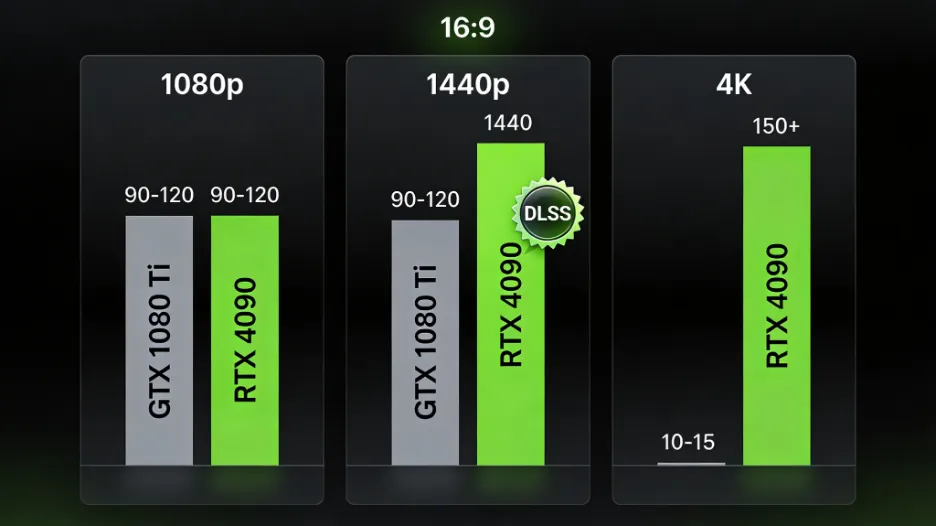 RTX vs GTX gaming performance comparison
DLSS and Frame Generation
DLSS is one of the biggest advantages in RTX vs GTX comparisons.
RTX GPUs support:
- AI upscaling (DLSS Super Resolution)
- Frame Generation
- Multi Frame Generation (newer RTX generations)
GTX GPUs cannot access these features, which often results in RTX outperforming GTX even when raw hardware specs are similar.
RTX vs GTX for AI and Deep Learning
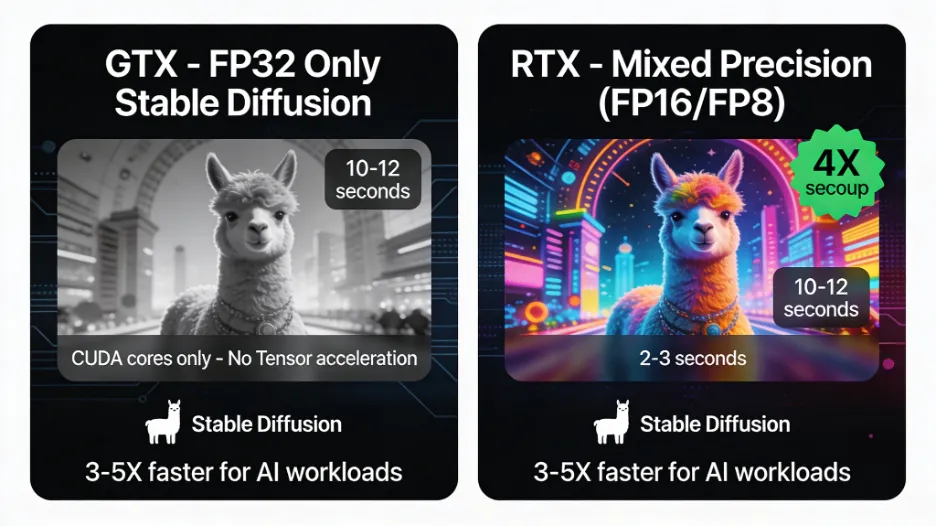
AI workloads highlight one of the most important differences between RTX and GTX.
GTX in AI Workloads
GTX GPUs can run AI applications through CUDA, but:
- Lack Tensor cores
- Have weaker FP16 performance
- Struggle with large models and training workloads
RTX in AI Workloads
RTX GPUs excel due to:
- Tensor core acceleration
- Mixed precision computing
- Optimized AI frameworks support
This makes RTX far more suitable for:
- Stable Diffusion
- Local LLM inference
- Machine learning development
- AI-assisted content creation
RTX vs GTX for Content Creation
For creators, RTX vs GTX differences appear in rendering speed, encoding quality, and workflow efficiency.
Video Editing and Streaming
RTX GPUs offer:
- Newer NVENC encoders
- AV1 encoding support (on newer generations)
- Faster export times
- Better streaming efficiency at lower bitrates
GTX GPUs rely on older encoder generations with fewer modern features.
3D Rendering
In tools like Blender:
- RTX supports OptiX acceleration
- Ray tracing workloads are hardware-accelerated
- Scene rendering is significantly faster
GTX can still render scenes but without dedicated acceleration.
Real-World Use Cases: RTX vs GTX
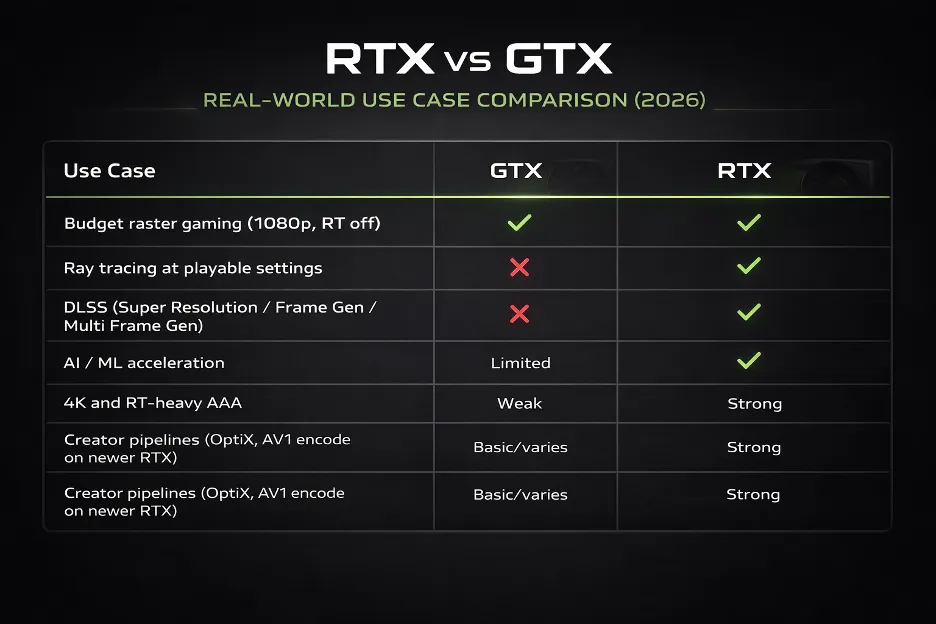 RTX vs GTX real-world use cases comparison chart
GTX is best for:
- Budget 1080p gaming
- Esports titles
- Older AAA games
- Basic productivity systems
RTX is best for:
- Modern AAA gaming
- Ray tracing-enabled titles
- AI workloads and machine learning
- Content creation and streaming
- Long-term system upgrades
RTX vs GTX Pricing and Longevity
Pricing plays a major role in GPU selection.
GTX GPUs:
- Lower cost (especially used market)
- Good short-term budget option
- Limited future feature support
RTX GPUs:
- Higher upfront cost
- Longer driver support lifecycle
- Better feature scalability (DLSS, AI, ray tracing)
In 2026, RTX GPUs generally provide better long-term value due to evolving game engines and AI-driven workloads.
Conclusion
RTX vs GTX [keyword] ultimately comes down to capability versus affordability.
GTX remains a solid choice for users focused on budget-friendly 1080p gaming and older titles. However, it lacks modern acceleration technologies that define today’s gaming and AI ecosystem.
RTX represents the future of GPU computing, offering:
- Ray tracing acceleration
- AI-powered DLSS technologies
- Stronger performance scaling at higher resolutions
- Better support for creative and AI workloads
If you want a system that remains relevant in modern gaming and AI-driven applications, RTX is the more future-proof choice in 2026.
References
- NVIDIA Developer Documentation: https://developer.nvidia.com/
- NVIDIA RTX Technology Overview: https://www.nvidia.com/en-us/geforce/technologies/rtx/
- NVIDIA DLSS Technical Guide: https://www.nvidia.com/en-us/geforce/technologies/dlss/
- NVIDIA GPU Architecture Whitepapers: https://www.nvidia.com/content/technologies/whitepapers/