
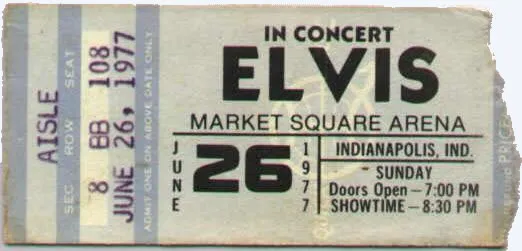
On the evening of June 26, 1977, nearly 18,000 fans packed Market Square Arena in Indianapolis, Indiana, to witness what would become one of the most historically significant performances in the history of oldies music and American rock ‘n’ roll. No one in that arena knew it at the time, but this was the final concert of Elvis Presley — the King of Rock ‘n’ Roll — a night that would be etched permanently into the memory of popular music. Decades later, that performance remains a powerful reminder of the enduring legacy of pre-1975 American music and the artists who shaped it.
The King Takes the Stage One Last Time
Elvis Presley had been a towering figure in American music since the mid-1950s. His unique blend of rhythm and blues, country, and gospel helped define an entire era of popular music — an era that fans of classic oldies music continue to celebrate to this day. By the summer of 1977, however, the King was in declining health, and public speculation about his condition had intensified following a sluggish performance in Indianapolis nearly two years prior.
The June 26 show was scheduled to begin at 8:30 p.m., but Elvis himself did not take the stage until 10 p.m. Before the King appeared, warm-up acts filled the arena — brass bands, soul singers, and comedian Jackie Kahane kept the crowd entertained. When Elvis finally emerged in his gold and white jumpsuit and white boots, the roar from the audience was immediate and electric.
A Setlist for the Ages
For approximately 80 minutes, Elvis delivered a setlist that balanced the anthems of golden era American music with more introspective, emotionally resonant pieces. He opened with the crowd-rousing “C.C. Rider” and moved through beloved classics including “Jailhouse Rock,” “Hound Dog,” “Teddy Bear,” and “I Got a Woman.” His rendition of “It’s Now or Never” — the song that had long demonstrated his operatic vocal range — drew some of the evening’s loudest applause.
The full setlist from that night ran 25 numbers:
- Also Sprach Zarathustra (orchestral opening)
- See See Rider
- I Got a Woman / Amen
- Love Me
- Fairytale
- You Gave Me a Mountain
- Jailhouse Rock
- O Sole Mio (sung by Sherrill Nielsen) / It’s Now or Never
- Little Sister
- Teddy Bear / Don’t Be Cruel
- Please Release Me
- I Can’t Stop Loving You
- Bridge Over Troubled Water
- Introductions
- Early Morning Rain
- What’d I Say
- Johnny B. Goode
- Hurt
- Hound Dog
- Can’t Help Falling in Love with You
He also delivered a moving cover of Simon & Garfunkel’s “Bridge Over Troubled Water” and the deeply emotional “Hurt,” both of which spoke to a more mature, contemplative side of his artistry that fans of classic American music had come to deeply admire.
The Crowd’s Reaction and the Press’s Mixed Verdict
The audience of nearly 18,000 was, by most accounts, passionate and devoted. Reporter Rita Rose, writing for The Indianapolis Star, captured the atmosphere vividly. She described how comedian Jackie Kahane warmed up the crowd with the declaration, “Elvis looks great and Elvis sounds great!” — a line that drew thunderous applause. Rose noted that Elvis’s name was everywhere: on posters, buttons, souvenir books, T-shirts, hats, and homemade garments that reflected the deep personal admiration millions of fans held for him.
The concert’s pre-show anticipation had been enormous. The Indianapolis News on June 25 had listed the event as a must-attend for music lovers, and The Indianapolis Star offered a characteristically playful note, pointing out that even seats behind the stage were still available for $15 for those who didn’t mind admiring the King from behind.
Rose’s review, while sympathetic in tone, did not shy away from honest observation. She noted that Elvis, at 42, was “still carrying around some excess baggage on his midsection,” but she was quick to assert that it did not diminish his ability to deliver a performance “in true Presley style.” She highlighted standout moments including “It’s Now or Never,” “This Time You Gave Me a Mountain,” and “Fairytale,” and described the legendary Elvis “leg jerks” — the rippling, jelly-like movement of his legs — as still capable of sending the crowd into hysteria.
Not all reviews were as generous. The local press was divided, reflecting a broader national conversation about the King’s health and whether he was still capable of the explosive performances that had defined his early career. Yet even critics acknowledged the devotion of the crowd and the undeniable magnetism that Elvis brought to the stage.
The Final Farewell
Elvis closed the concert with “Can’t Help Falling in Love with You,” one of the most tender and enduring ballads in the catalogue of American oldies music. As he left the stage, he reportedly told the audience: “We’ll meet you again, God bless, adios.”
It was a farewell none of them knew was final. Less than two months later, on August 16, 1977, Elvis Presley passed away at his Graceland estate in Memphis, Tennessee. He was 42 years old.
The concert ticket from that night — a modest stub representing admission to Market Square Arena — became an artifact of profound historical and emotional significance, treasured by collectors of pre-1975 and oldies-era memorabilia worldwide.
Why This Night Still Matters
For fans of classic American music — the golden era of rock ‘n’ roll, rhythm and blues, and country-inflected pop that flourished from the mid-1950s through the early 1970s — the Indianapolis concert of June 26, 1977, occupies a unique and irreplaceable place. It is the final chapter of a performing career that had spanned more than two decades and touched the lives of hundreds of millions of people across the globe.
Elvis’s setlist that night was itself a testament to the breadth and richness of oldies music. From the rockabilly energy of “Jailhouse Rock” to the operatic sweep of “It’s Now or Never,” from the gospel warmth of “Amen” to the aching vulnerability of “Hurt,” he drew on the full spectrum of American popular music — demonstrating why, even at the end, he remained its most iconic figure.
Subsequent concerts and tours by other artists would reference Elvis’s shadow. The era of American music he helped define — raw, emotionally direct, rooted in the struggles and joys of ordinary life — continued to resonate long after his passing. Today, his recordings remain among the best-selling and most-streamed catalogue of any artist from the pre-1975 era of American music.
Conclusion: A Legend’s Last Night on Stage
The concert at Market Square Arena on June 26, 1977, was more than a performance — it was the closing note of one of history’s most extraordinary musical careers. Elvis Presley gave everything he had to those 18,000 fans in Indianapolis that summer evening: his voice, his energy, his humor, his warmth, and his undiminished ability to make an audience feel that they were in the presence of something genuinely extraordinary.
For anyone who loves oldies music — who values the craftsmanship, authenticity, and emotional power of American popular music from its golden era — that night stands as both a celebration and a farewell. The King may have left the stage, but the music he made, and the spirit he brought to every performance, endures as vividly as ever.
If you have not yet explored the remarkable catalogue of Elvis Presley and the broader world of classic American oldies music, there is no better time to begin. Seek out the recordings, read the histories, and listen to the songs that moved an entire generation — because that music, timeless and alive, is still waiting to move you.
References
- Rose, Rita. “Elvis performs in true Presley style before 18,000.” The Indianapolis Star, June 27, 1977.
- Clark, Justin. “The King’s Final Bow: Elvis’ Last Concert in Indianapolis.” ElvisPresleyMusic.com.au. Retrieved from https://www.elvispresleymusic.com.au/pictures/1977-june-26.html
- The Indianapolis News, June 25, 1977. Pre-concert coverage of Elvis Presley at Market Square Arena.