
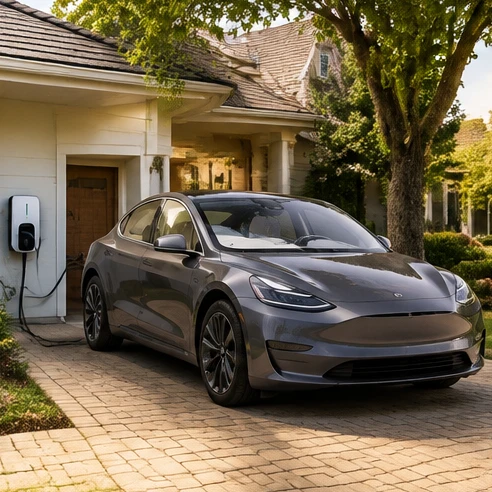
An e-vehicle, or electric vehicle, is a car, truck, or SUV powered by a battery pack and electric motor rather than an internal combustion engine. Over a 5-year ownership period, e-vehicles typically offer significant savings on fuel and routine maintenance compared to gas-powered vehicles, though total costs depend on electricity rates, driving habits, and federal tax credit eligibility.
Most buyers researching e-vehicles run into the same wall: sticker prices, range numbers, and tax credit rules that never quite add up to a real answer. This guide works through the actual math — a 5-year total cost of ownership comparison, charging time by charger type, and a model-by-model breakdown — so you can match a specific battery-powered vehicle to your budget and daily driving pattern.
An e-vehicle, or electric vehicle, is a car, truck, or SUV that uses a battery and electric motor instead of (or alongside) an internal combustion engine. Battery electric vehicles (BEVs) run entirely on stored electricity and produce no tailpipe emissions, while plug-in hybrid electric vehicles (PHEVs) pair a smaller battery with a gas engine for extended range. Over a 5-year ownership period, EVs typically cost less to fuel and maintain than comparable gas vehicles, though the exact savings depend on your electricity rate, driving distance, and whether you qualify for the federal tax credit.
What Are E-Vehicles and How Do They Work
An electric vehicle replaces the engine, fuel tank, and transmission of a gas car with a battery pack, one or more electric motors, and a power electronics system that converts stored energy into motion. The battery — almost always a lithium-ion pack similar in chemistry to what powers a laptop or phone, just far larger — stores energy measured in kilowatt-hours (kWh). A bigger kWh capacity generally means a longer EPA range rating, though efficiency (how many miles the vehicle gets per kWh) matters just as much as raw battery size.
When you press the accelerator, the battery sends current to the motor, which spins the wheels directly — there’s no multi-gear transmission to shift through, which is part of why EVs deliver instant torque. Regenerative braking captures energy that would otherwise be lost as heat: when you lift off the accelerator or brake, the motor reverses its role and acts as a generator, feeding some of that kinetic energy back into the battery. This is why EV range can improve noticeably in stop-and-go city driving compared to steady highway cruising, where regenerative braking has fewer opportunities to recover energy.
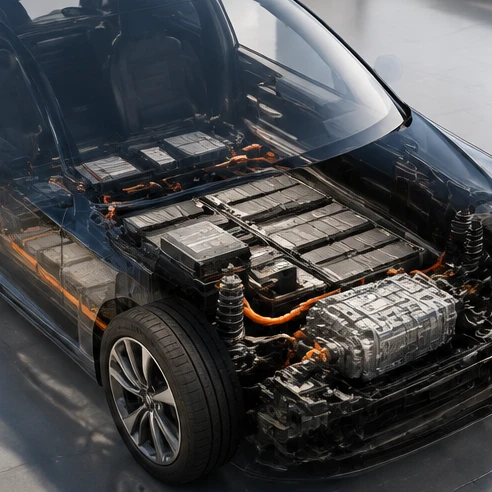
The distinction between BEV and PHEV matters most when deciding what "electric vehicle" actually means for your driving pattern. A BEV like the Tesla Model 3 or Toyota bZ4X has no gas engine at all and depends entirely on charging infrastructure. A PHEV carries a much smaller battery — typically enough for 20 to 40 miles of electric-only driving — before the gas engine takes over, which suits drivers who want electric commuting without changing their road-trip habits. Hybrid electric vehicles (HEVs), a third category sometimes lumped in with "e-vehicles," never plug in at all; their battery is charged solely through regenerative braking and the engine itself.
For most households comparing options today, the practical question isn’t which technology sounds more advanced — it’s which one matches how many miles you actually drive and whether you have reliable access to charging.
Total Cost of Ownership Breakdown
The upfront price on a window sticker tells you almost nothing about what an EV will actually cost you to own. Fuel savings, lower maintenance, and the federal tax credit all shift the real number, sometimes dramatically, and the direction of that shift depends heavily on how many miles you drive per year.
On the plus side, electricity is generally cheaper per mile than gasoline, EVs have far fewer moving parts to service (no oil changes, no timing belts, no exhaust system), and regenerative braking extends brake pad life well beyond what a gas car sees. On the downside, upfront prices remain higher before incentives, home charger installation adds a one-time cost for many buyers, and battery replacement — while rare within the ownership window most people care about — carries a larger repair bill than a comparable gas-engine repair. Grid integration also varies by region: areas with time-of-use electricity pricing can make overnight charging significantly cheaper than daytime charging, which is worth checking with your utility before assuming a flat rate.
Estimated Monthly Charging Cost Formula
Monthly cost = (Monthly miles driven / 100) x 30 kWh x average electricity price
- Monthly miles driven: total distance the vehicle covers in a month.
- Consumption rate: roughly 30 kWh consumed per 100 miles, a commonly used efficiency baseline.
- Average electricity price: $0.16 per kWh, based on typical U.S. residential electricity rates.
Example: at 1,000 miles driven per month, the calculation is (1,000 / 100) x 30 x 0.16 = $48 per month. A driver covering 1,500 miles a month would land closer to $72 — still well under what the same mileage would cost in gasoline for most midsize vehicles.
5-Year Total Cost of Ownership for Electric Vehicles
Comparing an EV against a gas car over a full ownership cycle — not just at the dealership — is the only way to answer whether the higher purchase price actually pays for itself. The table below breaks down the three cost categories that move the most: energy, maintenance, and insurance plus taxes.
| Cost Category | 5-Year Electric Vehicle ($) | 5-Year Gas Car ($) | Variance / Savings |
|---|---|---|---|
| Fuel / Energy | 3,000 | 7,500 | Save $4,500 |
| Routine Maintenance | 2,000 | 4,500 | Save $2,500 |
| Insurance and Taxes | 6,000 | 6,500 | Save $500 |
Across these three categories alone, the EV comes out roughly $7,500 ahead over five years — before factoring in any federal tax credit applied at purchase. That gap narrows for low-mileage drivers and widens for anyone commuting long distances, since fuel savings scale directly with miles driven. Insurance costs for EVs can run slightly higher than for comparable gas models due to battery replacement risk built into some insurers’ pricing, which is part of why the insurance and tax line shows the smallest gap of the three.
Federal Tax Credit Eligibility and Application
The federal tax credit — up to $7,500 for a qualifying new EV — is the single most misunderstood part of the purchase process. It isn’t a flat discount available to every EV buyer; it’s tied to the vehicle’s price, where its battery components come from, and your own income.
Federal Tax Credit Eligibility Checklist
- Confirm the vehicle’s MSRP falls under the segment cap — up to $80,000 for SUVs, trucks, and vans, or up to $55,000 for cars.
- Verify the battery’s mineral sourcing meets the minimum North American or free-trade-partner content threshold required under current law.
- Verify the battery’s component assembly also meets North American content requirements — mineral sourcing and assembly are evaluated separately.
- Confirm your modified adjusted gross income does not exceed the applicable limit for your filing status.
How the credit reaches you depends on how the purchase is structured. Since dealer point-of-sale transfer options became available, eligible buyers can apply the credit as an immediate price reduction at the time of sale rather than waiting to claim it on a tax return the following spring. Not every dealership participates in point-of-sale transfer, and eligibility rules — along with which specific models qualify — change often enough that confirming current status directly with the dealer before signing is worth the extra step, since federal incentive rules for 2026 continue to be adjusted as manufacturers requalify or lose eligibility.
Charging Infrastructure and Duration Analysis
Charging time is the variable most likely to catch new EV owners off guard, mostly because "charging is fast" and "charging is slow" are both true depending entirely on which charger you’re using. Nationally, there are more than 250,000 public chargers available, and drivers can search by location to find the nearest option, with choices split mainly between Level 2 and DC Fast charging.
Real-World Charging Times at Home and in Public
A Level 2 home charger and a public DC Fast Charger are not interchangeable in practice — one is built for overnight convenience, the other for a 20-minute stop on a road trip.
| Charging Level | Power Output (kW) | Estimated Time (20% to 80%) | Best Use Case |
|---|---|---|---|
| Level 2 (Home) | 9.6 kW | 7 to 8 hours for a 75 kWh pack | Overnight home charging |
| DC Fast Charger (Public) | 150 kW – 350 kW | 20 to 30 minutes (10% to 80%) | Fast charging on long trips |
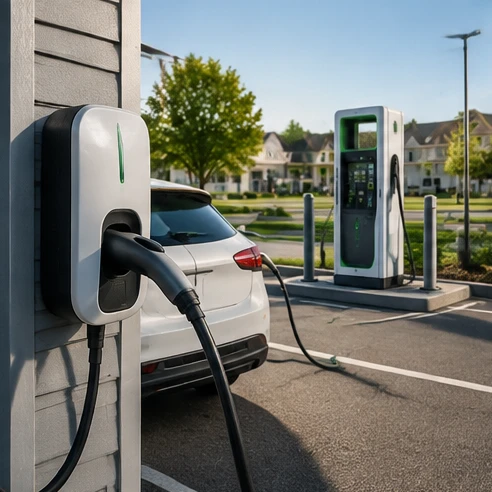
For smaller battery packs in the 60 to 80 kWh range that many mainstream EVs use, a 9.6 kW Level 2 home charger will generally need somewhere between 6 and 9 hours to go from a low charge to 80 percent — this is a reasonable estimate based on the power output and battery size, not a fixed figure, since actual time shifts with outside temperature, charger amperage, and how depleted the battery is at the start. Charging overnight on a standard 240-volt Level 2 setup covers this window easily for most households, which is why installing a home charger — rather than relying on public DC fast charging as a daily habit — remains the more common setup for owners who park at home. Public DC fast charging exists for a different purpose: bridging a long trip, not replacing nightly charging.
Tesla Supercharger Network and NACS Adoption
The charging port standard used across the industry has shifted meaningfully in the past few years. Newer battery electric vehicle lineups, including Toyota’s current BEVs, now come equipped with a North American Charging System (NACS) port along with CCS1 and J1772 adapters, which lets those vehicles plug into Tesla’s Supercharger network as well as older CCS1-based public stations. This dual compatibility is a meaningful change from the earlier landscape, where non-Tesla EVs were locked out of the largest fast-charging network in the country.
Charging Adapter Selection Rule
Situation: you’re driving a newer EV such as a Toyota bZ or Hyundai Ioniq 6 and need to charge at either a NACS or a CCS1 station.
- Identify the charging port standard built into your vehicle — many Korean and Japanese models still ship with a native CCS1 port even when NACS adapters are included.
- Check the compatibility of the charging station you’re heading to — a Tesla Supercharger versus a legacy CCS1 public station requires different adapters.
- Use only a manufacturer-approved or certified adapter (for example, NACS-to-CCS1) to ensure the connection can safely handle the current.
- Seat the adapter fully into the charging cable before plugging it into the vehicle’s port; a loose connection is a common cause of a charging session that starts and then stops.
Result: the vehicle draws a stable charging current from the station without an interrupted session. A charging attempt that repeatedly starts and stops, or that displays a fault code on the station screen, is usually a sign the adapter isn’t fully seated rather than a problem with the vehicle or the charger itself — reseating the connection resolves most of these cases.
Always check your vehicle manufacturer’s documentation before using any third-party or uncertified adapter, since an incompatible adapter is one of the more common avoidable causes of a failed public charging session.
Best Electric Vehicles for Families and Budget Selection
Range and price both vary more across current EV models than most shoppers expect, and the gap between a compact sedan and a performance-oriented model can be tens of thousands of dollars for a similar EPA range. Shoppers exploring premium options might also look into mercedes ev made in india models as part of their global market comparison. The 2026 Tesla Model 3 starts at $38,630 with an EPA estimated range between 309 and 363 miles, while the 2025 Hyundai Ioniq 6 starts slightly higher at $39,095 with a range between 240 and 342 miles. Further up the price ladder, the 2026 Mercedes-Benz CLA-Class EV starts at $48,500 with a 374-mile estimated range, and the 2026 Porsche Taycan starts at $108,050 with a range between 251 and 293 miles — illustrating that a higher price doesn’t automatically translate to a longer range once you move into performance-focused models.
For families cross-shopping SUV-style options, Toyota’s current battery electric lineup gives a useful mid-market reference point: the 2026 bZ has an as-shown price of $43,775 with a 299-mile range rating, the bZ Woodland trim runs $45,650 with a 281-mile rating, and the smaller C-HR Battery EV comes in at $40,500 with a 273-mile rating. Chevrolet’s Equinox EV occupies a similar price and range tier within GM’s broader electric portfolio, giving families a domestic option alongside the Toyota and Hyundai models above.
Vehicle Spec and Price Comparison
| Vehicle Model | Starting Price | EPA Range (Miles) | Battery Capacity (kWh) | Eligible Federal Tax Credit |
|---|---|---|---|---|
| Tesla Model 3 | $38,990 | 272 mi | 57.5 kWh | Yes ($7,500) |
| Hyundai Ioniq 6 | $42,450 | 361 mi | 77.4 kWh | Yes (via lease terms) |
| Toyota bZ4X | $43,070 | 252 mi | 71.4 kWh | Varies by timing |
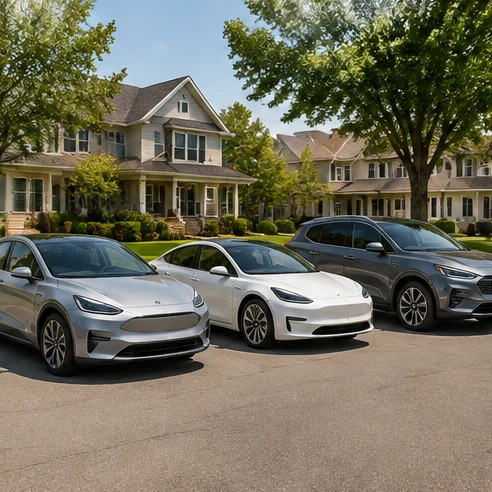
Top Affordable Models and Cheapest E-Car Options
The cheapest EVs on the market cluster in the compact segment, generally starting under $30,000 before any federal tax credit is applied — a reasonable estimate for entry-level trims rather than a fixed figure, since pricing shifts by trim year and dealer inventory. Buyers prioritizing the lowest sticker price over maximum range should expect a trade-off: shorter EPA ratings, smaller battery packs measured in kWh, and fewer standard driver-assistance features than mid-tier models like the Ioniq 6 or bZ4X.
A useful decision rule for budget-focused shoppers: if your typical daily driving stays under 40 miles round trip, a smaller-battery, lower-range EV in the $30,000-and-under range covers your needs without paying for range capacity you’ll rarely use. If your household regularly drives 200-plus miles in a single day, the extra cost of a longer-range model like the Model 3 or Ioniq 6 usually pays for itself in reduced charging stops.
Battery Replacement Costs and Long-Term Reliability
Battery degradation is the long-term cost question every EV shopper eventually asks, and it deserves a direct answer rather than a reassurance. Most manufacturers back their battery packs with warranties covering 8 years or 100,000 miles, whichever comes first — a minimum standard that applies broadly across current EV models sold in the U.S. Within that window, a battery replacement due to a manufacturing defect is generally covered at no cost to the owner.

Outside of warranty, a full pack replacement is a significant expense, and the observable signal to watch for is a noticeable drop in usable range relative to when the vehicle was new — losing more than roughly 20 percent of original range well before the warranty period ends is the kind of degradation pattern worth raising with a dealer rather than dismissing as normal wear. Gradual, modest range loss over many years is expected and not itself a failure sign; a sudden, sharp drop is the pattern that warrants inspection.
On the environmental side, life-cycle studies comparing EVs to gas vehicles consistently find that manufacturing an EV battery carries a larger upfront carbon footprint than building a gas engine, but that gap is offset over the vehicle’s operating life as it avoids tailpipe emissions entirely — the crossover point depends on the local electricity grid’s mix of energy sources, which is why regional results vary rather than converging on one universal number.
Market Realities and Consumer Adoption Trends
EV sales growth has slowed compared to a few years ago, and the reasons are less about the technology than about the buying experience around it. Public charging infrastructure, while expanding, still feels inconsistent to many shoppers cross-country, and a station showing as "available" in an app isn’t always working when a driver arrives.
Price remains the other major friction point. Even with the federal tax credit narrowing the gap, luxury cars in india under 10 lakhs and broader alternative mobility options remind us that EV adoption must also contend with regional affordability. EVs as a category still carry a higher average transaction price than gas vehicles, and shifting eligibility rules for which specific models qualify have made some buyers hesitant to commit without confirming credit status at the exact moment of purchase.
That hesitation is rational, not irrational. A used, well-maintained EV with intact battery health and a full charging setup already installed at home tends to sidestep both of these friction points, since the depreciation has already been absorbed by the first owner and the charging routine is already established.
So are e-vehicles worth it for a typical buyer? For most households with access to home charging and average-to-above-average annual mileage, the 5-year fuel and maintenance savings shown earlier — combined with the federal tax credit where eligible — generally outweigh the higher upfront price. The calculation shifts for drivers with very low annual mileage or no reliable home charging access, where the fuel-savings advantage shrinks and the charging-convenience gap widens.
If you’re weighing a purchase this month, run the monthly charging cost formula above using your own mileage and check your specific model against the federal tax credit checklist before signing anything — that combination will tell you, in dollars rather than generalities, whether the EV you’re considering actually beats what you’re driving now.