
If you’ve heard the roar of V8 Supercars but never quite understood what separates this uniquely Australian motorsport from Formula 1, NASCAR, or any other touring car series, you’re in the right place. V8 Supercars—now officially known simply as Supercars—is one of the most fiercely contested and technically fascinating racing categories in the world, built on a philosophy of close, production-based competition that has captivated fans for more than six decades. This guide breaks down everything a newcomer needs to know, from its origins to its cars, tracks, and race-day strategy.
The Origins of V8 Supercars
Supercars traces its roots back to 1960, when it began life as the Australian Touring Car Championship. The very first race was held at Gnoo Blas Motor Racing Circuit, a since-vanished street circuit carved from country roads in Orange, New South Wales. Journalist David McKay became Australia’s first national touring car champion behind the wheel of a Jaguar Mark 1.
The championship expanded to a multi-race format in 1969, and by the 1970s the sport had become defined by a rivalry between two domestic manufacturers: Holden, backed by General Motors, and Ford. That Ford-versus-Holden feud became one of the fiercest and most enduring in Australian sport. The series was rebranded V8 Supercars in 1997, before shortening to simply Supercars in 2016—though a V8 engine has powered every car in the field ever since.
What Cars Compete in Supercars Today?
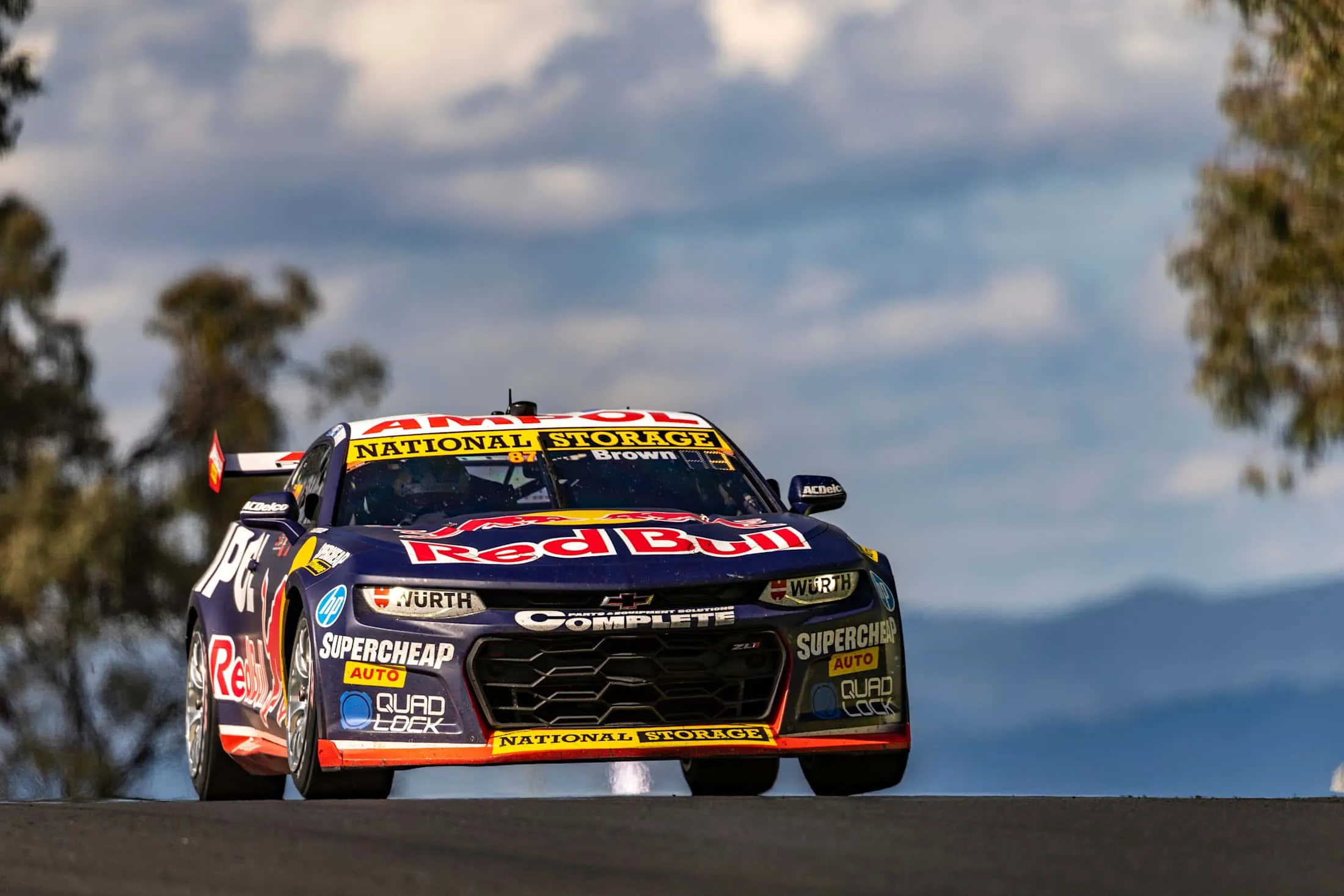
Only two manufacturer models currently do battle in the Supercars field: the Ford Mustang GT and the Chevrolet Camaro ZL1. Visually, both closely resemble their road-going counterparts, but underneath the bodywork they share an identical space-frame chassis designed to guarantee performance parity between the two marques.
Even though the Mustang and Camaro bodywork looks distinct, both are engineered to perform almost identically on track, which keeps the on-track battles tight and unpredictable rather than one-sided. Toyota is set to join the grid from 2026 with its GR Supra, adding a third manufacturer to the mix for the first time in years.
How Fast Are V8 Supercars?
Performance is where these cars truly separate themselves from ordinary road cars. The Mustang runs a 5.4-litre Coyote V8, while the Camaro is powered by a 5.7-litre LTR engine. Both power plants produce roughly 447 kilowatts (around 600 horsepower) and more than 650 newton-metres of torque, delivered through a spec six-speed sequential gearbox.
Despite weighing a substantial 1,335 kilograms, these cars are capable of reaching top speeds near 300 kilometres per hour. At Albert Park Circuit in Melbourne—the series’ fastest track—cars average 180 km/h over a single lap. Acceleration is equally impressive: a Supercars racer can sprint from a standstill to 100 km/h in just 3.4 seconds, less than half the time it takes a typical family sedan.
How the Supercars Championship Format Works
Every race weekend on the Supercars calendar is worth a maximum of 300 championship points, regardless of how many races take place that weekend—meaning some rounds carry significantly more weight than others depending on their format.
From 2025, the season is split across three distinct formats:
- Sprint Cup – Eight rounds held across Sydney, Melbourne, Taupō, Launceston, Perth, Darwin, Townsville, and Ipswich. A typical sprint weekend features three races: one short sprint with no mandatory pit stops, and two longer races requiring tyre changes and refuelling. The Melbourne SuperSprint, staged alongside the Formula 1 Australian Grand Prix, is the exception, running four races totalling 395 kilometres due to a tighter schedule.
- Enduro Cup – Two gruelling endurance events. The Bend 500, held at Tailem Bend in South Australia, is a single 500-kilometre race. The second is the legendary Bathurst 1000 at Mount Panorama—Australia’s most prestigious motor race, run over roughly six hours and 1,000 kilometres, and the event every Supercars driver dreams of winning.
- The Finals – A three-round knockout series inspired by NASCAR’s playoff system. Each of the final three rounds features two 250-kilometre races, with Adelaide adding a bonus 100-kilometre sprint. Championship points for the top 10 drivers are reset heading into this stage, with small bonuses applied based on standings. After the Gold Coast round, the bottom three drivers are eliminated; points reset again ahead of Sandown, eliminating three more. The season finale in Adelaide decides the title among the four remaining contenders, guaranteeing a down-to-the-wire finish.
Tyres, Fuel, and Race Strategy
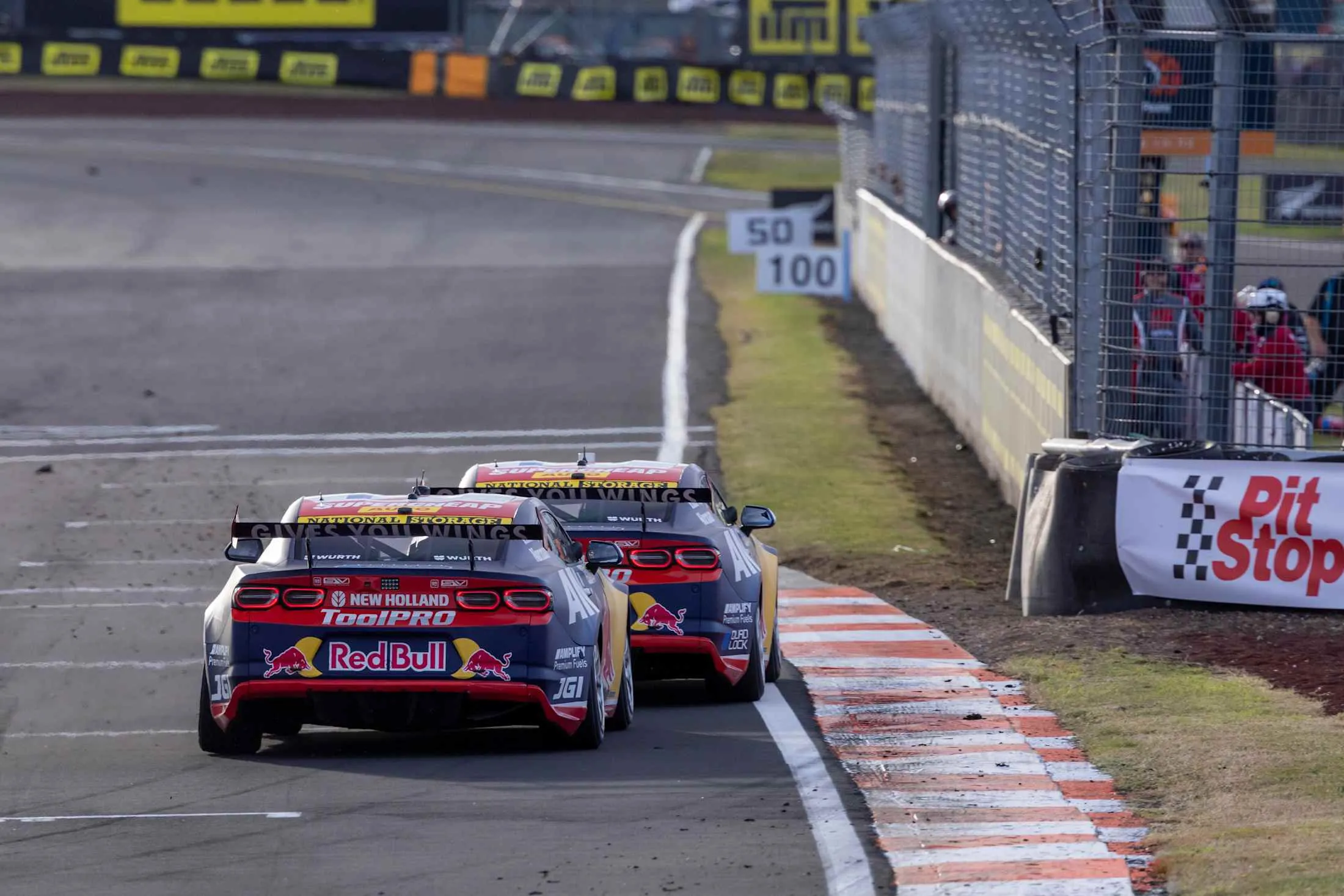
Strategy plays an outsized role in Supercars because of how tyres and fuel are managed. Any race longer than 105 kilometres requires mandatory pit stops, making tyre and fuel management central to race-day success. Each weekend, teams typically use between 28 and 52 fresh 18-inch Dunlop tyres, with Dunlop supplying between 800 and 1,000 dry-weather tyres and roughly 400 wet-weather tyres per round—every one of them handmade in Japan. The unique four-day Bathurst 1000 format alone requires around 2,500 tyres.
From 2025, teams will choose between two compounds: a durable but slower “soft” tyre, and a faster but more fragile “super soft.” While most rounds offer both compounds across the weekend, only one compound can be used per race. Pit stops require a minimum of two tyre changes, with crews limited to four mechanics (five during endurance races), meaning every additional tyre change comes with a strategic time cost. Refuelling adds further complexity, since fuel tanks are capped at 135 litres, often making fuel strategy the deciding factor in longer races.
Where Do V8 Supercars Race?
Supercars competes at some of the most storied circuits in Oceania. Mount Panorama Circuit, home to the Bathurst 1000, began life as a designated tourist road before becoming one of Australia’s most feared and respected racetracks. Albert Park Circuit in Melbourne, shared with Formula 1, is the series’ fastest track and places Supercars drivers alongside international motorsport royalty in a scenic inner-city setting.
The Gold Coast 500 is widely regarded as one of the most demanding events on the calendar, run on a street circuit originally built for the CART IndyCar World Series in 1991. Meanwhile, the Adelaide 500 takes place on the Adelaide Street Circuit, a track first built for Formula 1 in 1985. After F1 relocated to Melbourne, Supercars adopted a shortened version of the layout, turning it into one of the season’s signature events.
Final Thoughts
From its humble beginnings on a country road in Orange, New South Wales, to today’s high-tech, closely matched battle between Ford and Chevrolet—with Toyota soon to join—V8 Supercars has grown into one of the world’s most compelling touring car championships. Its blend of raw V8 power, tight regulations that keep competition close, and a demanding calendar spanning iconic circuits like Mount Panorama and Albert Park make it essential viewing for any motorsport fan.
Whether you’re drawn in by the strategic chess match of tyres and fuel, the fierce Ford-versus-Chevrolet rivalry, or the sheer spectacle of the Bathurst 1000, Supercars offers something no other series quite replicates. If you’re new to the sport, there’s no better time to start following along as the 2025 season’s new three-format structure promises even tighter, more unpredictable racing. Explore more Supercars coverage and driver profiles to deepen your knowledge of this uniquely Australian motorsport.