
Autonomous vehicles are rapidly transitioning from a futuristic concept to an emerging reality on roads worldwide. The journey toward self-driving technology began in the early 20th century, but significant industrial progress accelerated in the 2010s when tech giants like Google and automotive leaders such as General Motors made substantial investments in the field. These vehicles promise to fundamentally transform transportation by enhancing decision-making capabilities, optimizing fuel consumption, and significantly improving road safety.
At the core of autonomous vehicle technology lies a sophisticated combination of radar systems, advanced sensors, and artificial intelligence (AI). AI serves as the brain of these vehicles, enabling them to navigate complex road environments without human intervention while making split-second decisions and adapting to ever-changing traffic conditions. As the industry pushes toward full autonomy, understanding the applications, benefits, and challenges of AI in this sector becomes essential for anyone interested in the future of mobility.
The Evolution of Autonomous Driving: Current State and Future Outlook
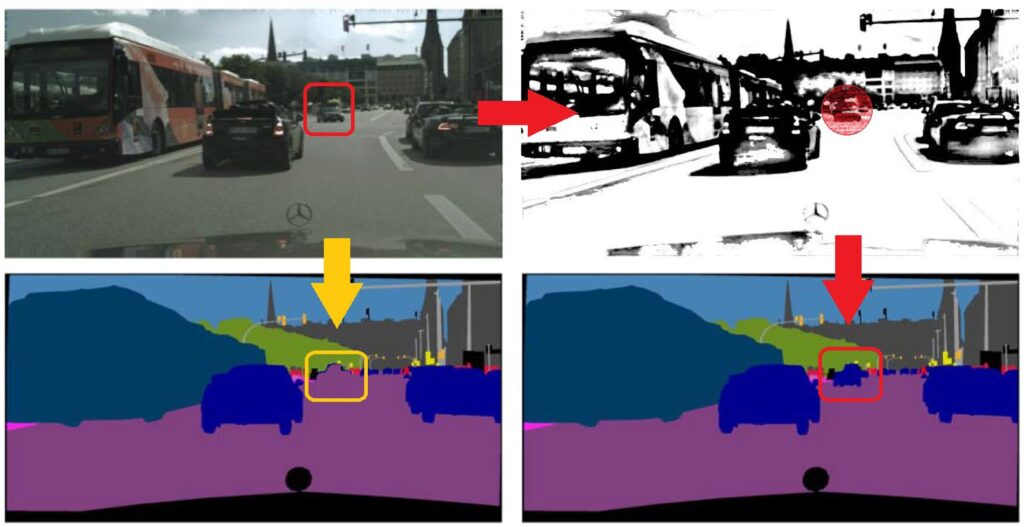
The past decade has witnessed unprecedented growth in self-driving technology, driven primarily by breakthroughs in artificial intelligence, machine learning (ML), and deep learning (DL). These advanced technologies have empowered engineers to tackle complex challenges including scene perception, motion control, path planning, and behavior arbitration—all critical components for safe autonomous operation.
To standardize the industry, the Society of Automotive Engineers (SAE) established a comprehensive framework defining six levels of driving automation, ranging from Level 0 to Level 5. As vehicles progress through these levels, the requirement for human intervention systematically decreases.
Level 1 vehicles feature a single automated function, such as cruise control for speed management. At Level 2, assistive technologies like adaptive cruise control, lane departure warning, and lane-keeping systems leverage AI capabilities. Level 3 represents a significant advancement where AI takes substantial control over navigation and decision-making, equipped with comprehensive sensor suites for data collection. Currently, only a handful of companies in Europe and North America publicly offer this level of autonomy with regulatory authorization.
Level 4 systems can perform nearly all functions of fully autonomous vehicles, though they remain restricted by geographic and weather conditions, requiring human drivers to take control in certain situations. Level 5 represents the ultimate goal—fully autonomous vehicles requiring no human input or oversight under any conditions.
Leading Companies in Autonomous Vehicle Development
The competitive landscape for autonomous vehicles features an impressive array of giant automakers, innovative AI companies, and ambitious startups, all competing to capture market share. These organizations are developing groundbreaking solutions that promise to revolutionize how consumers experience mobility.
Zoox, operating under Amazon’s umbrella, develops autonomous vehicles that utilize computer vision to analyze surroundings with remarkable precision. Their advanced features can detect pedestrians using mobile phones and interpret light flashes from other vehicles, demonstrating sophisticated environmental awareness.
Waymo, a subsidiary of Alphabet (Google’s parent company), creates autonomous cars equipped with comprehensive sensor suites and AI-powered software. Their vision system and machine learning algorithms enable multiple capabilities that allow vehicles to respond safely to real-world traffic situations.
Tesla has developed an autopilot neural network incorporating diverse real-world vehicle simulations. Their AI solution excels at object detection, depth estimation, and semantic segmentation—critical functions for safe autonomous operation.
Pony.ai builds autonomous capabilities for robotrucks, robotaxis, and personal vehicles, utilizing AI for localization, map features, scene perception, and trajectory prediction.
Cruise, owned by General Motors, employs complex machine learning models to help autonomous vehicles develop dynamic understanding and decision-making capabilities, supported by continuous learning frameworks that enhance safety and reliability.
Other notable companies advancing AI for autonomous vehicles include Baidu, Mercedes-Benz, and Motional, each contributing unique innovations to the field.
Key AI Technologies Powering Autonomous Driving
Perception Systems
Autonomous vehicles rely on an array of sensors including Lidar, radar, cameras, GPS, and various data-collection devices that continuously gather environmental information. Computer vision technology, incorporating motion detection and calibration, enables vehicles to detect and identify objects in their surroundings.
Deep learning algorithms, particularly convolutional neural networks (CNN) and recurrent neural networks (RNN), process the collected 3D data to help vehicles understand their environment comprehensively. This information enables the vehicle to plan maneuvers, perceive surroundings accurately, and make informed decisions.
Lane Detection and Changing
Lane changing represents one of the most complex challenges for autonomous vehicles due to the unpredictable nature of other road users. Machine vision serves as the primary component for lane detection, using segmentation techniques to identify lines and curves on road surfaces.
Multiple neural network algorithms, including line-CNN, spatial-CNN, deep-CNN, and 3D CNN, work together to process temporal and spatial information, enabling accurate lane identification. Tesla, for example, employs a neural network called Hydranet specifically for lane detection and lane-changing capabilities.
Prediction Capabilities
Self-driving vehicles must project how identified road agents—including pedestrians, cyclists, and other vehicles—may behave. This task proves particularly challenging given the dynamic nature of each agent and how their interactions produce varying outcomes.
Deep learning algorithms like CNN and RNN process data to forecast trajectories. NVIDIA has developed PredictionNet, a deep neural network that anticipates and predicts the trajectories of road agents, outputting a series of scored trajectories and events with their probability of occurrence.
AI Applications in Robotaxis
Robotaxi services have gained significant popularity in cities like San Francisco and Beijing, with residents in Wuhan and Beijing already using them for public transport following regulatory approvals for Baidu’s Apollo Go service. Baidu aims to deploy 1,000 robotaxis in Wuhan by the end of 2024, signaling rapid expansion in this sector.
Robotaxis utilize cameras and sensors that enable AI to reconstruct a 360-degree view of the vehicle’s surroundings. The AI-based computing engine within these vehicles manages journey planning, collision avoidance, scenario prediction, and navigation through complex city streets.
Many companies have developed proprietary neural network engines to support intelligence and autonomy in their robotaxis, while others rely on third-party AI-driven platforms provided by companies like NVIDIA. These powerful computing engines convert sensor and camera data into actionable insights for safe navigation.
NVIDIA offers comprehensive end-to-end solutions for autonomous vehicle development, recently unveiling a new centralized computing platform capable of running generative AI applications. By integrating this platform with natural language processing (NLP), robotaxis can develop customized personas that engage in dialogue, provide real-time recommendations, and offer assistance to passengers.
AI in Autonomous Mass Public Transport
Artificial intelligence has already helped solve complex problems in mass transport, including traffic management, route optimization, and optimized scheduling. Researchers continue expanding AI’s capabilities for autonomous public transport vehicles, a technology that promises to shuttle people within specific city zones such as campuses and business districts.
Robobuses represent prime examples of mass transport vehicles leveraging AI across multiple systems. Equipped with comprehensive sensor and camera suites, onboard AI systems manage navigation, precise docking, energy consumption, and traffic management. Integrating V2X (vehicle-to-everything) capabilities enables optimized fleet management and improved environmental responsiveness.
Companies like WeRide and Pix Moving have made significant progress in producing autonomous mini shuttles. Beyond open road testing in designated Beijing zones, WeRide operates at Resorts World Sentosa in Singapore, where their robobus runs along a 1.2-kilometer stretch, picking up and dropping off passengers.
Benefits of AI in Autonomous Vehicles
Improved Road Safety and Reduced Accidents
Human errors, including fatigue, distraction, and impaired driving, remain the leading causes of most traffic accidents. AI-powered self-driving vehicles can significantly reduce incidents resulting from these human factors. With adaptive capabilities, advanced visual processing, and proximity sensing analysis, AI enables autonomous vehicles to operate safely and avert dangerous scenarios before they escalate.
Increased Mobility Access
Autonomous vehicles can transform travel options for disabled individuals, elderly citizens, and people with medical conditions. Using speech recognition or mobile applications, these vehicles can safely navigate passengers to their destinations. Additionally, ridesharing robotaxis offer affordable, convenient alternatives to traditional transportation methods, expanding mobility access across communities.
Reduced Traffic Congestion and Environmental Impact
AI-powered vehicles can detect and avoid traffic congestion through dynamic routing capabilities, sophisticated route planning, and precise maneuvering. AI systems manage energy consumption by optimizing braking and acceleration patterns, limiting fuel consumption and reducing greenhouse emissions—creating an eco-friendly transportation solution.
Improved Traffic Management
Self-driving cars utilizing V2X frameworks communicate with other road agents to understand traffic conditions comprehensively. This shared information enables better route planning and helps vehicles avoid congested areas, contributing to overall traffic flow optimization.
Challenges Facing Autonomous Vehicle Adoption
Technical Limitations and Edge Cases
Several technical complexities challenge autonomous vehicle advancement, including limitations in onboard computing power, perception accuracy, localization challenges, and hardware constraints. Simulating rare edge cases—unusual scenarios that can occur in real-world driving—remains particularly challenging for developers.
Regulatory Hurdles and Liability Concerns
Uncertainty regarding liability when autonomous vehicles are involved in accidents creates significant regulatory challenges. Adapting existing laws to accommodate self-driving vehicles proves difficult, requiring stakeholders to develop comprehensive frameworks for managing liability. Standardized frameworks will help lawmakers establish regulations that prioritize human safety while encouraging continued innovation.
Consumer Trust and Acceptance
Self-driving cars face intense public scrutiny whenever accidents occur. Cruise robotaxis experienced significant criticism in San Francisco following two separate incidents, highlighting how such events can undermine community trust. Building consumer acceptance requires companies to prioritize user safety in design and conduct rigorous testing protocols.
Ethical Dilemmas
AI systems in autonomous vehicles may face morally challenging situations that force difficult choices between ambiguous outcomes. For instance, selecting between protecting onboard passengers or pedestrians in accident scenarios presents complex ethical considerations. Stakeholders must develop acceptable frameworks and standards to address these pressing moral dilemmas.
Conclusion
Artificial intelligence has driven remarkable advancements in autonomous vehicle technology, with deep learning algorithms revolutionizing perception, planning, and execution frameworks across the industry. These technological breakthroughs have enabled diverse applications in self-driving vehicles, from lane recognition to comprehensive environmental awareness.
The resulting innovations have paved the way for transformative projects like autonomous taxis and robobuses, bringing self-driving technology closer to mainstream adoption. As the industry continues leveraging AI’s potential, companies must maintain a human-centered approach, prioritizing enhanced mobility options and safety in their technological implementations. The future of transportation depends not only on technological capability but on building systems that serve society’s needs while earning public trust through demonstrated safety and reliability.
What are your thoughts on autonomous vehicles? Would you trust AI to drive you to your destination? Share your perspective in the comments below, and explore our other articles to learn more about emerging automotive technologies shaping our world.
References
- U.S. Department of Transportation. (2023). Automated Vehicles for Safety. NHTSA.
- SAE International. (2021). Taxonomy and Definitions for Terms Related to Driving Automation Systems for On-Road Motor Vehicles. SAE J3016.
- European Commission. (2023). Conditional Automated Driving: Level 3 Vehicles in Europe.
- Waymo. (2023). Understanding SAE Levels of Driving Automation.
- National Highway Traffic Safety Administration. (2023). Automated Vehicles for Safety.
- Zoox. (2023). Our Technology: Computer Vision and AI.
- Waymo. (2023). Waymo Driver Technology Overview.
- Tesla. (2023). AI & Autopilot: Tesla Neural Networks.
- Pony.ai. (2023). Autonomous Driving Technology Stack.
- Cruise. (2023). AI and Machine Learning at Cruise.
- Liu, S., et al. (2021). Deep Learning for Autonomous Driving: A Comprehensive Review. IEEE Transactions on Intelligent Vehicles.
- Tesla AI Day. (2022). Hydranet: Neural Networks for Lane Detection.
- NVIDIA Developer Blog. (2023). PredictionNet: Forecasting Trajectories for Autonomous Vehicles.
- Baidu. (2023). Apollo Go: Robotaxi Deployment in Wuhan.
- NVIDIA. (2024). NVIDIA DRIVE Thor: Centralized Computing for Autonomous Vehicles.
- WeRide. (2023). Robobus Operations at Resorts World Sentosa.
- California DMV. (2023). Autonomous Vehicle Collision Reports.