
Artificial intelligence in autonomous vehicles is no longer a futuristic concept — it is the core technology driving one of the most significant transformations in the automotive industry today. As self-driving cars edge closer to mainstream reality, AI serves as the critical bridge between raw sensor data and the split-second decisions that keep passengers and pedestrians safe.
Human drivers are remarkable information processors. At highway speeds or in dense urban traffic, a person simultaneously absorbs visual cues, interprets audio signals, and anticipates the behavior of other road users — all while maintaining vehicle control. Replicating that capability in a machine is an extraordinary engineering challenge.
For an autonomous vehicle, every input matters: traffic lights changing color, a pedestrian stepping off the curb, a construction zone narrowing lanes, or reduced visibility from rain and fog. The vehicle’s AI system must sense all of these inputs, predict what happens next, and recommend — or execute — the appropriate response, whether that means applying the brakes, adjusting speed, or steering around an obstacle. No single piece of hardware or software handles this alone. True vehicle autonomy emerges from the tight integration of AI algorithms, purpose-built hardware, and specialized autonomous software working in concert.
How Neural Networks Power Self-Driving Technology
AI is already deeply woven into everyday life. Every web search, digital payment, and smartphone camera filter relies on some form of artificial intelligence operating quietly in the background. Now, the same technology that made smartphones “smart” is being applied to make vehicles intelligent enough to drive themselves.
The technical foundation for this capability is the neural network — a machine learning architecture modeled on the structure of the human brain. Neural networks enable machines to recognize patterns and identify objects with a speed and consistency that rivals, and in many scenarios exceeds, human perception. For an autonomous vehicle, this translates directly into computer vision: the ability of an onboard system to interpret the surrounding environment in real time, distinguishing a cyclist from a traffic cone, or reading a partially obscured road sign in poor lighting.
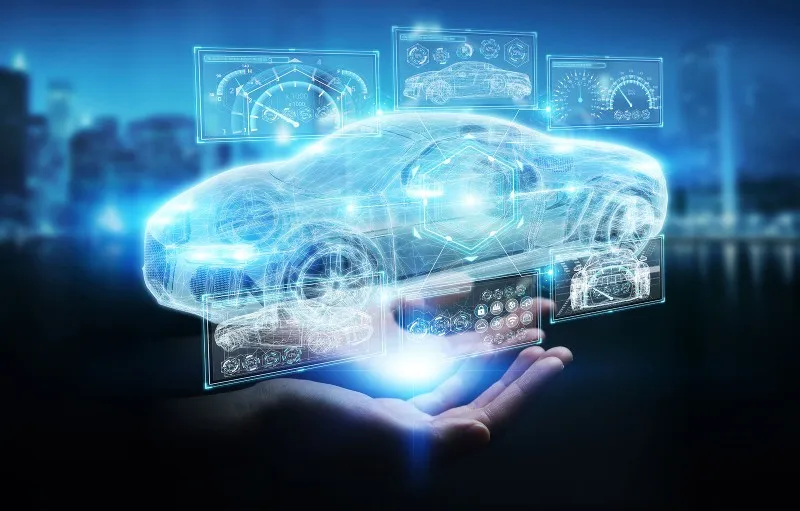
The concept of neural networks has existed for decades, but their practical deployment was long constrained by the availability of sufficient computing power. That barrier has progressively fallen. As processor performance has scaled, neural networks can now run faster and more efficiently on cost-effective, low-power hardware — a prerequisite for embedding them inside a production vehicle.
From Data Centers to the Edge: Processing AI Onboard
The evolution of neural network hardware tells its own story. Early implementations ran on general-purpose central processing units (CPUs). A major leap forward came when engineers discovered that graphics processing units (GPUs) — with their massively parallel compute architectures — were exceptionally well suited to the matrix calculations that neural networks demand, delivering dramatic speed improvements.
The next evolution is the dedicated neural network accelerator (NNA). Unlike GPUs, which were originally designed for rendering graphics, NNAs are built from the ground up to run neural network workloads. The result is a substantial improvement in both power efficiency and silicon area efficiency — making NNAs orders of magnitude more effective than GPUs for AI inferencing at the edge.
This efficiency gain has a profound practical consequence for autonomous driving. It is now possible to run sophisticated AI models directly inside the vehicle, without routing data to a remote cloud server and waiting for a response. In safety-critical driving scenarios, that round-trip latency is unacceptable. Local, on-device processing delivers the determinism and speed that autonomous operation requires.
The Vehicle as a Mobile Data Center
The modern autonomous vehicle is, in effect, a data center on wheels. By running neural networks locally, the full suite of autonomous driving capabilities — functional safety systems, multi-sensor fusion, real-time path planning, and multi-core task management — can execute with low latency and low power consumption. These are capabilities that, only a few years ago, required the dedicated infrastructure of a physical data center.
This shift is enabling AI to fundamentally reshape the automotive sector. Manufacturers and technology start-ups alike are investing heavily in AI-driven platforms, with the shared goal of achieving fully autonomous vehicles: cars that can operate without any human intervention across a wide range of driving conditions.
The breakthroughs accumulating in trained neural network capability are bringing that goal progressively within reach. Each advance in AI model efficiency, hardware performance, and software integration moves self-driving cars one step closer to the road.
The Road Ahead for AI in Autonomous Driving
The convergence of powerful AI models, energy-efficient neural network accelerators, and mature autonomous software stacks represents a genuine inflection point for mobility. The self-driving car is becoming a reality — not through any single invention, but through the compounding progress of AI research, semiconductor engineering, and systems integration.
For consumers, the implication is a future where the vehicle handles the cognitive burden of driving, reducing accidents caused by human error and opening mobility to those who cannot drive. For the industry, it represents a fundamental reimagining of what a car is — not merely a mechanical conveyance, but an intelligent, responsive system capable of navigating a complex world on its own.
The journey is ongoing, but the direction is clear. AI is the engine of autonomous vehicle development, and its role will only grow as the technology matures.
Have thoughts on how AI is reshaping the future of driving? Share your perspective in the comments, or explore more in-depth coverage of autonomous vehicle technology below.
References
- Imagination Technologies. (2023). Artificial Intelligence in Autonomous Vehicles. https://www.imaginationtech.com/future-of-automotive/how-do-autonomous-cars-work/
- Imagination Technologies. (2023). What Software Is Needed for Autonomous Vehicles? https://www.imaginationtech.com/future-of-automotive/how-do-autonomous-cars-work/what-software-is-used-for-autonomous-vehicles/
- Imagination Technologies Blog. (2020). Running LSTM Neural Networks on an Imagination NNA. https://blog.imaginationtech.com/running-lstm-neural-networks-on-an-imagination-nna/
- Imagination Technologies Blog. (2020). Imagination and Humanising Autonomy Part 1: The Path to Safer Roads. https://blog.imaginationtech.com/humanising_autonomy/