
With more than half of all pet parents turning to apps to find reliable care, the question of which platform to choose — Wag! or Rover — has never been more relevant. Whether you’re a seasoned pet professional or just getting started, picking the right platform can make the difference between a thriving business and a frustrating experience. In a direct head-to-head comparison, Rover earns the top spot as the best overall pet care app in 2025 — but that doesn’t mean Wag! is without merit. Depending on your goals, you might find that using both platforms is the smartest move of all.
Wag! vs Rover at a Glance
Before diving into the details, here’s a quick side-by-side snapshot of what each platform offers pet caregivers:
- Business model: Wag uses AI matchmaking and auctions — you bid on open jobs or get matched automatically. Rover relies on search marketing, where clients browse local profiles and reach out to you directly.
- Customer base: Wag serves around 671,000 customers across 50 U.S. states. Rover boasts over 2 million clients internationally.
- Commission fee: Wag takes a steep 40% cut from every booking. Rover keeps just 20%.
- Signup cost: Wag charges a $49.95 background check fee. Rover charges a $40 profile review fee plus a background check.
- Approval time: Wag averages about 14 business days. Rover takes 10 to 20 business days.
- Primary use case: Wag is best known for on-demand dog walking. Rover shines for recurring pet sitting and boarding.
Platform Overview: How Each App Works

Understanding how clients find you — and how you find clients — is the most important distinction between these two platforms.
Rover works like a marketplace. You build a detailed profile showcasing your services, rates, experience, and reviews. Pet parents in your area search for caregivers that match their needs, and if your profile stands out, they reach out to you. The process is slower but encourages relationship-building through meet-and-greets before any service begins. Think of it as the private chauffeur of pet care: more personal, more intentional, and more likely to result in loyal, recurring clients.
Wag operates more like a gig economy app. Similar to how Uber connects drivers with passengers, Wag connects pet owners who need a walk right now with caregivers who are available. You can either wait for Wag’s algorithm to match you with a job or proactively bid on open requests. This on-demand model — a feature Rover doesn’t offer — is ideal for caregivers who want maximum flexibility and fast bookings.
Getting Started: Application and Screening
Both platforms have similar onboarding requirements. You must be at least 18 years old, live in an area where the app operates, reside somewhere that allows pets, and download the app. Both require a background check, a pet care knowledge quiz, and application approval from a team of specialists.
On Rover, the process involves setting up your profile, choosing services, submitting testimonials (recommended but not required), passing a safety quiz, and completing a background check ($35) plus a $40 processing fee. Rover’s review takes 10 to 20 business days.
On Wag, you’ll provide your information, submit at least five endorsements (recommended), pass a background check ($49.95), and complete a pet care quiz. Once approved, you’ll download the app, do a practice walk, and finalize your profile. Wag’s approval typically takes around 14 business days.
Services You Can Offer
Both apps support most of the same core services: dog walking, pet sitting, drop-in visits, doggy daycare, dog and cat boarding, grooming, and dog training. There are a few differences worth noting.
Rover requires dog trainers to hold a formal certification and have documented experience before offering training services. Wag doesn’t offer doggy daycare as a formal menu option — instead, caregivers work around this by having clients book recurring short sitting or boarding visits.
Based on Google search volume data, dog walking is the most searched service on Wag, pulling around 2,500 monthly searches for the platform. On Rover, pet sitting leads with roughly 5,600 monthly searches — nearly three times Wag’s volume. Dog walking on Rover also outpaces Wag significantly, with 7,100 monthly searches compared to Wag’s 2,500.
Pricing, Commissions, and Earnings
How much you earn depends heavily on commission fees, and here the gap between the two platforms is significant. Rover keeps 20% of every booking. Wag takes 40% — double Rover’s rate and one of the highest commissions in the industry.
Both platforms allow clients to tip, and 100% of tips go to you. Rover has a tipping window that expires after a service, while Wag offers more flexibility, allowing tips before, after, or even for past services.
For payouts, Rover deposits earnings directly to your bank account within two days of completing a service. Wag pays out weekly via Stripe, though you can access funds immediately for a $1.99 fee using the Instant Pay feature.
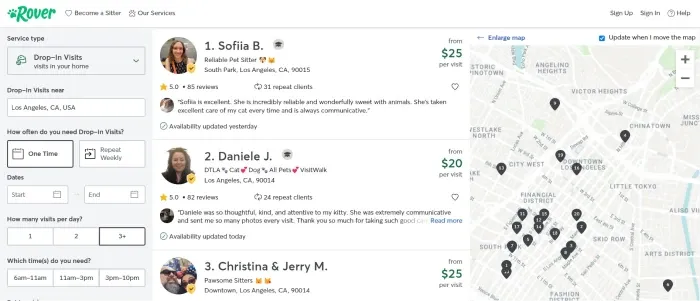
Since January 2024, both apps allow caregivers to set their own rates. This freedom is a double-edged sword — you can price yourself competitively, but also undervalue or overprice your services without careful research.
Tips for Setting Competitive Rates
- Browse competitor profiles on both apps to understand local pricing norms
- Factor Wag’s 40% (or Rover’s 20%) commission into your base rate so you’re not shortchanging yourself
- Account for real costs: gas, transit, equipment, and wear and tear on your home or vehicle
- Build credibility through certifications, reviews, and experience before raising prices significantly
- Offer tiered pricing — base rates for standard walks and premium add-ons for holiday care, medication administration, or senior pet handling
Wag also offers a Wag Pro account for $149 per year, which includes priority search placement, profile badges, and early access to new users. Pro members reportedly earn up to 10% more than free-plan users, though whether it’s worth the investment depends on how frequently you use the platform.
Risk Protection and Insurance
One of the most overlooked aspects of working on either app is the reality of liability. Both Wag and Rover classify caregivers as independent contractors, which means neither platform provides you with true insurance coverage.
Rover’s Guarantee is a reimbursement program — not an insurance policy — designed to protect pets and address property damage in some circumstances. It excludes injuries to third-party pets, jobs booked outside the app, employee dishonesty, lost keys, equipment damage, and more. It’s a helpful safety net, but it’s not a substitute for proper business insurance.
Wag takes no financial responsibility for harm to pets, property, or people during your services. The platform will mediate disputes but will not cover your costs. Wag does promote optional pet insurance plans for owners, but a pet owner’s policy protects the pet — not your business.
A recent survey found that 80% of pet owners are more likely to hire a caregiver who carries liability insurance. The average pet care claim costs around $1,758, with some exceeding $1 million. If you’re serious about working on either platform, investing in dedicated pet business insurance isn’t optional — it’s essential.
What Real Users Say
Pet caregivers consistently rate Rover higher than Wag across review platforms.
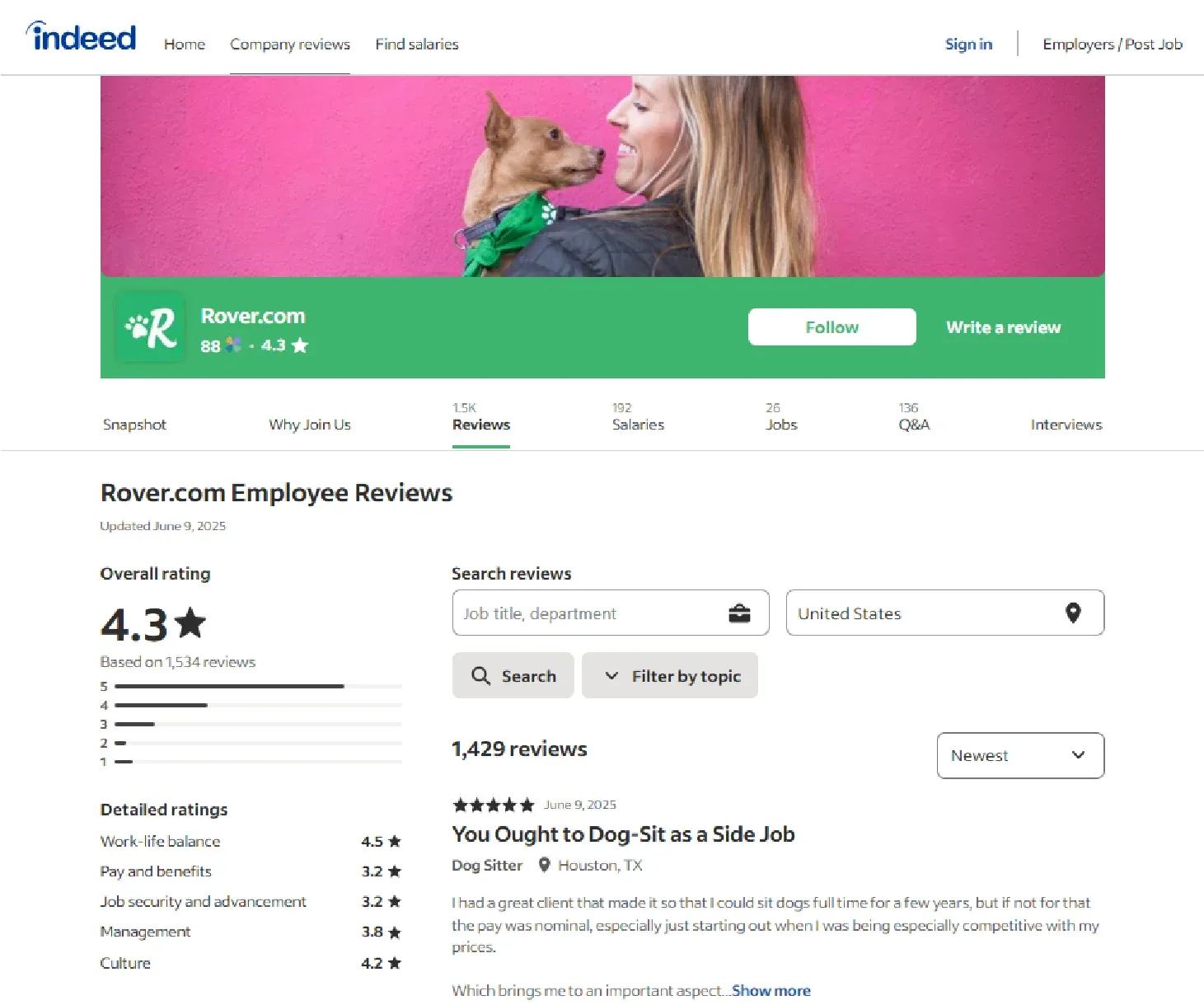
Rover holds a 4.3/5 on Indeed and a 4.7/5 on Google Play. Common praise includes the freedom to set your own rates and schedule, a safer environment thanks to meet-and-greet policies, and reliable payment. Common complaints focus on the 20% commission, inconsistent support quality, and difficulty breaking through when starting out.
Wag earns a 3.7/5 on Indeed and a 3.9/5 on Google Play. Caregivers appreciate the flexibility and the platform’s suitability for side-hustle income, but frequently cite the 40% commission, glitchy app behavior, inadequate human support, and declining walk volume as frustrations.
Pros and Cons at a Glance
Rover pros: Lower commission fee, larger international client base, meet-and-greet safety policy, recurring daycare booking feature, faster payment cycle, high app ratings.
Rover cons: No on-demand dog walking, slower route from application to first gig, more caregivers competing in saturated markets, no lockbox feature.
Wag! pros: On-demand booking for fast gigs, proactive bidding model, lockbox feature for easy key exchanges, shorter average application period, instant pay option.
Wag! cons: 40% commission is the highest among major platforms, no meet-and-greets for safety screening, no reimbursement program, no recurring daycare booking, weekly payouts unless you pay for Instant Pay.
Using Both Platforms Together
The smartest approach for many pet care professionals isn’t choosing one platform over the other — it’s using both strategically. Since each app attracts a different type of client, you can build a more well-rounded business by maintaining a presence on both:
- Use Wag for on-demand dog walking and quick drop-in visits. These are high-frequency, low-commitment bookings that fit Wag’s bidding model perfectly.
- Use Rover for recurring pet sitting, boarding, and long-term clients. Rover’s profile-first approach and meet-and-greet policy are better suited to nurturing lasting relationships.
Many pet professionals start on one platform to gain experience and reviews, then expand to both as their client base grows.
 Pet parents affectionately nuzzling their Shiba Inu together
Which Platform Should You Choose in 2025?
If you’re picking just one, Rover is the stronger platform for most pet care professionals in 2025. Its lower commission rate, larger client base, better app ratings, and relationship-building model make it the better long-term investment for building a sustainable pet care business.
That said, Wag’s on-demand model fills a real gap that Rover doesn’t address. If you thrive on fast bookings, flexible hours, and proactive job-seeking, Wag can be a reliable source of supplemental income — especially for dog walkers in densely populated cities.
Whichever platform you choose, make sure your profile is detailed and specific, your rates reflect both your value and your local market, and — critically — that you’re covered by a dedicated pet business insurance policy. The apps will handle the bookings, but protecting yourself and the pets in your care is always your responsibility.

Ready to take the next step? Explore detailed reviews of each platform — including insider tips on building your profile and landing your first bookings — to make the most of whichever app you choose.
References
- Rover. Become a Rover Sitter. rover.com/become-a-sitter
- Wag. What is Wag Pro? support.wagwalking.com
- Wag. Incident Resolutions Guidelines. safety.wagwalking.com
- Rover. The Rover Guarantee. rover.com/rover-guarantee
- NerdWallet. Pet Insurance Survey Data. nerdwallet.com/article/insurance/pet-insurance-survey-data
- Second Measure. Wag SPAC Public Debut vs Rover. secondmeasure.com
- Pet Care Insurance. 2025 Pet Parent & Pro Survey. petcareins.com