
Ratan Tata, born on December 28, 1937, in Bombay (now Mumbai), India, and passing away on October 9, 2024, in Mumbai at the age of 86, was a towering figure in Indian business and philanthropy. For over two decades, he helmed the Tata Group, a Mumbai-based conglomerate, transforming it into a global powerhouse and leaving an indelible mark on India’s industrial landscape and the lives of millions. His distinguished career was recognized with two of India’s highest civilian honors: the Padma Bhushan in 2000 and the Padma Vibhushan in 2008.
The First Family of Indian Business
Ratan Tata hailed from the esteemed Tata family, renowned industrialists and philanthropists who were instrumental in pioneering much of India’s industrial development. His great-grandfather, Jamsetji Tata, founded the Tata Group in 1868, and its companies, including Tata Steel, played a pivotal role in nation-building, particularly after India gained independence in 1947. The group’s expansion continued under Ratan Tata’s uncle, J.R.D. Tata, who established key subsidiaries like Tata Consultancy Services, Tata Motors, and Tata Salt. Early achievements of the Tata Group included the establishment of the Taj Mahal Palace Hotel in 1903, India’s first hotel with electricity, the founding of Air India in 1932, and the launch of India’s first indigenous cosmetics brand, Lakmé, in 1952.
Education and Early Career
After completing high school in New York City in 1955, Ratan Tata pursued higher education at Cornell University, earning a B.S. in architecture in 1962. He then returned to India to gain practical experience across various Tata Group businesses. He was appointed director of the National Radio and Electronics Co. in 1971 and became chairman of Tata Industries a decade later. In 1991, he succeeded his uncle, J.R.D. Tata, as chairman of Tata Sons, the parent company of the Tata Group.
Leading the Tata Group to Global Prominence
Ratan Tata assumed leadership of the Tata Group at a pivotal time, coinciding with India’s economic liberalization. Despite initial resistance from senior management, he consolidated his position by implementing a retirement age policy, restructuring reporting lines, and making strategic executive changes. Under his stewardship, the Tata Group embarked on an aggressive expansion strategy, with a strong focus on globalization. Key international acquisitions included Tetley Tea (UK) in 2000, Daewoo Motors’ truck manufacturing operations (South Korea) in 2004, Corus Group (UK) in 2007, and the prestigious Jaguar and Land Rover brands (UK) in 2008 from the Ford Motor Company for $2.3 billion.
In December 2012, Ratan Tata retired as chairman but briefly returned as interim chairman in October 2016 after the ousting of his successor, Cyrus Mistry. He retired again in January 2017 when Natarajan Chandrasekaran was appointed chairman.
The Tata Nano and the Singur Controversy
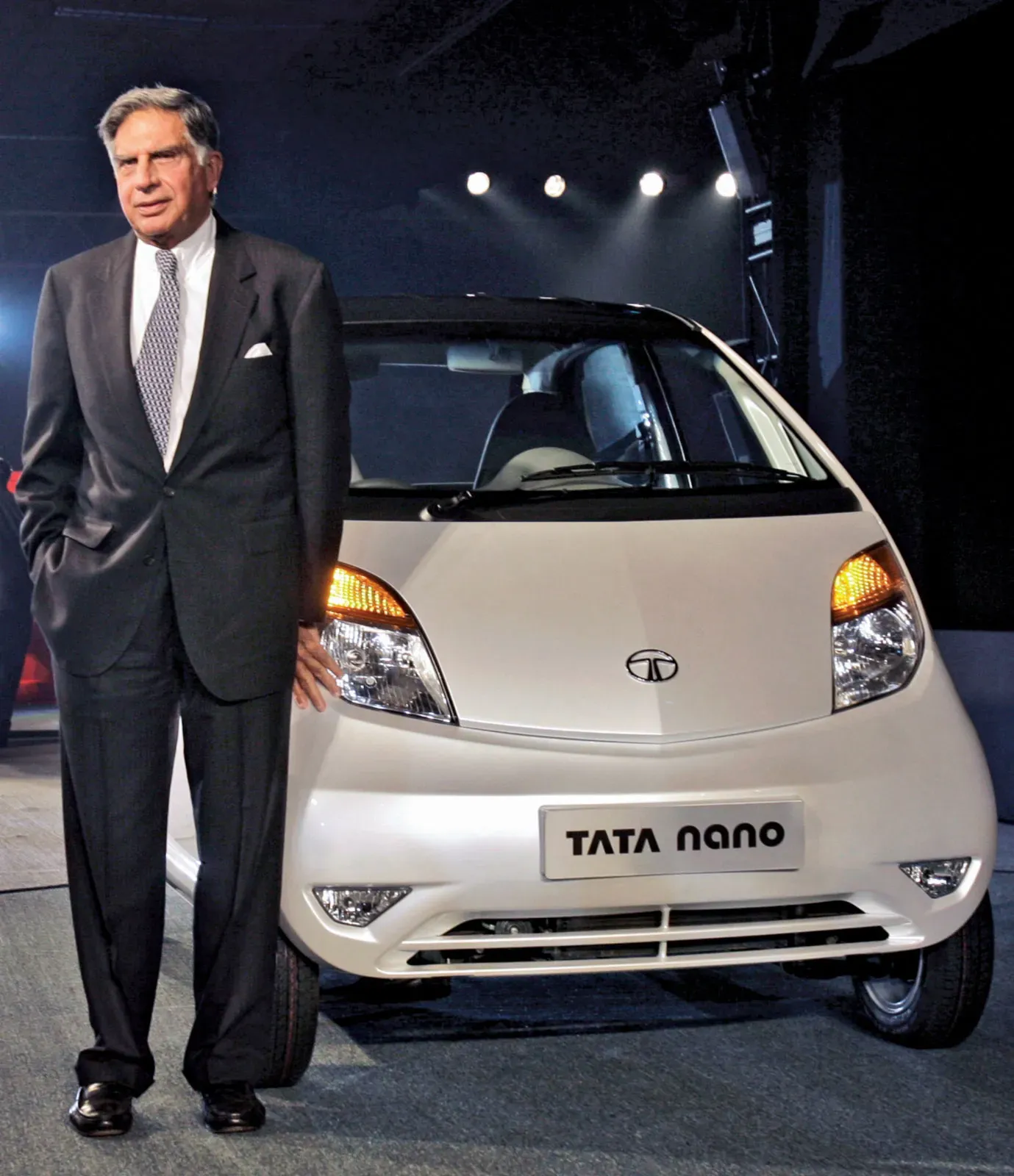
In 2008, Ratan Tata championed the development of the Tata Nano, marketed as the world’s most affordable car. This “People’s Car,” designed to seat five, was intended to provide safe, all-weather transportation for millions of middle and lower-income consumers. Launched in 2009, the Nano initially sold for around 100,000 rupees ($2,000), though this price point proved unsustainable. Despite initial sales challenges, production continued for a decade due to the company’s commitment.
The manufacturing of the Nano was preceded by a controversy over land acquisition in Singur, West Bengal, which led to protests by displaced farmers and opposition political parties. The production plant was eventually relocated to Sanand, Gujarat.
A Legacy of Philanthropy
Belonging to the Parsi community, followers of the Zoroastrian faith known for their public service, Ratan Tata was deeply committed to philanthropy. His philanthropic endeavors spanned education, medicine, and rural development, including the establishment and enhancement of hospitals and cancer research centers. He also focused on reducing social and economic inequality, exemplified by the Tata Group’s 2024 announcement of plans to build India’s first indigenous semiconductor manufacturing facility in Assam, a project envisioned by Tata to create over 25,000 local jobs.
Donations from the Tata Group and Tata Trusts have supported numerous institutions and scholarships at U.S. universities, including Tata Hall at the University of California, San Diego, and an executive center at Harvard Business School. An endowment to Cornell University provides financial aid for Indian students, and a donation from Tata Consultancy Services funded the Tata Consultancy Services Hall at Carnegie Mellon University. The Tata Center for Technology and Design at the Massachusetts Institute of Technology develops solutions for communities facing challenges related to limited electricity access, low income, and poor literacy. In recognition of the Tata family’s “constructive philanthropy,” they were awarded the Carnegie Medal of Philanthropy in 2007.
In October 2024, Ratan Tata’s younger brother, Noel Tata, succeeded him as chairman of the group’s philanthropic arm.
Air India Returns Home
In 2021, the Tata Group successfully bid to reacquire Air India, an airline originally founded by the conglomerate before its nationalization in 1953. This marked an emotional moment for Tata, who, though no longer interim chairman, released a statement expressing the opportunity to restore the airline’s former prestigious image. He noted that J.R.D. Tata would have been overjoyed.
A Love for Animals
Ratan Tata was a known animal lover, particularly of dogs, and a lifelong advocate for animal welfare. At the Tata Group’s headquarters, Bombay House, he ensured stray animals had access to a well-equipped kennel and could roam freely. His final project was a state-of-the-art animal hospital in Mumbai, offering 24/7 emergency care, inaugurated in mid-2024.
Awards and Global Recognition
Beyond national honors like the Padma Bhushan and Padma Vibhushan, and honorary degrees from educational institutions worldwide, Ratan Tata received numerous global recognitions. These awards often acknowledged his efforts in strengthening economic ties between India and various countries. Ratan Tata passed away on October 9, 2024, following a brief hospitalization for age-related ailments. His extensive contributions to business and society have cemented his legacy as one of India’s most influential and respected figures.
Would you like to explore the impact of other influential Indian business leaders?