
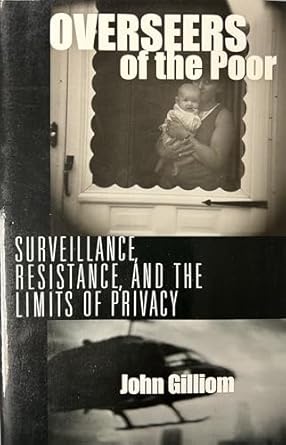
John Gilliom’s seminal work, Overseers of the Poor, delves into the intricate world of surveillance, shifting the focus from abstract privacy rights to the lived experiences of those under constant watch. The book challenges conventional discourse surrounding surveillance, arguing that it is often fraught with conceptual and political shortcomings. Instead of relying on the perspectives of critics and analysts, Gilliom amplifies the voices of the “watched,” particularly low-income mothers in Appalachian Ohio, to offer profound insights into the realities of modern surveillance systems.
These women navigate a complex welfare bureaucracy that employs an advanced surveillance apparatus, encompassing supercomputers, caseworkers, fraud control agents, and even their immediate community members, including grocers and neighbors. Their daily struggles to provide for their families are intricately linked to this pervasive monitoring and assessment.
Through in-depth interviews, Gilliom reveals that the primary concern for these mothers is not the abstract notion of privacy rights. Instead, they articulate a critique of surveillance that exposes the deeply personal and political conflicts inherent in their lives. While conventional politics may hold little appeal, the book vividly illustrates widespread patterns of everyday resistance. These women strategically subvert the surveillance regime when they perceive it as a hindrance to their ability to be effective parents, demonstrating a nuanced understanding of power dynamics. Ultimately, Overseers of the Poor compels a reconceptualization of the surveillance-privacy debate and extends to broader discussions of language, participation, and the politics of rights.
In an era where our lives are increasingly subject to surveillance, Gilliom posits that our efforts to understand and confront this new order should shift. He advocates for a move away from excessive focus on privacy rights, legislative measures, and legal battles, and towards a more critical examination of power, domination, and the persistent struggles faced by ordinary people. This perspective underscores the critical need to understand surveillance not just as a technological or legal issue, but as a fundamental aspect of social and political power that shapes everyday existence.