
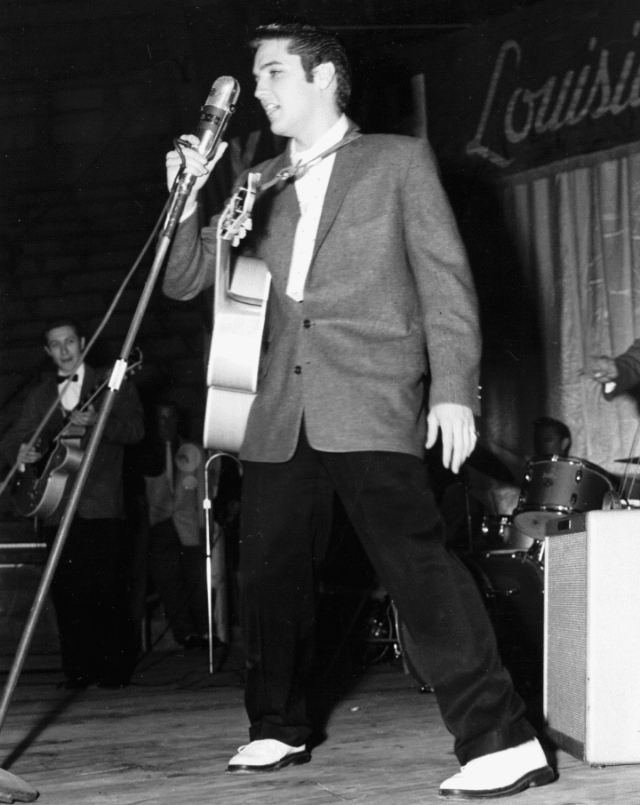
The debut of Elvis Presley on The Ed Sullivan Show was more than just a television appearance; it was a pivotal cultural moment that captivated an estimated 60 million viewers, representing 82% of the television audience at the time. This broadcast marked a turning point, introducing a sound and performance style that challenged the conservative norms of the Eisenhower era and resonated deeply with the youth of America, igniting a cultural revolution that would forever alter musical tastes and the entertainment landscape.
The Making of a King
Elvis’s musical journey began in the church, where his family’s attendance at The First Assembly of God instilled in him a love for gospel music. His mother gifted him a guitar on his eleventh birthday, and he began teaching himself to sing and play, inspired by southern gospel singers like Jake Hess and country artists such as Hank Snow and Roy Acuff. As he matured, his passion for music intensified, drawing him into the vibrant sounds of Memphis, Tennessee. By 1955, at the age of 20, Elvis had established himself as a burgeoning regional star across the southern United States. His performances were characterized by a dynamic blend of R&B, country, gospel, and rock ‘n’ roll, complemented by his energetic stage presence.
It was during this formative period that influential music promoter Colonel Tom Parker recognized Elvis’s immense potential and the electric audience reaction he generated. Parker orchestrated the acquisition of Elvis’s recording contract from Sun Records by RCA for an unprecedented $35,000. Elvis’s first single, “Heartbreak Hotel,” released on January 27, 1956, quickly ascended to the number one spot, followed by his gold-certified self-titled debut album.
National Exposure and Controversy
To further amplify his artist’s reach, Colonel Parker secured Elvis’s first national television appearance on The Dorsey Brothers Stage Show. A strategic glossy photo of Elvis, accompanied by a note from Parker to producer Jackie Gleason, helped seal the deal for a series of appearances, providing Elvis with his initial taste of national exposure.
Hollywood soon took notice, leading to a movie contract with Hal Wallis and Paramount Pictures. Parker then arranged for two appearances on The Milton Berle Show. The first, broadcast from the USS Hancock in San Diego on April 3, 1956, featured Elvis performing for hundreds of sailors. The second appearance, on June 5, 1956, saw Elvis’s electrifying rendition of “Hound Dog” ignite the enthusiasm of teenage fans, but it also sparked outrage among some adults and the press due to his provocative “bumps and grinds.” This controversy, fueled by his gyrating hips, only intensified public interest.
Initially hesitant due to anticipated criticism, Ed Sullivan had declined the opportunity to book Elvis on his show. However, after Steve Allen’s The Steve Allen Show sensationally outperformed The Ed Sullivan Show in the ratings with Elvis performing a humorously toned-down version of “Hound Dog” while dressed in a tuxedo, Sullivan recognized the ratings imperative.
The Historic Ed Sullivan Appearance
A telegram from Ed Sullivan to Steve Allen, playfully dubbed “Steven Presley Allen,” signaled Sullivan’s capitulation. An agreement was struck for Elvis to appear three times on The Ed Sullivan Show for a then-staggering $50,000, a record sum for a television performer.
Tragically, just a month before Elvis’s scheduled debut, Ed Sullivan was hospitalized due to a near-fatal automobile accident. Consequently, British actor Charles Laughton stepped in to host the September 9, 1956 broadcast from Sullivan’s New York studio. Laughton introduced Elvis to a global audience before the performance transitioned to Hollywood, where Elvis delivered powerful renditions of “Don’t Be Cruel” and “Love Me Tender,” the latter being the theme song for his first feature film.
Elvis also performed Little Richard’s hit “Ready Teddy,” expressing his gratitude to Mr. Sullivan for the opportunity and wishing him a swift recovery. He then segued into “Hound Dog,” punctuating the performance with his signature snarling and gyrating, reigniting the controversy. Contrary to popular belief, the cameras provided a full view of Elvis during this performance.
By Elvis’s next appearance on October 28, 1956, Ed Sullivan had recovered and resumed hosting duties. Following a performance by The Little Gaelic Singers, Elvis took the stage again with “Don’t Be Cruel” and “Love Me Tender.” During a subsequent performance of “Love Me,” a close-up captured Elvis’s iconic smile and lip snarl, sending the studio audience into a frenzy. The show concluded with another rendition of “Hound Dog,” again showing Elvis in full view.
Lasting Impact and Legacy
Despite immense ratings, Elvis’s performances continued to provoke strong reactions, including effigy burnings in Nashville and St. Louis, and critical press coverage. Rock and roll faced increasing opposition, labeled a negative influence on American youth. However, this pushback paradoxically strengthened Elvis’s support among teenagers.
Elvis’s third and final appearance on The Ed Sullivan Show occurred on January 6, 1957. Due to the ongoing controversy surrounding his provocative stage movements, CBS censors mandated that he be filmed from the waist up. He performed a medley of hits, including “Hound Dog,” “Love Me Tender,” “Heartbreak Hotel,” and gospel favorite “Peace in the Valley.” At the conclusion of the show, Ed Sullivan publicly praised Elvis, stating he had “never had a pleasanter experience on our show with a big name.”
The History Channel recognized the September 9, 1956, broadcast as one of “10 Days That Unexpectedly Changed America.” Elvis Presley’s appearances on The Ed Sullivan Show were instrumental in his ascent to worldwide fame, solidifying his status as a cultural icon and a global legend. He remains the best-selling solo artist in popular music history, a testament to his enduring impact.
Discover more about Elvis Presley’s career by exploring his Elvis Presley birth chart. You can also delve deeper into his discography with details on how many albums did Elvis Presley have. For a closer look at his life during a significant year, check out Elvis Presley in 1973. Understand the scale of his success by learning about how many records did Elvis Presley sell.
Explore full performances from The Ed Sullivan Show and more by checking out our Elvis Presley playlist.