
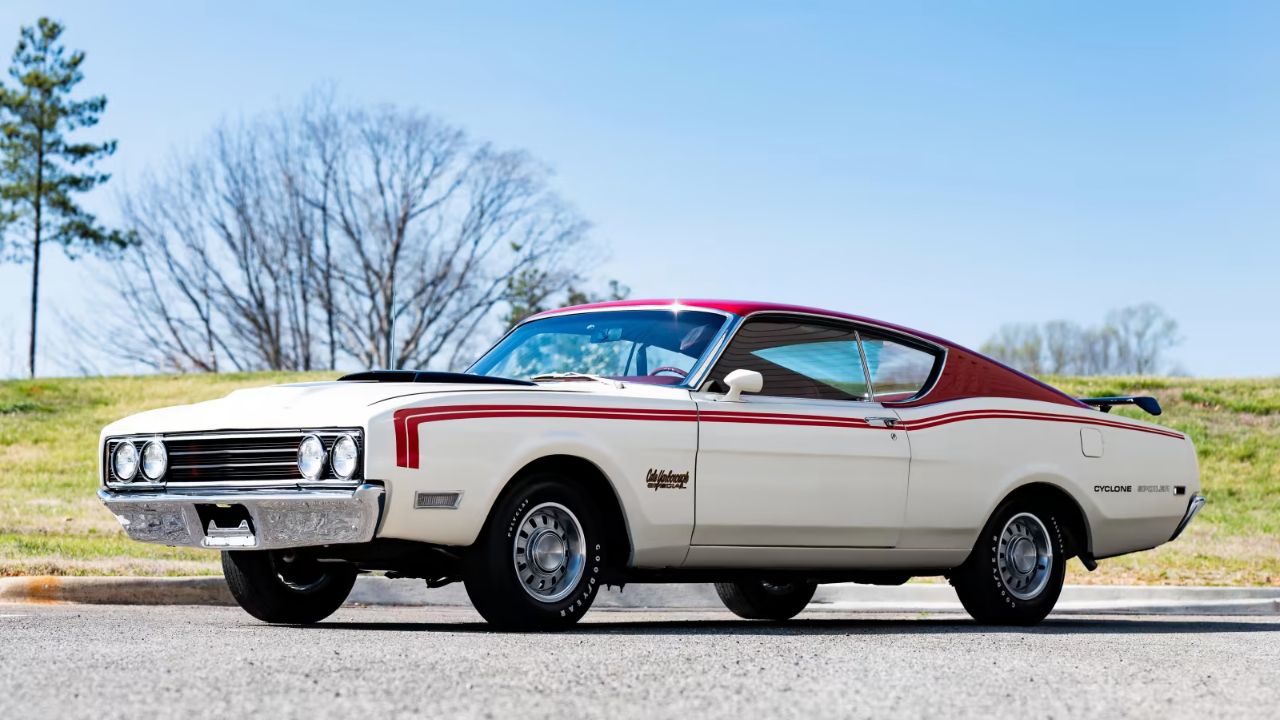
The 1969 Mercury Cyclone Spoiler II emerged as a unique contender in the fierce “aero wars” of NASCAR’s 1969-70 racing season. Born from the intense competition between Ford and Chrysler, this muscle car was designed with a singular purpose: to qualify a production-friendly, wind-cheating shape for high-speed stock-car racing. This pursuit of aerodynamic dominance resulted in a lineage of specialized vehicles, including the iconic 1969 Dodge Charger 500 and Daytona, the 1970 Plymouth Superbird, the 1969 Ford Talladega, and this particular aerodynamic warrior, the Cyclone Spoiler II.
The Cyclone Spoiler II represented Mercury’s strategic entry into the aero-car segment, essentially a streamlined iteration of its fastback Cyclone intermediate model. Its concept mirrored that of the 1969 Ford Torino Talladega, featuring an extended, tapered nose and a flush-mounted grille meticulously engineered for optimal aerodynamics on superspeedways. While the NASCAR Cyclone Spoiler race cars held a slight speed advantage over their Talladega counterparts on the track due to their subtly longer bodies and aerodynamic nuances, the street versions presented a different story.
Production versions of the Cyclone Spoiler II were equipped with a 290-horsepower 351-cid V-8 engine paired with an FMX three-speed automatic transmission. This contrasted with the Talladegas, which boasted a more potent 428 Cobra Jet engine with a C6 three-speed automatic. Despite the less potent powertrain for street models, the Mercury offered a distinctive visual appeal. Cyclone Spoilers were available in two special paint schemes, named after Mercury’s celebrated NASCAR drivers. The Dan Gurney Specials featured Presidential Blue over Wimbledon White with blue vinyl interiors, while the Cale Yarborough Specials were distinguished by Candyapple Red roofs and matching red vinyl interiors.
Homologation and Unique Construction
To meet NASCAR’s stringent homologation rules, Mercury was obligated to produce the Cyclone Spoiler II for public sale. While exact production figures are difficult to ascertain, the total run is estimated to be between 300 and 500 units, making it a rare find for collectors. The transformation from a standard Cyclone to the Spoiler II was a labor-intensive process. This involved welding separately stamped extensions to stock Montego/Cyclone front fenders and adapting a Ford Fairlane rear bumper, carefully cut and rewelded into a subtle V-shape, for the front fascia.
Furthermore, the rocker panels underwent a modification known as “re-rolling,” which raised them by one inch. This alteration allowed the race cars to be lowered for improved aerodynamics without violating NASCAR’s ride height regulations. Despite the significant engineering and cosmetic modifications, Mercury introduced these specialized vehicles with minimal fanfare. Adding to the confusion, Mercury also produced standard-nose models adorned with the same Gurney and Yarborough graphics, which were also marketed as Cyclone Spoilers. The distinctively designed “droop-snoot” models were specifically designated as Cyclone Spoiler IIs.
The “Win on Sunday, Sell on Monday” Philosophy
In retrospect, it’s quite remarkable that both Ford and Chrysler invested considerable resources into developing specialized, limited-production vehicles that often functioned as loss leaders on the showroom floor. The underlying rationale for these strategies can be encapsulated by a frequently repeated adage, one that held even greater truth in the 1960s than it does today: “Win on Sunday, sell on Monday.” This mantra underscored the belief that success in high-profile racing events directly translated to increased consumer interest and sales of production vehicles. The 1969 Mercury Cyclone Spoiler II stands as a testament to this era of performance-driven marketing, a rare piece of automotive history built for both the thrill of the race and the admiration of enthusiasts.
Share your thoughts on this unique muscle car in the comments below!
References
- Publications International, Ltd. (2007). 1969 Mercury Cyclone Spoiler II. HowStuffWorks. Retrieved from https://auto.howstuffworks.com/car-shows-and-events/car-week/muscle-car17.htm