
Few recordings in the golden era of American roots music capture the raw energy and soulful authenticity of a live performance quite like Man in Black: Live in Denmark 1971. This landmark concert album brings together Johnny Cash and an extraordinary ensemble of classic American artists, offering international listeners a rare window into the world of pre-1975 oldies music at its most electrifying. From the haunting twang of country ballads to the fiery pulse of rockabilly, this live set stands as one of the most compelling documents of America’s musical heritage ever committed to record.
Johnny Cash: The Man Behind the Legend
Johnny Cash — widely known as “The Man in Black” — was one of the most iconic singer-songwriters in American music history. His deep, resonant baritone voice and plainspoken storytelling spoke to working-class Americans with an honesty that transcended genre boundaries. Cash moved fluidly between country, rockabilly, folk, and gospel, earning devoted audiences not only across the United States but throughout Europe and beyond.
By the time this Danish concert was recorded in 1971, Cash had already cemented his legacy with timeless recordings such as “I Walk the Line” and “Folsom Prison Blues” — songs that remain cornerstones of American roots music to this day. His stage presence was commanding yet deeply human, and Live in Denmark preserves that presence with remarkable clarity.
A Concert Steeped in American Roots Music
The tracklist of Man in Black: Live in Denmark 1971 reads like a definitive survey of pre-1975 American music. The nineteen-track set opens with “A Boy Named Sue”, a witty narrative song that showcases Cash’s gift for storytelling, and moves through a rich repertoire spanning country, rockabilly, and sacred music.
Backed by his legendary rhythm section the Tennessee Three, Cash delivers performances that are both tight and deeply felt. The Tennessee Three’s stripped-down, percussive sound — often described as the “boom-chicka-boom” train beat — gave Cash’s music its unmistakable forward momentum, and their work on this recording is exemplary.
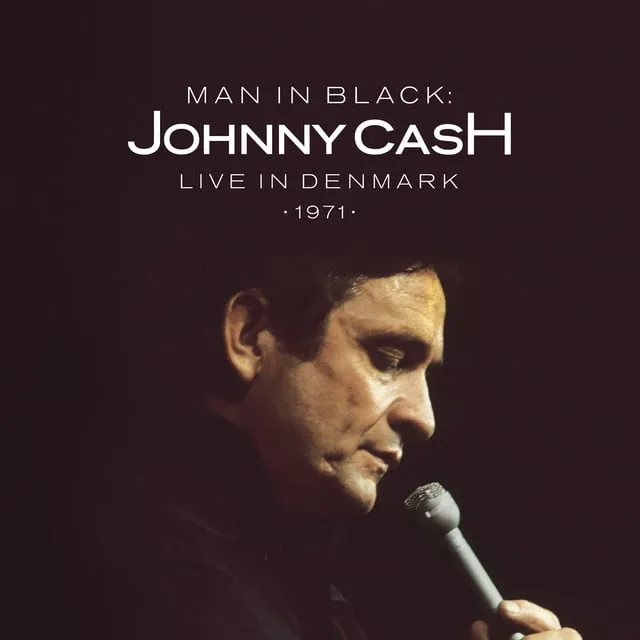
Among the standout moments is “Folsom Prison Blues”, one of Cash’s most celebrated compositions, inspired by the 1951 film Inside the Walls of Folsom Prison. The song’s gritty realism and moral ambiguity placed Cash apart from the polished Nashville mainstream, making him a singular voice in oldies music history. “Sunday Mornin’ Comin’ Down”, penned by Kris Kristofferson, is another highlight — a meditation on loneliness and longing that resonates as powerfully today as it did in 1971.
The Carter Family: America’s First Family of Country Music
One of the most treasured aspects of this concert is the prominent role of the Carter Family, one of the founding dynasties of American country music. June Carter Cash, who had married Johnny in 1968, appears in three duets with her husband, most memorably on “If I Were a Carpenter” — a tender exchange that reveals the deep personal bond between the two performers.
June’s mother, the legendary Maybelle Carter, is also present on stage. Maybelle was a pioneering guitarist whose revolutionary “Carter scratch” picking style helped define the sound of early country music in the 1920s and 1930s. Her daughters Anita and Helen Carter round out the family ensemble, adding rich harmonies that root the performance in a living tradition of American folk and country song.
The Carter Family’s participation transforms this concert into more than just a Johnny Cash show — it becomes a multi-generational gathering of American musical royalty, a living testament to the enduring power of oldies and roots music.
Carl Perkins and the Rockabilly Spirit
No celebration of pre-1975 American music would be complete without a nod to rockabilly — the explosive fusion of country music and rhythm and blues that helped ignite the rock and roll revolution of the 1950s. Live in Denmark features Carl Perkins, the Tennessee-born guitarist and songwriter whose “Blue Suede Shoes” became one of the defining anthems of the entire era.
Perkins joins the ensemble for “Children Go Where I Send Thee”, a traditional spiritual arranged in the rollicking style that made him famous. His appearance on this recording is a reminder that the roots of rock and roll ran deep through the same Southern American soil that nurtured Cash, the Carters, and the country music tradition at large. For listeners exploring the origins of oldies music, Perkins represents an essential bridge between generations.
The Statler Brothers: Harmony, Humor, and Heart
Completing this remarkable cast of American music legends are the Statler Brothers, a vocal quartet celebrated for their four-part harmonies, their dry wit, and their ability to blend sacred and secular American song. On Live in Denmark, they join Cash and the Carter Family for “No Need To Worry” and “Rock of Ages” — gospel numbers that bring a communal, almost revivalist energy to the concert’s final section.
The Statler Brothers’ presence underscores an important truth about golden-era American music: at its core, it was music made for and by communities — families, congregations, neighbors — and it carried within it the full emotional range of American life, from heartbreak and hardship to faith and celebration.
Why Live in Denmark 1971 Still Matters
Decades after its original release on September 14, 1971, Man in Black: Live in Denmark endures as a masterclass in what made pre-1975 oldies music so deeply human. In an age of elaborate production and digital precision, this recording reminds us of the irreplaceable value of artists performing together in real time, responding to each other and to a live audience with immediacy and passion.
The Copenhagen crowd’s enthusiastic reception — evident throughout the recording — also speaks to the universal appeal of American roots music. These songs about loss, faith, freedom, and resilience crossed language barriers effortlessly because they spoke to experiences shared by people everywhere.
For anyone seeking to understand the golden age of American music — the era of Cash, Perkins, the Carters, and the Statler Brothers — Live in Denmark 1971 is not merely a historical document. It is a living, breathing performance that invites you in and refuses to let go.
Conclusion
Man in Black: Live in Denmark 1971 is a landmark in the canon of pre-1975 oldies music — a concert recording that gathers some of the most important figures in American musical history onto a single stage and captures them at the height of their powers. From Johnny Cash’s commanding baritone to Maybelle Carter’s pioneering guitar work, from Carl Perkins’ rockabilly fire to the Statler Brothers’ rich harmonies, every element of this performance speaks to the depth and diversity of America’s roots music tradition.
The album is a reminder that the greatest oldies music was never merely entertainment — it was storytelling, community, and an act of shared humanity. If you are new to the world of classic American music, or if you are a longtime devotee looking to deepen your appreciation, there is no better place to start than here. Explore the timeless melodies and unforgettable voices of this extraordinary recording — and let the music of America’s golden era speak to you across the years.