
Laurie Anderson is an American performance artist, composer, and writer whose career spans experimental music, multimedia art, and public storytelling. In the source material, her work is framed by major recent honors and projects, including the 2026 Kyoto Prize, the 2025 About Time conversations, and new music centered on Amelia Earhart. en.wikipedia
Early Life and Education
Laurie Anderson was born on June 5, 1947, in Wayne, Illinois, and began studying classical violin at the age of five. She later performed with the Chicago Youth Symphony before moving to New York City in 1966. britannica
She attended Barnard College, earning a B.A. in 1969, and Columbia University, where she received an M.F.A. in 1972. After that, she taught art history at the City University of New York for two years. britannica
Performance Art Beginnings
Anderson’s early performance art focused on inventive, often surprising forms that mixed sound, image, and concept. One of her first major works, Automotive (1972), used car horns at the Town Green in Rochester, Vermont. britannica
Another early piece, Duets on Ice, featured Anderson wearing ice skates frozen into blocks of ice while she played a duet with herself on an altered violin. The performance ended when the ice melted, turning time itself into part of the work. britannica
Breakthrough In Music
To support her art, Anderson worked as a freelance interviewer and art critic for ARTnews and Artforum. By 1974, she had received grants that gave her more freedom to expand her artistic practice. britannica
Her growing use of rock rhythms led to recordings that brought her wider attention. The eight-minute single “O Superman” reached No. 2 on the English pop charts in 1981, helping establish her as a major figure in experimental music. britannica
Multimedia Works
Anderson’s landmark project United States I–IV brought together music, photography, film, drawings, animation, and text in a massive four-part structure. First performed at the Brooklyn Academy of Music in 1983, it lasted more than six hours and used more than 1,200 photos, cartoons, and films. britannica
She later reused material from that project in Home of the Brave (1986), which she wrote, directed, and performed in herself. Other notable recordings from this period include Strange Angels (1989), Bright Red (1994), and The Ugly One with the Jewels and Other Stories (1995). britannica

Later Career and Projects
In 1994, Anderson’s retrospective Stories from the Nerve Bible: A Retrospective, 1972–92 was published. The following year, she launched The Nerve Bible, a multimedia tour combining reading, music, comedy, illusion, dance, film, songs, and even a simulated tornado. britannica
She also created the interactive CD-ROM Puppet Motel with designer Hsin-Chien Huang in 1995. Later projects included Songs and Stories from Moby Dick in 1999 and The End of the Moon, which grew out of her work as NASA’s artist in residence from 2002 to 2004. britannica
Recent Work and Honors
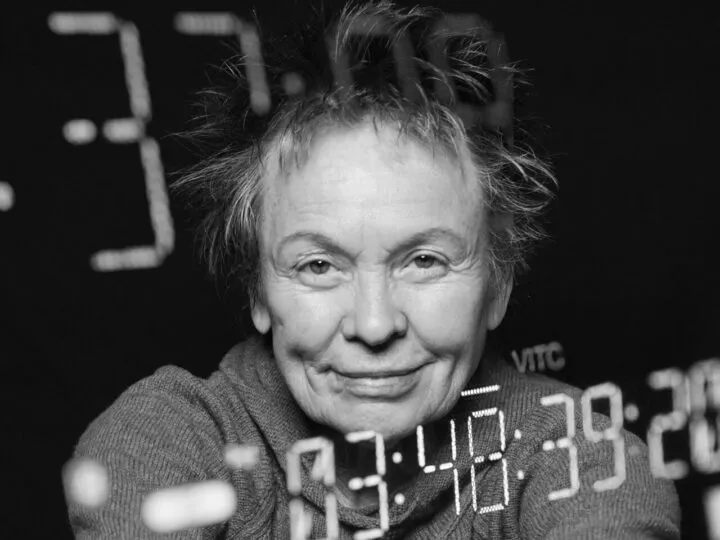
The source material shows Anderson continuing to create in the 2020s with new projects and honors. In 2024, she was recognized with a Grammy Lifetime Achievement Award, and in 2025 she appeared in the Rubin Museum’s About Time series, which explored how different traditions think about time. en.wikipedia
Her 2024 project Amelia focused on Amelia Earhart’s final flight and featured Anderson’s music and lyrics across twenty-two tracks. The source also highlights ARK: United States V, a work that connects her long-standing concerns about systems, climate collapse, and uncertainty in the modern world. de.wikipedia
Legacy
Laurie Anderson’s career has consistently joined performance art, experimental sound, literature, and visual media into a single artistic language. Her work has remained influential because it turns abstract ideas such as memory, technology, and time into vivid public experiences. en.wikipedia
From early avant-garde performances to recent honors like the Kyoto Prize, Anderson’s biography reflects a rare blend of innovation and longevity. Her body of work shows how a single artist can shape multiple fields at once and still keep evolving. britannica
References
Anderson, L. (2026, June 19). Kyoto Prize 2026. Laurie Anderson.
Anderson, L. (2025, April 3). Laurie Anderson: About Time. Laurie Anderson. en.wikipedia
Encyclopaedia Britannica. (2025, May 31). Laurie Anderson. britannica
Anderson, L. (2024, June 26). Amelia. Laurie Anderson. de.wikipedia
Anderson, L. (2024, July 15). ARK: United States V. Laurie Anderson. pl.wikipedia