
If your engineering team is racing to ship AI agents this year, you’ve probably run into a wall: every agent, every model, and every API call adds a new layer of complexity to secure, monitor, and pay for. This is exactly the problem an AI gateway is designed to solve. As companies move from a world built around API calls to one built around tokens and autonomous agents, having a unified way to manage that traffic isn’t a nice-to-have anymore — it’s becoming the backbone of how modern software gets built, deployed, and monetized.
From an API Economy to a Token Economy
For more than a decade, the API call was the fundamental unit of digital business. Enterprises invested heavily in becoming API-first, building out gateways, endpoints, and rate-limiting infrastructure to support that model. Concepts like dynamic caching and payload management became standard practice for any team serious about scaling cloud-native applications.
That foundation hasn’t disappeared, but it’s no longer the whole picture. Tokens are now the dominant currency of digital infrastructure. Agents, large language models, and context windows have replaced simple request-response patterns with something far more dynamic — and far more expensive to get wrong. Instead of managing endpoints, teams now need to manage token budgets, semantic caching, and the behavior of autonomous agents operating across multiple systems. An AI gateway sits at the center of this shift, giving organizations one place to build, run, and govern agents rather than bolting AI capabilities onto infrastructure that was never designed for them.
The Cost of Fragmentation
The core challenge most organizations face isn’t a lack of AI ambition — it’s fragmentation. When agents, APIs, and event streams are each managed by separate tools with separate security models, teams end up with inconsistent access controls, duplicated infrastructure, and no unified view of cost or risk. That fragmentation is often what turns a promising AI pilot into a stalled project.
Consolidating API and AI traffic under one platform addresses this directly. Instead of stitching together point solutions, teams gain a single, coherent way to enforce security policies, monitor usage, and control spend across every LLM, MCP server, event stream, and API request flowing through their systems. The result is infrastructure that can ship fast, ship safely, and ship in a way that’s financially sustainable — three goals that are difficult to achieve independently but become far more attainable when unified.
What a Unified API and AI Platform Actually Does
A modern platform built for this shift generally needs to cover five interconnected areas.
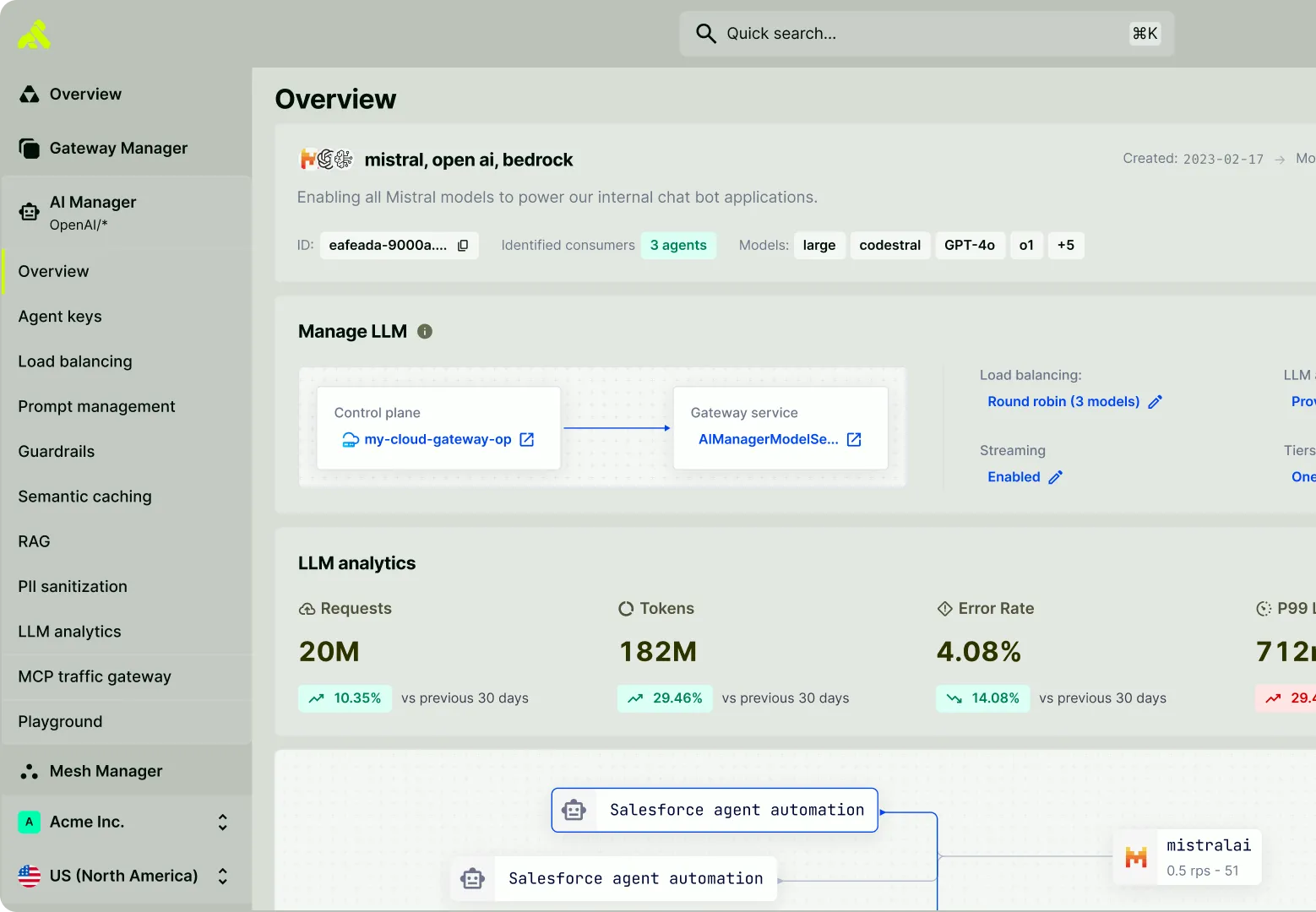
Agentic AI management focuses on building and testing agents quickly, using pre-built policies to connect them with enterprise context and intelligence while keeping token consumption and resilience risks under control.
API management covers the full lifecycle of traditional APIs — design, testing, publishing, and monetization — while enforcing consistent access control and threat protection across every API in the organization, not just the newest ones.
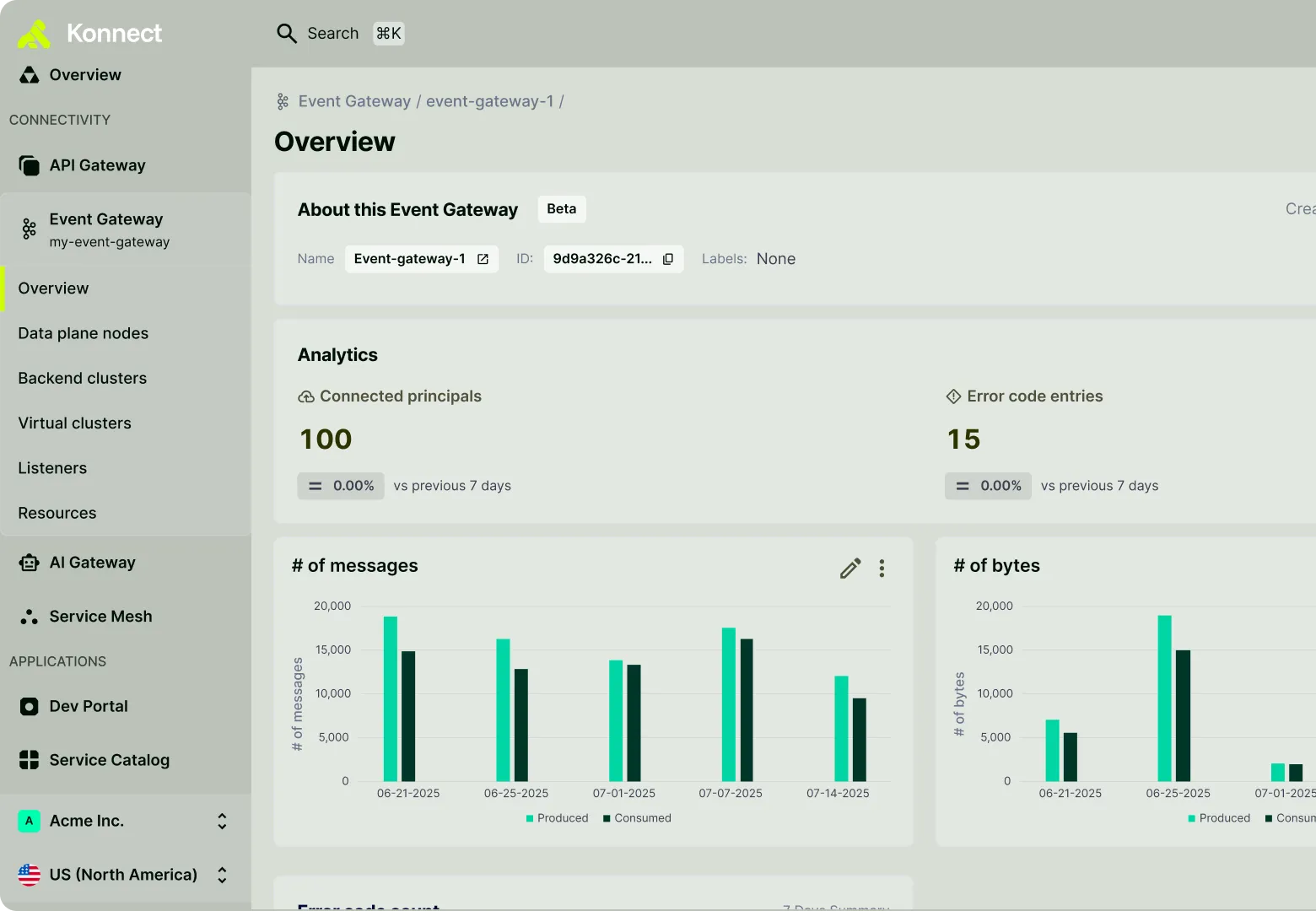
Event management standardizes how agents and applications tap into real-time data streams, cutting down on redundant broker infrastructure while offloading authentication, encryption, and failover to the gateway layer itself. This matters increasingly as agents need live, current information rather than static datasets to make decisions.
API and AI monetization lets teams govern the cost of intelligence itself — setting entitlements, enforcing usage limits at runtime, and adjusting pricing quickly as consumption patterns evolve. As token costs become a meaningful line item for many businesses, the ability to launch pricing changes in minutes rather than weeks becomes a genuine competitive advantage.
Developer productivity rounds out the picture by giving both human developers and AI agents self-serve access to discover APIs and MCP tools, publish monetized products through a developer portal, and test for quality and security risks before anything reaches production.
Real Results from Enterprise Teams
Organizations that have consolidated their API and AI infrastructure report meaningful, measurable gains. Teams working with a unified gateway platform have described a need to move fast while staying compliant and secure, with the platform allowing them to scale innovation responsibly. Others point to operational resilience programs that became models for vendor management across entire organizations, alongside development cycles that sped up by as much as 50%. One fintech infrastructure provider reported cutting development costs by roughly 60% after adopting a unified approach, while a ticketing platform now processes billions of requests each month through the same infrastructure.
These aren’t isolated wins — they reflect a broader pattern. When security, governance, and cost control are handled consistently across every API and every agent, teams spend less time firefighting fragmented systems and more time building the products their users actually want.
Bringing It All Together
The shift from an API-first world to an agent-first one isn’t optional for companies that want to stay competitive — it’s already underway. What separates teams that ship successful AI products from those stuck in endless pilots often comes down to infrastructure: whether agents, APIs, and event streams are managed as one coherent system or as a patchwork of disconnected tools.
An AI gateway won’t replace the engineering work of building good agents, but it removes a huge amount of friction around security, cost control, and governance — the parts of the job that don’t show up in a demo but absolutely determine whether an AI initiative survives contact with production traffic. If your team is evaluating how to move from experimentation to a reliable, profitable agentic AI strategy, it’s worth taking a closer look at how a unified platform approach could simplify that path forward.