
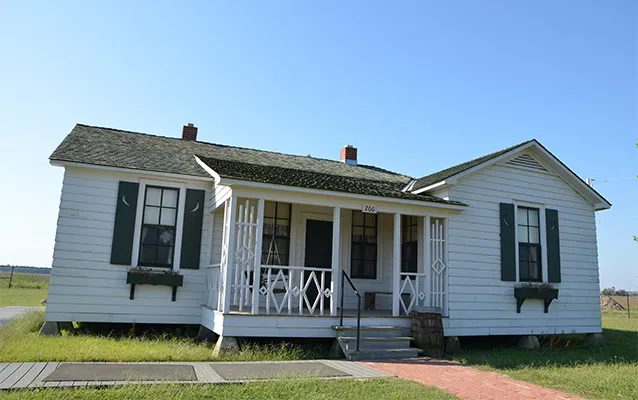
Few places in American music history carry as much quiet power as a modest five-room farmhouse in Dyess, Arkansas. Known officially as Farm No. 266, the Johnny Cash Boyhood Home stands as a testament to hardship, resilience, and the raw rural roots that shaped one of country music’s most iconic voices. For fans of oldies music and American roots music history, this site offers a rare and deeply moving window into the forces that forged a legend.
A New Deal Home with a Historic Legacy
Farm No. 266 was built during the Great Depression as part of the Dyess Resettlement Colony, a federal initiative in Mississippi County, Arkansas. Constructed by the Federal Emergency Relief Administration (FERA), the house was one of many modest homes erected to help struggling farming families rebuild their lives during one of America’s darkest economic periods.
It was here that Ray and Carrie Cash brought their family to start over — and it was here that a young J.R. Cash, who would later become the legendary Johnny Cash, spent his formative years. The flat Delta landscape, the cotton fields, the collective struggle of a relief colony — all of it seeped into the boy who would one day sing about suffering, faith, and redemption with unmatched authenticity.
The Making of an American Music Legend
Johnny Cash’s childhood in Dyess was anything but easy. The family worked the land through poverty, loss, and the lingering hardships of the Depression. Yet it was precisely this environment — the gospel hymns sung at home, the field hollers drifting across the Delta, the storytelling culture of rural Arkansas — that planted the seeds of his extraordinary career.
Cash would go on to become one of the most decorated artists in the history of American country music and classic oldies. His accolades span an almost unbelievable range of institutions: the Country Music Hall of Fame, the Rock and Roll Hall of Fame, the Gospel Music Hall of Fame, the Memphis Music Hall of Fame, the Nashville Songwriters Hall of Fame, and the Rockabilly Hall of Fame. He was also a recipient of the National Medal of Arts and was honored at the Kennedy Center Honors — a constellation of recognition that few artists in any genre have ever matched.
His music — gravelly, honest, and deeply human — drew directly from his years in Dyess. Songs rooted in working-class struggle, spiritual yearning, and moral complexity reflected a childhood shaped by the same New Deal landscape that still surrounds this small white farmhouse today.
A Museum That Tells Three Stories at Once
Today, Farm No. 266 has been carefully restored and operates as a house museum managed by Arkansas State University Heritage Sites. Visitors who make the journey to 110 Center Drive in Dyess, Arkansas, will find a space that tells not one but three interconnected stories.
The first is the story of the Great Depression and the New Deal, a pivotal chapter in American history when the federal government intervened on an unprecedented scale to rescue rural communities from economic collapse. The Dyess Colony was one such intervention — a planned agricultural community designed to give displaced farming families a fresh start.
The second is the story of the Dyess Colony itself — its community planning, its architecture, its political and social significance as an experiment in government-assisted resettlement. The colony’s original layout and the surviving structures, including Farm No. 266, are listed in the National Register of Historic Places (Reference No. 100002000), recognizing their architectural and historical importance.
The third — and perhaps most universally compelling — is the story of Johnny Cash’s early life and the profound influence this landscape had on his music. Guided tours and exhibits bring to life the domestic details of Cash family life: the rooms where he slept, the fields he worked, the community where he first heard music that would transform him.
Why This Site Matters for Roots Music and Oldies Fans
For those who love pre-1975 American music — the golden era of country, rockabilly, gospel, and folk — the Johnny Cash Boyhood Home is more than a historic site. It is a pilgrimage destination. Understanding where Cash came from deepens the experience of listening to classics like Folsom Prison Blues, Ring of Fire, or Man in Black. The poverty, the faith, the Delta soil — they are all present in every note he ever recorded.
Cash’s place in the golden era of American music is unassailable. He bridged the gap between country and rock and roll at a time when those lines were just being drawn, and he remained relevant and revered across six decades of musical change. His boyhood home in Dyess is where that journey began — in a FERA-built farmhouse on a Depression-era colony, miles from anywhere, full of everything.
Visiting Farm No. 266
The Johnny Cash Boyhood Home is located at 110 Center Drive, Dyess, Arkansas 72330, approximately one mile northwest of the Dyess Colony center. The site is managed by Arkansas State University Heritage Sites, and visitors are encouraged to check current hours and tour availability through the official site at dyesscash.astate.edu.
The surrounding landscape remains largely rural and agricultural — much as it would have appeared during Cash’s childhood — making the visit a genuinely immersive experience in American roots history.
Conclusion: A Small House, an Enormous Legacy
The five-room farmhouse at Farm No. 266 is, by any objective measure, a humble structure. But its historical and cultural significance is immeasurable. It is the birthplace of a musical philosophy — one built on truth-telling, empathy for the marginalized, and the belief that even the hardest life contains beauty worth singing about.
For lovers of classic American music, American history, or simply great storytelling, the Johnny Cash Boyhood Home in Dyess, Arkansas, is an essential destination. It reminds us that the greatest art often grows from the most difficult ground — and that the songs we cherish most were shaped long before they were ever recorded.
Explore the roots of one of America’s most beloved voices, and let the quiet fields of Dyess speak to you the way they spoke to a young boy named J.R. Cash — the man who would become a legend.
References
- National Register of Historic Places, Reference No. 100002000 — Farm No. 266, Dyess, Arkansas.
- Arkansas State University Heritage Sites. Johnny Cash Boyhood Home. Retrieved from http://dyesscash.astate.edu/
- Photograph by Callie Williams, courtesy of Arkansas State Historic Preservation Office.