
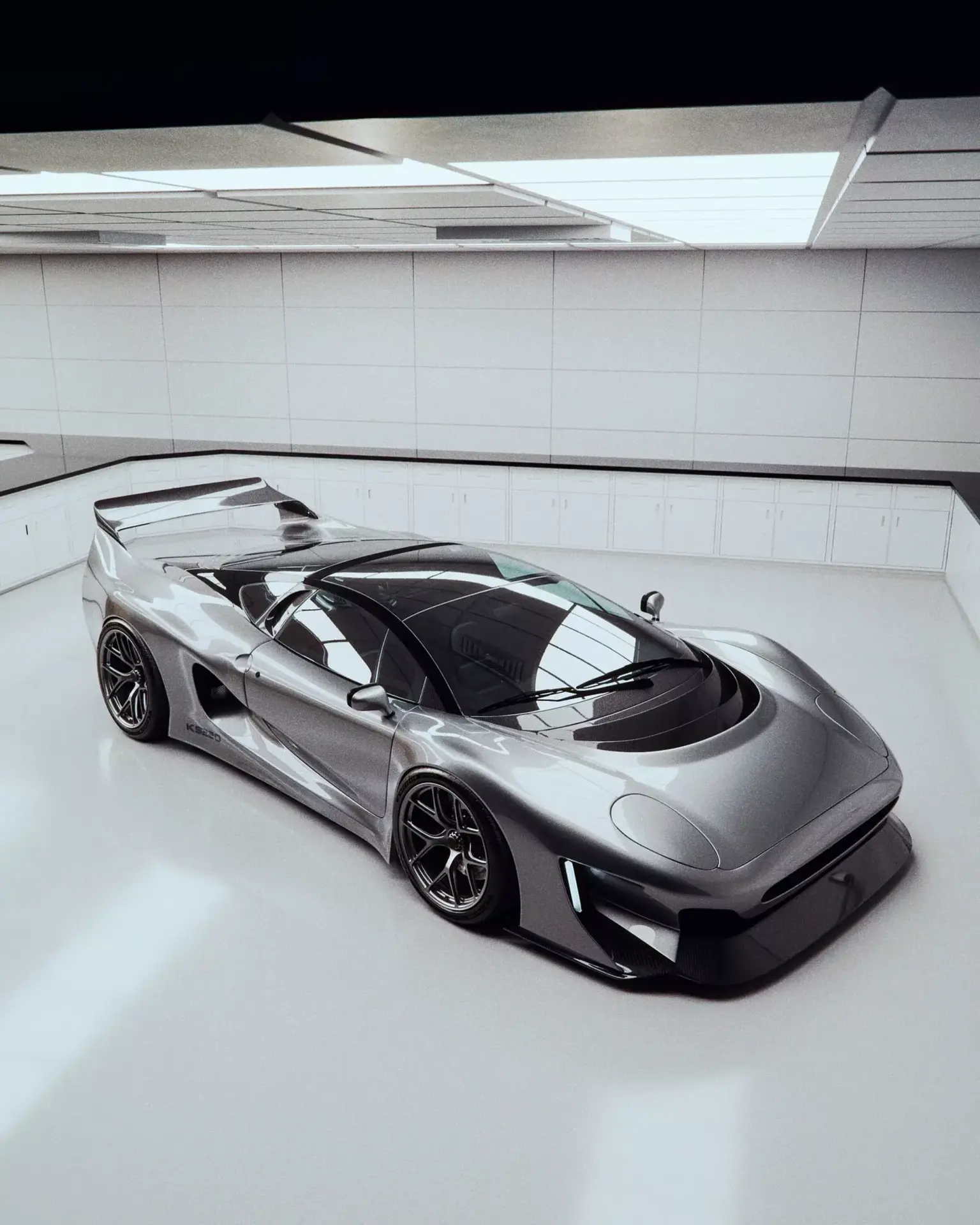
When the Jaguar XJ220 first appeared at the 1988 British International Motor Show, it was unlike anything the automotive world had seen. Its futuristic, missile-like design and ambitious specifications—a 6.2-liter V12 engine, four-wheel drive—ignited the public’s imagination. Within an hour, an astonishing 1,500 pre-orders were placed, with deposits secured by enthusiasts like Elton John and Rod Stewart. However, the path from concept to production was not without its challenges.
The initial fervor tempered as a global economic recession loomed, leading many prospective owners to reconsider their commitments. A significant factor contributing to this shift was a notable change in the production model’s specifications. By the time the XJ220 entered production, it had undergone substantial revisions: the V12 engine was replaced with a V6, its displacement was reduced, and it transitioned to rear-wheel drive. Despite these re-evaluations by JaguarSport engineers, the XJ220’s performance remained exceptional. It achieved a 0-60 mph time of under four seconds and a top speed of 213 mph, making it the fastest production car in the world until the arrival of the McLaren F1.
The racing pedigree of the XJ220 soon became apparent. Private owners began successfully campaigning the supercar, and TWR (Tom Walkinshaw Racing) set its sights on a return to Le Mans. By May 1993, TWR unveiled the XJ220 C, a competition variant, at the iconic La Sarthe circuit. This highly modified machine featured a fully detachable carbon composite nose, tail, and body panels, a stripped-out interior with a Kevlar racing seat, and an up-rated V6 engine. Although one of these endurance racers achieved a class victory at Le Mans, it was later disqualified on a technicality.
In addition to the three endurance racers, TWR produced five road-going examples built to homologation requirements, known as the XJ220 S. Unveiled at the 1993 Autosport Racing Car Show, these models were finished in striking colors. Chassis 220779, presented here in “Outrageous Orange,” is one of these rare examples. Like its racing counterparts, this XJ220 S had its aluminum bodywork—save for the door skins—replaced with carbon fiber composite panels. Modifications extended to the chassis tub, featuring wider sills, and an aerodynamic package that included a front splitter and an adjustable rear spoiler. These enhancements not only provided greater downforce but also significantly reduced the car’s kerb weight to just under 1,080 kilograms. The 3,498 cc V6 engine was further tuned to produce a remarkable 680 horsepower, an increase of over 138 horsepower compared to the standard road car.
Completed on April 21, 1993, chassis 220779 is believed to have remained with TWR until its sale to a Belgian collector in February 1998. The car was subsequently exported to the United States in November 1999. It changed hands multiple times before finding a new owner in 2007, remaining in California until 2012. It was then acquired by renowned collector Jasbir Dhillon, joining his impressive collection which included a Jaguar XJR-15. During Dhillon’s ownership, the car was showcased at The Quail: A Motorsports Gathering in 2015. Dhillon retained this homologation special until 2018, when it was purchased by the current consignor and became part of The Gran Turismo Collection. This left-hand-drive homologation special has a mere 4,822 kilometers on its odometer.
The Jaguar XJ220 S stands as one of the most striking and elusive supercars of its era. Its rarity, combined with performance and breathtaking styling, allows it to rival even the most extreme modern machinery. With only five examples ever produced, the opportunity to acquire one of these homologation specials is exceptionally rare. For enthusiasts seeking a unique piece of automotive history, this XJ220 S represents an unparalleled offering.
References:
(2024, January 13) Original article retrieved from [bài viết gốc]