
The “stay” command is more than just a basic obedience skill; it’s a cornerstone of reliable dog training that can significantly enhance your dog’s self-control and ensure their safety in various situations. From everyday scenarios to critical emergencies, a well-trained “stay” provides a foundation for a well-behaved canine companion. This article delves into the nuances of teaching a dependable “stay,” exploring its various forms and providing a step-by-step training approach.
The Versatile “Stay”: More Than Meets the Eye
The concept of “stay” can manifest in several ways, requiring trainers to identify specific applications and tailor their training accordingly. It can refer to maintaining a particular position (sit, down, or stand) or remaining in a designated spot, such as their bed. Furthermore, “stay” can denote a mental state – either a relaxed “hang out” or a focused “alertness” for action, as seen in dog sports like agility.
Common variations include:
- The Basic Stay: The dog remains in a specified position (sit, down, or stand) until formally released with a cue.
- Wait: A more casual version, implying patient waiting for a short period, often used at doorways.
- Go Relax or Go to Bed: This focuses on place and mindset, encouraging the dog to settle in a designated spot.
- Dog Sport Stay: A ritualized behavior in competitive obedience and agility, often involving specific cues and signals for initiation and release.
A common pitfall in training is the conflation of these variations, leading to confusion. To ensure clarity, it’s crucial to develop a distinct understanding of the behavior you’re training. For this guide, “stay” will refer to the basic command: maintaining a specific physical position until released.
The “Stay” Cue: To Use or Not to Use?
While the inherent expectation of a “sit” or “down” cue is that the dog will remain in that position until released, a distinct “stay” cue can offer significant advantages.
Using a separate “stay” cue can be beneficial for:
- Clarity with Varied Stays: Differentiating between different types of stays becomes easier for your dog.
- Reassurance in Difficult Situations: A “stay” cue can serve as a backup, reinforcing the command in challenging or emergency circumstances.
- Transferability to New Positions: If you use “stay” consistently across various positions (sit, down, stand), it can be more readily applied to novel positions, such as lying on their side for a veterinary examination.
- Reinforcing Release Cues: For those inconsistent with distinct release cues, a “stay” cue provides an extra layer of clarity for both trainer and dog.
A balanced approach involves teaching initial positions with an expectation of remaining until released, and then introducing a secondary “stay” cue or hand signal once the behavior is established.
Training the Reliable “Stay”
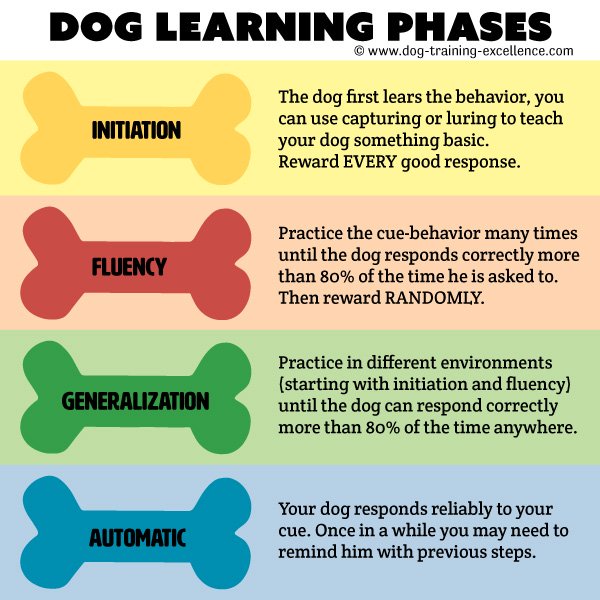
Establishing a reliable “stay” involves a gradual progression from brief holds to extended durations, increased distances, and controlled distractions.
Building Duration: Begin by gradually increasing the time between the dog assuming the position and offering a clicker marker or verbal cue (“Yes!”) followed by a treat. Start with short intervals and slowly extend them to around 10 seconds. Alternate longer and shorter durations to keep your dog engaged. If your dog breaks the stay, simply ask them to try again with an easier criterion. Avoid verbal scolding or corrections, as this can lead to insecurity. Aim for at least a 4 out of 5 success rate before increasing the duration, gradually working up to 30 seconds.
Introducing a Release Cue: To reinforce that the stay only ends with a specific release cue (e.g., “Okay!”), click and immediately offer a treat directly under your dog’s nose. This encourages them to remain in position while eating. Following the click and treat, use your distinct release cue.
Adding the “Stay” Cue: Once your dog reliably holds a sit for short durations, introduce your chosen verbal cue or hand signal for “stay” as they perform the action. Continue practicing as before.
The Three D’s: Duration, Distance, and Distractions
Mastering the “stay” requires systematically working on the three crucial elements: duration, distance, and distractions.
Duration: This refers to how long your dog holds the position. For a sit/stay, aim for one to three minutes; for a down/stay, two to five minutes. Training for extended periods (e.g., 30 minutes) in one static position can be uncomfortable. Consider teaching a “go to bed” command for longer durations, allowing for positional comfort.
Distance: Gradually increase the space between you and your dog while they are in a stay. Begin by taking a half step back, then increase the distance incrementally. Also, practice with variations in your body position, such as turning away, kneeling, or stepping to the side. Eventually, you can train them to stay while you step out of sight. It’s crucial to work on distance and duration separately initially. When increasing distance, keep the duration short, and vice-versa. To prevent anticipation of the release cue, return to your dog to click and treat while they are still in position.
Distractions: Once the basics are solid, practice in various locations with different distractions. Lower your criteria in new environments; if your dog can stay for two minutes in your living room, start with just a few seconds in a new, busier location. Begin with controlled distractions, like waving your arms, and gradually introduce more challenging stimuli like other people, dogs, or moving objects. Set up situations where you can control the distractions to set your dog up for success.
Secrets to Success
Achieving a reliable “stay” hinges on two core principles: realism and consistency.
Be Realistic: Train at a level your dog can successfully handle. Pushing them beyond their capabilities, leading to broken stays, will undermine their confidence. If your dog breaks the stay, simplify the exercise and build upon successes.
Be Consistent: Maintain consistency in your training methods and expectations. If your dog struggles, make the exercise easier and progress more gradually. While confident dogs may advance more quickly, patience and consistency will enable even high-energy or insecure dogs to develop a rock-solid stay.
By diligently applying these principles and training techniques, you can cultivate a dependable “stay” that enhances your dog’s safety, obedience, and overall well-being.