
A dog who pulls on the leash can turn a peaceful stroll into a wrestling match in seconds. It’s uncomfortable for the person holding the leash, and it can even be dangerous, especially on icy sidewalks or busy streets. If you’ve been struggling with leash pulling, you’ve probably heard no shortage of advice, some of it useful, much of it outdated, and some of it downright harmful.
Leash pulling is one of the most common issues dog owners bring to professional trainers. The good news is that a dog who pulls isn’t stubborn, dominant, or trying to challenge your authority. Pulling happens for reasons rooted in normal canine behavior, and once you understand those reasons, you can start teaching a better alternative instead of just trying to suppress the symptom.
Why Dogs Pull in the First Place
Before looking at training techniques, it helps to see the walk from your dog’s point of view. Behavior always happens for a reason, and leash pulling is no exception.
Dogs are simply built to move faster than people. Aside from small breeds, senior dogs, or those with mobility limitations, most dogs have a naturally quicker walking pace than humans. This trait goes back to their ancestry, when speed and efficient movement mattered for hunting and survival.
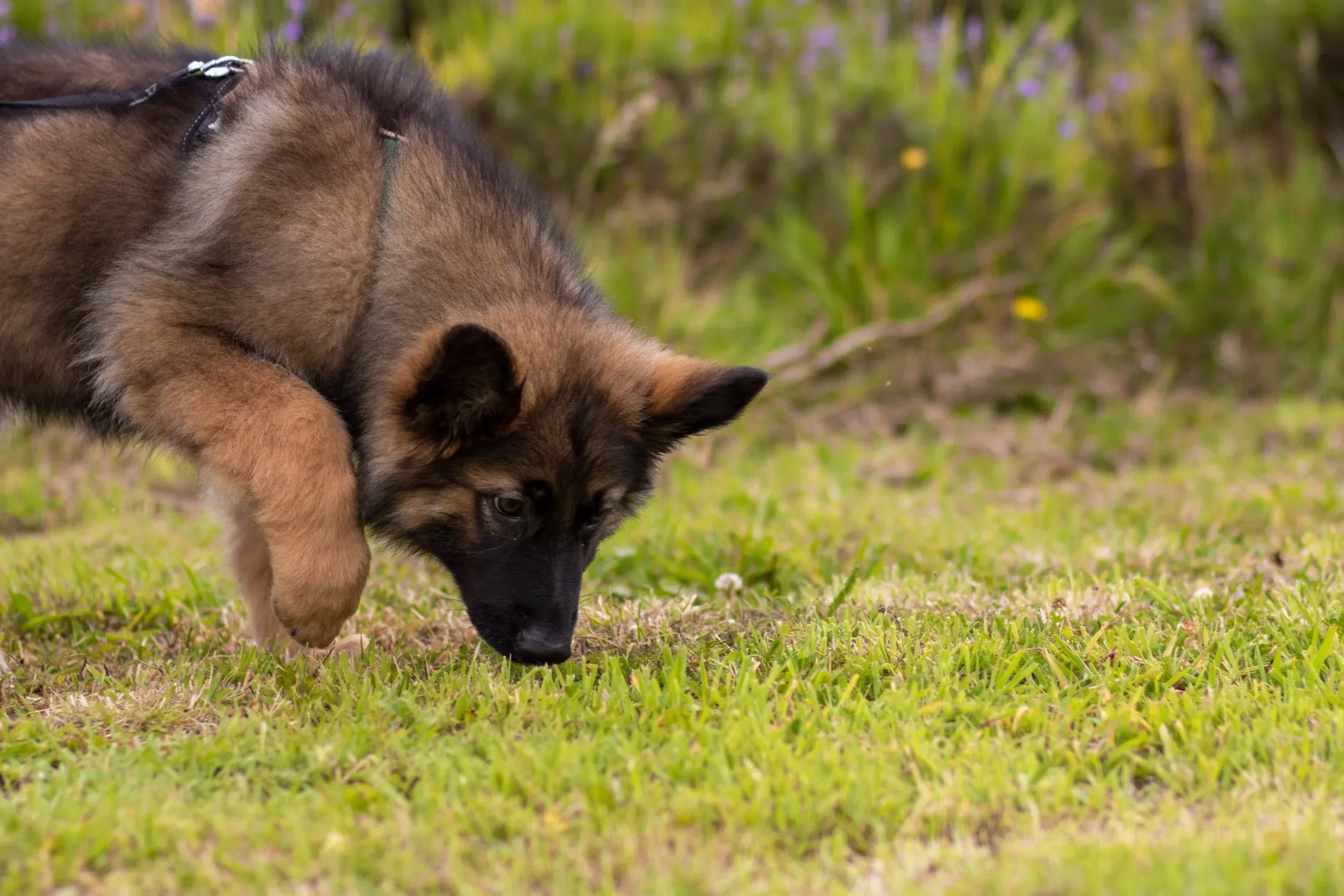
Scent is another major driver. A dog’s nose is extraordinarily sensitive, far more so than a human’s, and sniffing gives them enormous amounts of information about their environment, other animals, and anything that recently passed through the area. Every walk is essentially a chance to gather data through smell, and that mental engagement is part of what makes a walk satisfying for a dog.
Finally, dogs pull because they simply want to get somewhere. It doesn’t take long for a dog to learn that leaning into the leash results in forward movement, which is often rewarded with a new smell, a person, or another dog to greet. Combine a faster natural pace with a strong desire to explore, and it’s easy to see why leash pulling is so widespread.
Common Leash-Pulling “Fixes” That Don’t Actually Work
Plenty of leash-pulling advice circulates online and among dog owners, but not all of it is sound, and some methods can cause real harm. Here’s a look at some frequently recommended techniques and why they fall short.
Keeping the dog on a very short leash. This approach physically prevents pulling by removing any slack to pull against. While it may stop the behavior in the moment, it requires constant micromanagement for the entire walk and denies the dog any chance to sniff, explore, or simply be a dog. It doesn’t teach any new skill; it just drains the enjoyment out of the outing.
Not allowing the dog to sniff or explore. The reasoning here is that letting a dog engage with its surroundings means losing control of the walk. In practice, this just makes the walk monotonous for the dog and prevents them from meeting a natural need. It’s another form of restriction rather than teaching.
Never letting the dog walk ahead of you. This tip is usually tied to outdated “alpha” or dominance theory, the idea that a dog walking in front is trying to assert leadership. This theory has been discredited by the very researcher who originally proposed it, and current understanding of canine and wolf social structures points to a family-based dynamic rather than a rigid dominance hierarchy.
Delivering leash corrections. A leash correction involves a sharp, sudden tug on the leash to interrupt pulling. While a well-timed punisher can suppress behavior, it carries serious risks, including trauma to the neck, trachea, and other sensitive structures. Organizations focused on animal behavior science, including the American Veterinary Society of Animal Behavior, have repeatedly cautioned against training methods built around punishment. Beyond the physical risk, corrections only tell the dog what not to do, without teaching what they should do instead.
Stopping every time the dog pulls. Freezing in place whenever tension appears in the leash is far less harmful than a correction, and it can work if the dog finds the interruption unpleasant enough. However, if the dog doesn’t care about the pause, the method won’t be effective, and it can become tedious for both dog and owner.
Using prong, pinch, choke, or slip collars. These tools tighten around the dog’s neck when pressure is applied, whether from the dog or the handler. They do suppress pulling in many cases, but they carry a significantly higher risk of physical and emotional harm than other equipment, making them a method many force-free trainers strongly discourage.
Wrapping the leash around the dog’s torso. This method shifts the pressure from the neck to the waist when the dog pulls. While it avoids strain on the throat, it’s still a punishment-based approach that stops behavior without teaching an alternative, and it can be awkward to set up before every walk.
Cueing a sit every time the dog pulls. This interrupts the walk in a less harsh way than other methods, but it can be time-consuming, tricky to time correctly, and ineffective if the dog doesn’t find the interruption meaningful. Repeated too often, the dog may even start ignoring the sit cue altogether.
A Better Approach to Leash Pulling
The starting point for effective training is accepting that leash pulling is normal dog behavior, not defiance. From there, the most useful question to ask is: what is the dog trying to accomplish by pulling? If a dog is pulling forward simply because they want to move quickly, a safe off-leash space to run might meet that need better than a structured walk. If a dog is pulling toward the next scent post, building more sniffing time into the daily routine could reduce the urge to rush ahead.
Understanding what’s motivating the pulling allows you to use those same rewards, forward movement, access to a smell, greeting another dog, to reinforce polite walking instead. When you reward loose-leash walking with the things your dog actually wants, both of you come out ahead.
The most important shift in mindset is this: if you don’t like a behavior, you need to teach the dog what to do instead. Rather than only trying to stop pulling, define clearly what “polite walking” looks like for you and your dog, then build a training plan around that goal.
It’s usually most effective to begin training in a low-distraction environment, ideally inside your home, where competing motivators are minimal. Setting your dog up to succeed early on builds momentum. Once your dog is walking well indoors, gradually add distractions, moving to the backyard, then the front yard, and eventually out onto regular walks.
The Role of Management
No training plan is complete without management, which simply means preventing the dog from practicing the unwanted behavior while you’re teaching a new one. Management keeps your dog set up for success, particularly once training moves outside the house into a more distracting environment.
A few practical management strategies include:
- Choosing walking routes and times that reduce triggers. If your dog pulls toward people to greet them, walking in quieter areas or at less busy times can cut down on those opportunities.
- Using a longer leash, such as a 10-foot lead, or even a long-line of 20 to 50 feet during training. This gives your dog room to explore without needing to strain against a short 4-foot leash just to reach a patch of grass.
- Meeting your dog’s needs before the walk. If your dog has a lot of energy, a chance to run beforehand can make a leisurely walk far more manageable afterward.
Rather than trying to control every moment of the walk, aim for a balance where your dog gets the enrichment, exercise, and exploration they need, while you still enjoy a comfortable, low-stress walk. What that balance looks like will vary from one household to another, and that’s perfectly fine, as long as your dog’s overall wellbeing stays part of the equation.
Final Thoughts
Leash pulling isn’t a sign of a bad dog or a battle for dominance. It’s a natural response to a faster pace, a powerful sense of smell, and a genuine desire to explore the world. Many popular quick fixes rely on suppressing the behavior through discomfort or restriction, without ever teaching the dog an alternative. A more sustainable approach starts with understanding why your dog is pulling, rewarding the walking style you want to see, and using management to set your dog up for success along the way.
If you’re working through leash pulling with your own dog and want extra guidance, consider connecting with a force-free trainer in your area who can tailor a plan to your dog’s specific needs and personality.
References
- American Veterinary Society of Animal Behavior. Position Statements on Humane Dog Training. Available at: https://avsab.org/resources/position-statements/