
MAKE is one of the most frequently used verbs in English, generally meaning “to do, to cause, to force.” Yet the MAKE structure takes on many different meanings depending on the words that follow it. Whether you’re preparing for an exam or simply want to sound more natural in conversation, understanding how MAKE works with different grammatical patterns and phrasal combinations will noticeably improve your fluency. Let’s break down every major use of this versatile verb below.
1. Common Grammatical Patterns with MAKE
The MAKE structure covers a wide range of grammatical patterns, each carrying a slightly different nuance. Below are the four most important patterns you’ll encounter in everyday English and on standardized tests.
1.1. Make + somebody + do something (To force someone to do something)
This is one of the most common causative structures in English, used to describe someone compelling another person to take an action.
Examples:
- The robber makes everyone lie down.
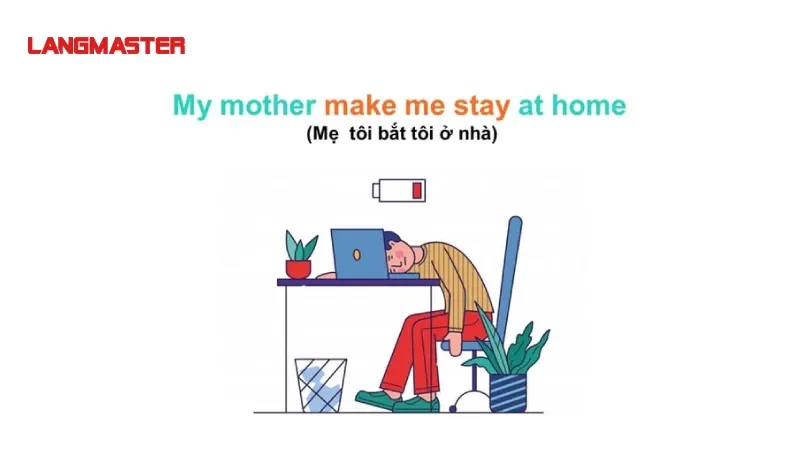
- My mother makes me do all the housework.
1.2. Make + somebody + to verb (passive form: to be forced to do something)
This pattern expresses the idea of compelling someone to act, but the grammar shifts depending on whether the sentence is active or passive.
Examples:
- Don’t make my son cry.
- I was made to go out.
Many learners confuse make somebody do something, make somebody to do something, and make somebody doing something. When you want to say that someone forces or requires another person to do something, use the pattern make + object + bare infinitive (a verb without “to”). In the active voice, MAKE is always followed by the bare infinitive form:
✗ He makes us to learn fifty new words every week.
✓ He makes us learn fifty new words every week.
✗ Advertising makes us to buy a lot of unnecessary things.
✓ Advertising makes us buy a lot of unnecessary things.
However, in the passive voice, MAKE is followed by a to-infinitive (be made to do something):
Example: She was made to work 12 hours a day.
1.3. Make + somebody/something + adjective (To cause someone/something to feel or become)
This pattern describes causing a change in someone’s emotional state or condition.
Examples:
- The film makes me sad.
- Her gift makes me very happy.
1.4. Make + possible/impossible
This is a more advanced structure that trips up many learners because the placement of “it” depends entirely on what follows.
Structure 1: Make it possible + to-verb
If the object of MAKE is a to-infinitive verb phrase, you must insert “it” between MAKE and POSSIBLE.
Example: The new bridge makes it possible to cross the river easily and quickly.
Notice that a to-infinitive (to cross) follows MAKE, so “it” is required.
Structure 2: Make possible + noun/noun phrase
When a noun or noun phrase directly follows MAKE, you should NOT insert “it” between MAKE and POSSIBLE.
Example: The internet makes possible much faster communication and development of economics all over the world.
Here, “faster communication and development” is a noun phrase, so the structure “make possible” is used without “it”.
Structure 3: Make possible for somebody to do something (= cause something to happen)
Example: The buses make possible for students to move from place to place much more cheaply.
2. Common Phrasal Combinations with MAKE
Beyond the core grammatical structures above, MAKE combines with a huge range of nouns, prepositions, and particles to create entirely new meanings. For instance, “make up” can mean to apply cosmetics, to invent a story, or to reconcile after an argument, depending on context.
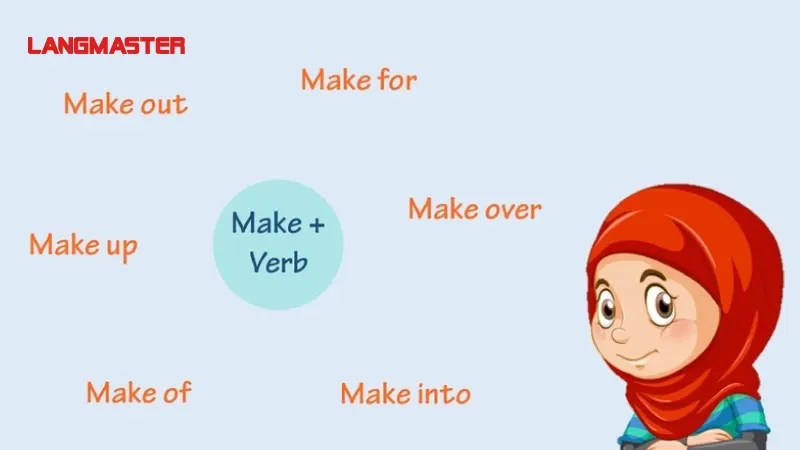
Here is a list of frequently used expressions built around MAKE:
- Make up: to invent a story, to reconcile, to apply makeup
- Make a fuss: to make a fuss over something
- Make fun of: to mock someone
- Make a decision / make up one’s mind (= decide): to decide
- Make a mistake: to make an error
- Make potential: to fulfill potential
- Make a success (= be home and dry / go through / be successful): to succeed
- Make a discovery: to discover something
- Made up of: to be composed of
- Make up a story: to invent a story
- Make a fortune: to earn a lot of money
- Make a guess: to guess
- Make a habit of: to develop a habit of doing something
- Make a loss: to lose money
- Make a mess: to create a mess
- Make a move: to move, to take action
- Make a promise: to promise
- Make a proposal: to put forward a proposal
- Make room for: to make space for
- Make war: to wage war
- Make trouble: to cause trouble
- Make use of: to utilize
- Make a phone call (= call / phone): to make a call
- Make a report: to write or deliver a report
- Make / deliver / give a speech: to give a speech
- Make noise: to make noise
- Make progress: to progress
- Make a profit: to earn a profit
- Make friends with: to become friends with
- Make no difference: to have no effect
- Make much of (= treat as very important): to treat something as important
- Make light of (= treat as unimportant): to downplay something
- Make no sense: to be illogical or confusing
- Make ends meet (= make both ends meet): to manage financially
- Make a living (= earn a living): to earn money through work
- Make an effort: to try hard
- Make the most of (= make the best of): to take full advantage of
- Make an excuse: to give an excuse
- Make way for: to clear a path for
3. Distinguishing MAKE from DO
Many English learners confuse MAKE and DO because they seem to share a similar meaning. In reality, these two verbs follow distinct rules and are used in different contexts.
 Comparison chart distinguishing usage rules between the verbs make and do
| DO | MAKE |
|---|---|
| Used for jobs, studies, and work that don’t produce a new physical product (e.g., do homework, do a job) | Used for creating something new from raw materials (e.g., made from grapes, made of wood) |
| Describes general or daily activities (e.g., do something, do the kitchen) | Describes planned actions or interactions with another person or object (e.g., make a decision, make someone happy) |
| Can replace a previously mentioned verb when the meaning is already clear | Commonly used with food and meals (e.g., make lunch, make coffee) |
Understanding this distinction is essential for both spoken fluency and written accuracy, since native speakers rarely mix these two verbs interchangeably despite their overlapping general meaning.
4. Practice Exercises on the MAKE Structure
To reinforce what you’ve learned, try the following exercises covering both the grammatical structures and the common collocations with MAKE.
4.1. Exercises
Exercise 1: Fill in the blanks with the correct form of do, take, or make.
- He is … research in chemistry now.
- My family normally … the shopping on Monday mornings.
- Let’s … a plan.
- She … crossword puzzles on the train every day.
- Could you … me a favor?
Exercise 2: Choose the correct answer.
I ____ a lot of things in my free time.
A. do B. makeIt doesn’t matter if he doesn’t get 10/10. Just ____ your best!
A. does B. makesMy brother always ____ a lot of mistakes when I write.
A. does B. makesToo much sugar in your diet can ____ you harm.
A. do B. makeDon’t ____ promises that you can’t keep!
A. do B. makeMy grandmother ____ the best chocolate cake!
A. does B. makes C. both
Exercise 3: Complete the following collocations with MAKE.
- Make ____ : to invent a story, to reconcile, to apply makeup
- Make ____ : to invent, to fabricate
- Make ____ : to mock someone
- Make ____ : to decide
- Make ____ : to guess
- Make ____ : to develop a habit
- Make ____ : to put forward a proposal
- Make ____ : to make space for
- Make ____ : to make noise
- Make ____ : to progress
- Make ____ : to give an excuse
- Make ____ : to clear a path for
4.2. Answer Key
Exercise 1:
- doing
- do
- make
- does
- do
Exercise 2:
1 – A, 2 – A, 3 – B, 4 – A, 5 – B, 6 – C
Exercise 3:
- Make up
- Make up a story
- Make fun of
- Make a decision
- Make a guess
- Make a habit of
- Make a proposal
- Make room for
- Make noise
- Make progress
- Make an excuse
- Make way for
Conclusion
Mastering the MAKE structure requires more than memorizing a single definition — it means understanding how the verb shifts meaning across different grammatical patterns, from causative structures like “make somebody do something” to fixed collocations like “make a decision” or “make ends meet.” Once you can confidently distinguish MAKE from DO and recognize the dozens of common phrases built around it, your English will sound noticeably more natural in both speaking and writing. Keep practicing with the exercises above, review the collocations regularly, and don’t hesitate to explore structured English courses if you want faster, more consistent progress with native-level instructors guiding your practice.