
The Honda e is a compact electric hatchback designed for urban mobility, combining a retro-inspired design with modern EV technology. Once positioned as Honda’s entry into the small electric car segment, the Honda e attracted attention for its minimalist design, rear-wheel drive layout, and city-focused driving dynamics. In this detailed Honda e review, we break down its real-world range, battery specifications, charging capabilities, performance, and practicality based on technical data.
Despite its innovative approach, the model is now discontinued, making it a niche option in the used EV market rather than a current production choice.
Overview of the Honda e Electric City Car
The Honda e is a B-segment electric hatchback built primarily for urban environments. It features a small footprint, tight turning radius, and a premium interior layout focused on digital displays and simplicity.
Key highlights include:
- 28.5 kWh usable battery capacity
- Rear-wheel drive electric motor
- 100 kW (136 PS) output
- Designed for short-distance city commuting
While its styling and technology were forward-thinking, its limited range positions it mainly as a second car for city use rather than a long-distance EV.
Battery Capacity and Real-World Range
The Honda e is equipped with a 35.5 kWh lithium-ion battery pack, of which 28.5 kWh is usable. This relatively small capacity directly influences its driving range.
Real-World Driving Range
- City (mild weather): up to 255 km
- Combined (mild weather): around 195 km
- Highway (mild weather): around 155 km
- Cold weather combined: about 140 km
In real-world EV usage, the Honda e achieves an average efficiency of around 168 Wh/km, which is typical for a small urban EV but limits its suitability for longer journeys.
Energy Consumption Insights
- WLTP range: 222 km
- Real consumption range: 112–238 Wh/km depending on conditions
- CO₂ emissions: 0 g/km (fully electric operation)
The data confirms that the Honda e prioritizes efficiency in urban driving rather than long-distance capability.
Charging Capabilities and Infrastructure Compatibility
Charging is one of the most important aspects of any EV, and the Honda e supports both AC home charging and DC fast charging via CCS.
AC Home Charging (Type 2)
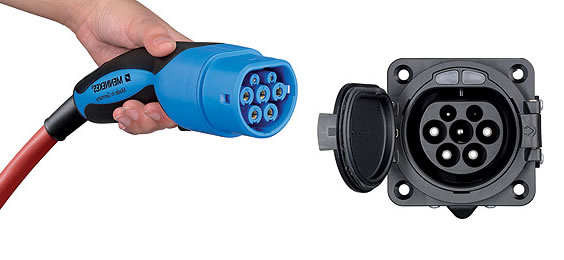
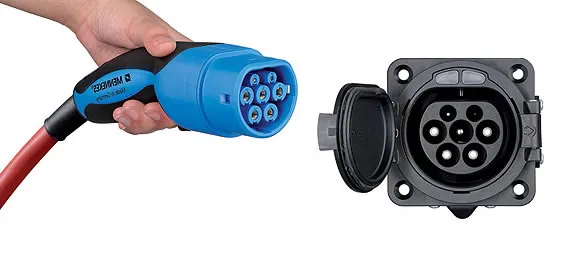
The Honda e uses a Type 2 charging port located at the front center of the vehicle.
- Maximum AC power: 6.6 kW
- Full charge time: ~5h15m (0 to 170 km equivalent)
- Wall plug charging possible (slow, ~14h45m)
This makes overnight home charging the most practical daily solution.
DC Fast Charging (CCS Combo 2)
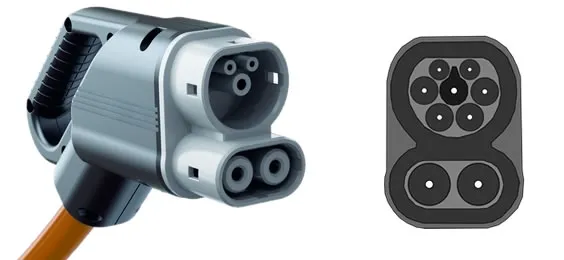
For faster charging on the road, the Honda e supports CCS DC fast charging.
- Maximum DC power: 46 kW
- Average charging power: ~31 kW
- 10–80% charge time: ~41 minutes
- Charging speed: up to 170 km/h range replenishment equivalent
However, compared to modern EVs, the charging speed is relatively modest, meaning longer stops on extended trips.
Charging Curve and Performance Behavior
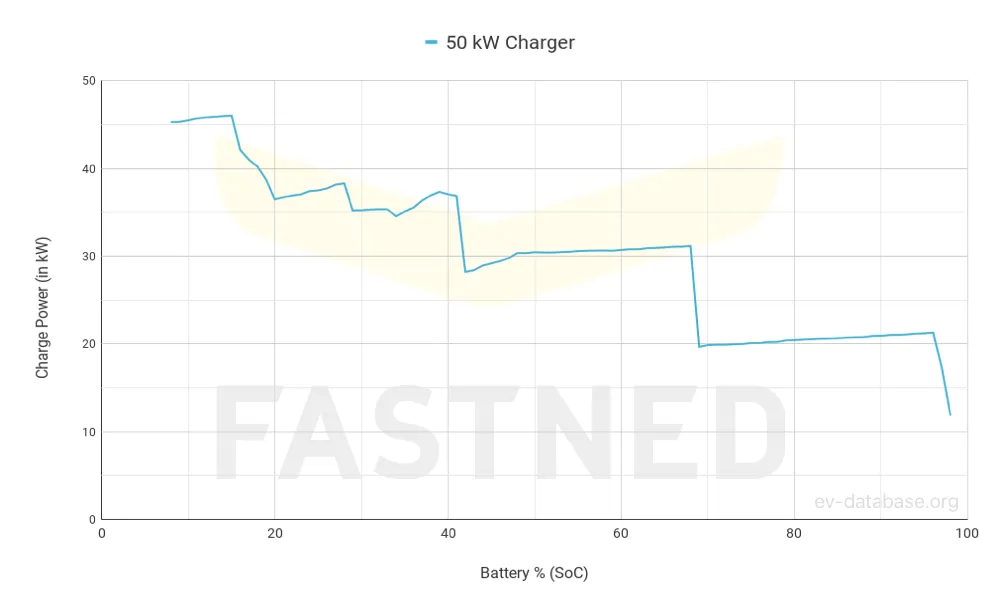 Honda e fast charging curve showing power delivery over time
The charging curve shows that peak charging power is maintained only briefly before gradually tapering off, especially after reaching higher state-of-charge levels. This is typical for smaller EV battery packs focused on urban efficiency rather than high-speed long-distance travel.
Performance and Driving Characteristics
The Honda e is not designed as a performance EV but delivers smooth and responsive urban driving dynamics.
- 0–100 km/h: 9.0 seconds
- Top speed: 145 km/h
- Torque: 315 Nm
- Drive layout: Rear-wheel drive
Its rear-motor configuration gives it a balanced feel, while the instant torque makes it particularly enjoyable in city traffic. The compact size and tight turning circle (9.2 m) enhance maneuverability in dense urban areas.
Safety and Dimensions
The Honda e achieved solid Euro NCAP ratings in 2020:
- Adult occupant protection: 76%
- Child occupant protection: 82%
- Safety assist: 65%
In terms of size, the vehicle emphasizes compact practicality:
- Length: 3894 mm
- Width: 1752 mm
- Wheelbase: 2538 mm
- Cargo capacity: 171 L (up to 861 L max)
- Seats: 4
This makes it ideal for city parking but less practical for families needing larger cargo space.
Conclusion: Is the Honda e Still Worth Considering?
The Honda e stands out as a unique urban electric vehicle with distinctive styling, strong build quality, and a premium feel. However, its limited range (around 170–222 km WLTP) and relatively slow fast charging make it unsuitable for frequent long-distance driving.
It is best suited for:
- Urban commuters
- Second-car households
- Drivers prioritizing design and maneuverability
For buyers seeking a modern EV with longer range and faster charging, newer alternatives in the compact EV segment may offer better practicality.
Still, the Honda e remains an iconic example of early urban electric car design and continues to attract enthusiasts in the used EV market.
References
- EV Database. (2026). Honda e technical specifications and real-world range data. https://ev-database.org/
- Euro NCAP. (2020). Honda e safety rating results. https://www.euroncap.com/
- Fastned. (2026). EV fast charging performance and charging curve analysis. https://fastned.nl/