
On January 26, 1980, one of the most dramatic moments in music history unfolded at Rio de Janeiro’s Maracanã Stadium. Backstage, in a dressing room transformed from a locker area, the atmosphere was thick with tension. A relentless Saturday downpour had made a soundcheck impossible—technicians refused to risk damaging their microphones, and violinists wouldn’t expose their precious Stradivarius instruments to the rain.
With just one hour until showtime, Frank Sinatra had already delivered an ultimatum: if the rain didn’t stop, he would return to his suite at the Rio Palace Hotel.
Fearing the worst—a cancellation that would disappoint an estimated 175,000 fans waiting anxiously in the stands—promoter Roberto Medina, head of Artplan Publicidade and the man responsible for bringing Sinatra to Brazil, took the singer by the arm and led him to the tunnel entrance overlooking the field. What Sinatra saw changed his mind.
“I can’t leave these people hanging,” he reportedly said, according to contemporary newspapers. “I’ll sing no matter what.”
That moment of hesitation and ultimate commitment marked the beginning of Sinatra’s historic relationship with Brazil—a connection that would span multiple tours, nine concerts across two cities, and create enduring memories for those lucky enough to witness “The Voice” perform on South American soil.
The Long Road to Brazil
Sinatra’s journey to Brazil was decades in the making. Roberto Medina’s father, businessman Abraham Medina, had first attempted to bring the star to the country in 1955—without success. For years, Sinatra deflected Brazilian promoters with a curious excuse: a fortune teller had supposedly warned him that traveling to South America would lead to his assassination.
In reality, this was simply a fabricated story to avoid persistent business inquiries. It wasn’t until 1979 that Sinatra finally accepted a proposal from the younger Medina, whom he had first met in 1977 during a whiskey commercial shoot. Ever cautious, Sinatra insisted on a contract clause guaranteeing a minimum audience of 60,000 spectators.
The Night the Rain Stopped
For 17-year-old student Renzo Mora, who had learned to appreciate Sinatra before he could even speak English, the journey from São Paulo to Rio was a pilgrimage. Traveling by bus with carefully budgeted money, he stayed at a cousin’s house and spent the day with his ear pressed to a transistor radio, listening to conflicting reports—one moment the show was canceled due to rain, the next it was confirmed.
“The tension was enormous,” recalls Mora, now a journalist and author of two books on Sinatra (Sinatra: The Man and the Music, 2008, and Frank, Dean & Sammy: Three Men and No Secrets, 2011). He would eventually attend three Sinatra concerts in total.
The weather seemed to conspire with destiny. According to journalist Ruy Castro, who chronicled the evening in Nostalgia for the 20th Century (1994): “Seven minutes before the scheduled time, something magical happened: the rain stopped. The sky opened above the stadium, and the stars appeared. And the greatest star of all appeared too.”
Amarilis Vianna, a ceremony coordinator hired by Artplan to serve as Barbara Sinatra’s interpreter during the Rio engagement, had one of the best seats in the house—positioned within the 40-piece orchestra conducted by maestro Vinnie Falcone. She was tasked with translating Sinatra’s stage banter, though organizers nervously asked her to keep it brief, fearing rain might interrupt the performance at any moment.
Sinatra kept her busy that night. He praised the audience (“Never in my life have I had a crowd like this”), complained about the press (“I came here to sing, not to talk to reporters”), and even joked about the weather (“See how God is our friend? The rain stopped!”).
A 75-Minute Masterpiece
The concert began at 9:00 PM and concluded at 10:15 PM. Over 75 minutes, Sinatra performed 20 songs from his legendary repertoire, including classics like “I’ve Got You Under My Skin,” “The Lady Is a Tramp,” and “New York, New York.” As a special tribute to Brazilian culture, he also performed “Corcovado,” honoring Antônio Carlos Jobim, with whom he had recorded the landmark album Francis Albert Sinatra & Antônio Carlos Jobim in 1967.
Roberto Muggiati, a journalist and music critic who served as editor-in-chief of Manchete magazine and sat among the 5,100 chairs on the field that night, offered perspective on Sinatra’s performance. “By the time he came to Rio, Sinatra was already 64 years old. Clearly, he was past the peak of his golden years, from the 1940s to the mid-1960s. But what he lost in vigor, he gained in experience.”
The Kissing Bandit
Two moments from the Maracanã concert became legendary. During “Strangers in the Night,” Sinatra momentarily forgot a section of lyrics—only to be “rescued” by the massive crowd singing along. “When I stopped, all of Maracanã began to sing. I was emotional,” he later wrote in one of his biographies.
Then came the surprise. As Sinatra finished “My Way,” a Portuguese taxi driver named José Alves de Moura—nicknamed “The Kisser”—rushed the stage, dodged security, and planted a kiss on the singer’s cheek. Sinatra would later recall the incident in his memoirs, referring to the man as “The Kissing Bandit.”
As the concert concluded at 10:15 PM, Sinatra waved one last time with a white handkerchief and descended the ramp toward his dressing room. “And, as if by cosmic agreement, the rain returned with full force,” Ruy Castro wrote.
Beyond the Stadium
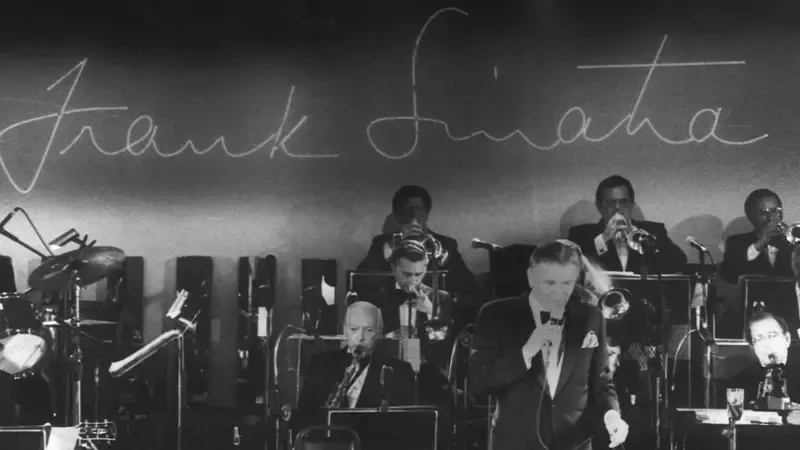
Sinatra’s visit to Rio wasn’t limited to the Maracanã spectacle. Between January 22 and 25, he performed four intimate shows at the newly inaugurated Rio Palace (now the Fairmont), where each of the 600 nightly attendees paid Cr$ 20,000—approximately R$ 4,700 in today’s currency. The exclusive audience included comedian Chico Anysio, singer Agnaldo Timóteo, and samba artist Oswaldo Sargentelli.
Singer Fafá de Belém emerged as one of Sinatra’s most devoted Brazilian followers, attending both the Rio performances and subsequent shows in São Paulo. “I learned to like Sinatra with my father,” she recalls. “He loved him so much that in 1997, he was buried to the sound of ‘New York, New York.’ Sinatra was no longer a young man when he came to Rio. But he remained as charming as ever.”
A Media Frenzy
“The Voice” arrived at Galeão Airport on Monday, January 21, at 8:40 AM, accompanied by an entourage of 25 people, including his wife Barbara and stepson Robert. From there, he traveled by helicopter to Santos Dumont Airport before taking a car to Copacabana. Outside his hotel, approximately 200 journalists from Brazil and abroad jostled for position, hoping for a glimpse of the star.
Rose Esquenazi, then a 25-year-old reporter for the newspaper Última Hora, was among those assigned to cover Sinatra’s Rio visit. “It was seven days of intense work,” remembers Esquenazi, now a researcher at PUC-Rio’s Department of Communication. “I’d arrive at the hotel around 9 AM and wouldn’t leave until after Sinatra’s show at the hotel, around 11 PM.”
The only press conference took place on the day of Sinatra’s arrival and lasted barely three minutes. During this brief appearance, the singer stated only that the trip had been tiring, he was exhausted, and his only reason for not visiting Brazil sooner was lack of time. Before any follow-up questions could be asked, press agent Lee Solters pulled him away by the arm.
In the ensuing scramble between photographers and security, even Barbara Sinatra found herself caught in the chaos. “Sinatra didn’t come to Brazil to be treated like an animal,” Solters shouted. Harold Emert, a correspondent producing content for the Latin American Post, recalled the tense atmosphere: “I got a scolding from Solters for writing in an article that Sinatra wore a toupee.”
Life Behind Closed Doors
Between performances, Sinatra rarely left his suite. While Barbara explored Tijuca Forest and visited Christ the Redeemer, her husband remained secluded in a 600-square-meter suite with bulletproof glass windows measuring 20 millimeters thick.
Rumors circulated about the singer’s activities during his stay. Some speculated that Sinatra was taking medication to combat a cold. Others spun urban legends about plans to open a casino in the Amazon. Renzo Mora offered a simpler explanation: “The temptation to sing for the largest audience ever assembled for a single artist was what motivated him to come.”
The city’s obsession with the visiting star was so pervasive that even poet Carlos Drummond de Andrade confessed in one of his chronicles for Jornal do Brasil: “I’m full of Sinatra, and wherever I go, I only hear talk about him, only see his picture, only hear songs sung by him.”
On the rare occasions Sinatra did venture from his room, he would descend to the hotel’s Le Pré Catelan restaurant. One such dinner included singer Eliana Pittman, who received an invitation from guitarist Al Viola—a member of Sinatra’s band and a friend of her father, saxophonist Booker Pittman.
“He invited me but gave a warning: don’t take pictures, because Sinatra doesn’t like it,” Pittman recalls with a laugh. “I was obedient, but I regret it to this day.” During the dinner, Barbara remained constantly at her husband’s side, allowing no one to approach. “I don’t remember what we talked about—after all, it’s been 40 years. But I haven’t forgotten those blue eyes. That man was a force of nature!”
The São Paulo Engagement
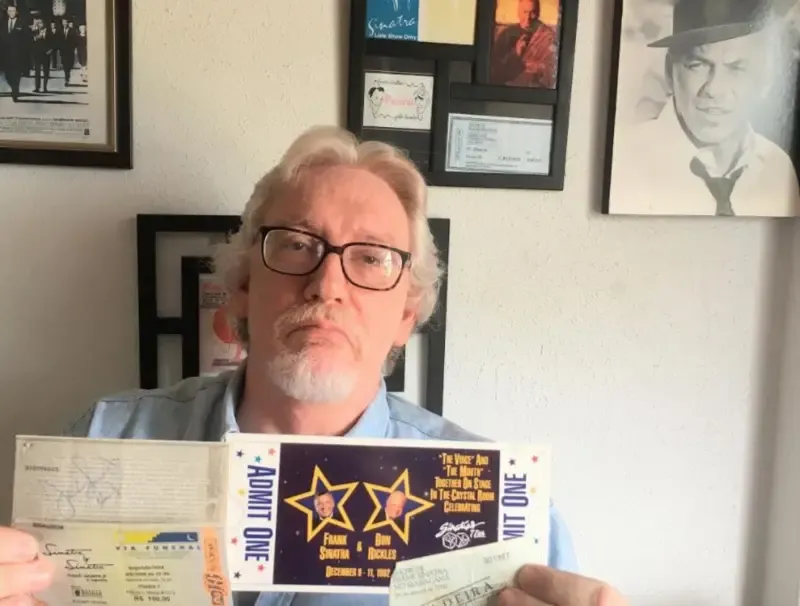
Sinatra’s Brazilian tour extended beyond Rio. In August 1981, he performed four concerts at São Paulo’s Maksoud Plaza Hotel, with tickets selling for Cr$ 59,000—approximately R$ 7,500 in today’s currency. These intimate performances, organized by businessman Henry Maksoud (founder of the hotel), attracted an exclusive audience of 2,800 spectators.
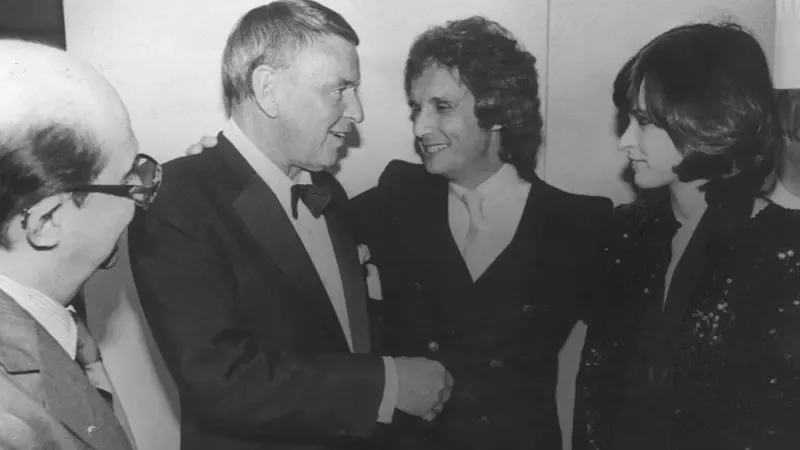
Actress Myrian Rios had the privilege of experiencing “Old Blue Eyes” up close during these São Paulo shows. To be near her idol, she and her husband, singer Roberto Carlos, stayed on the same floor as the presidential suite—the 20th floor.
“Sinatra complimented Roberto on the quality of his work and congratulated him for having such a young wife,” Rios recalls.
A Legacy Cemented
In total, Frank Sinatra performed nine concerts in Brazil: five in Rio de Janeiro during January 1980, and four in São Paulo in August 1981. These performances represented more than just a successful international tour—they cemented a cultural connection that continues to resonate.
For Brazilian fans of American oldies music, Sinatra’s Brazilian sojourn represents a pinnacle moment—when one of the 20th century’s greatest entertainers brought his artistry to their country against considerable odds. The 1980 Maracanã concert, with its dramatic weather intervention, last-minute decisions, and the singer’s ultimate commitment to his audience, encapsulates the magic that made Sinatra legendary.
For those who were there, and for the generations who have heard the stories since, Sinatra’s Brazilian concerts stand as a testament to music’s power to transcend language, culture, and even weather. As the singer himself acknowledged when the clouds parted that January evening, sometimes the stars align to create something unforgettable.
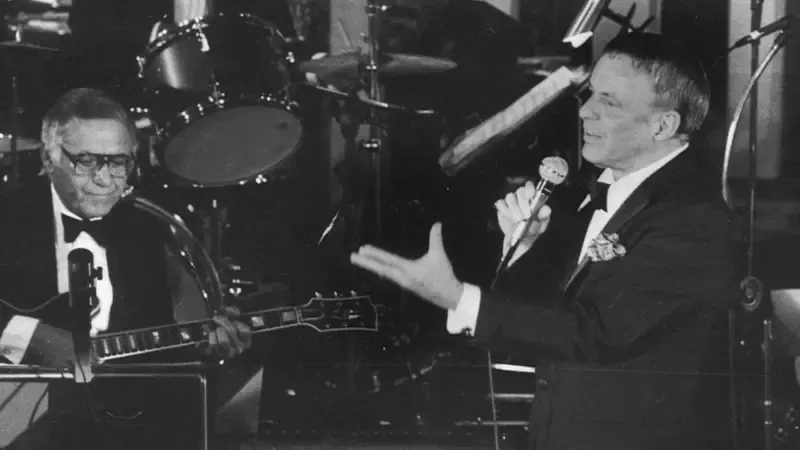 Frank Sinatra on stage during his São Paulo concert series at the Maksoud Plaza hotel
References
- Castro, R. (1994). Saudades do Século XX. Rio de Janeiro.
- Mora, R. (2008). Sinatra: O Homem e a Música. São Paulo.
- Mora, R. (2011). Frank, Dean & Sammy: Três Homens e Nenhum Segredo. São Paulo.
- BBC News Brasil archives (1980-1981).
- Acervo Maksoud Plaza historical collection.
- Personal accounts from Renzo Mora, Eliana Pittman, Myrian Rios, and other eyewitnesses.
For international readers discovering the magic of pre-1975 American music, Sinatra’s Brazilian concerts offer a unique window into how this timeless repertoire traveled across continents to captivate audiences far beyond its country of origin. The stories of these historic performances invite us to explore further—to listen again to the recordings, to appreciate the cultural bridges built by artists like Sinatra and Jobim, and to celebrate the music that continues to unite generations across borders.