
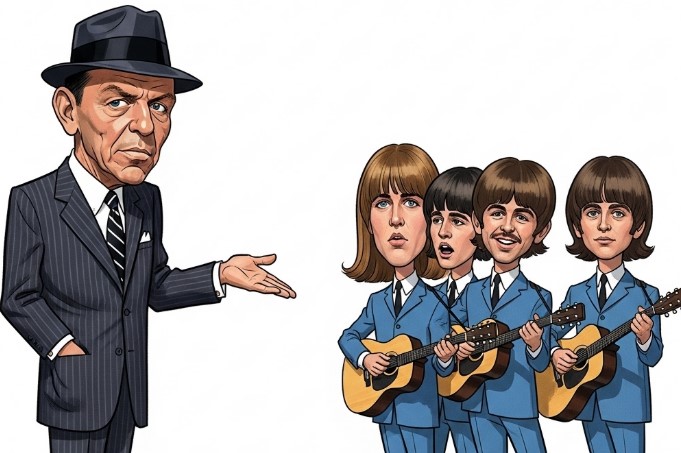
Frank Sinatra, a towering figure in American music, once expressed a strong disdain for the emerging rock and roll scene, particularly targeting the immense popularity of The Beatles. While The Beatles’ legacy is undeniably cemented in pop music history, their innovative sound and youthful image initially clashed with the established norms represented by artists like Sinatra. This article delves into Sinatra’s critical remarks about “kid singers with mops of hair” and the underlying generational shift occurring in the music industry during the 1960s.
The Established Crooner vs. The British Invasion
Before the advent of rock and roll, Frank Sinatra had already carved out a significant career, becoming an acclaimed actor and singer. He is credited with pioneering the concept album with In the Wee Small Hours, demonstrating a sophisticated approach to music creation long before The Beatles explored similar artistic avenues with their later works. However, as rock and roll began to gain traction in the late 1950s, Sinatra was openly critical, famously stating, “Rock and roll smells phoney and false. It is sung, played, and written, for the most part, by goons. It is the most brutal, ugly, desperate, vicious form of expression it has ever been my displeasure to hear.”
Despite his criticism, there were instances where the influence of established artists like Sinatra subtly appeared in The Beatles’ music. Paul McCartney reportedly conceived the song ‘When I’m Sixty-Four’ with a style reminiscent of Sinatra’s jaunty rhythms. However, as The Beatles’ fame grew, Sinatra perceived them as a challenge to his dominance in sophisticated music.
“Kid Singers with Mops of Hair”
In response to the growing phenomenon of The Beatles, Sinatra did not shy away from expressing his views. In a press release for his album A Man and His Music, he is quoted as saying, “If you happen to be tired of kid singers wearing mops of hair thick enough to hide a crate of melons…it should be refreshing.” This statement clearly articulated his frustration with the new wave of young artists who, in his view, lacked the maturity and substance of his generation.
For a time, Sinatra’s own output continued to resonate, with him frequently winning the Grammy Award for ‘Album of the Year’, often in direct competition with The Beatles. However, as The Beatles increasingly utilized the studio as an experimental playground in the late 1960s, they ultimately surpassed Sinatra in this category when Sgt. Pepper’s Lonely Hearts Club Band received the coveted award.
A Complex Relationship and Enduring Influence
Interestingly, the relationship between Sinatra and The Beatles wasn’t entirely antagonistic. Paul McCartney later considered giving a song he wrote during his solo sessions, titled ‘Suicide,’ to Sinatra to perform. Similarly, John Lennon penned ‘Nobody Loves You’ from his album Walls and Bridges as an homage to the style of music Sinatra excelled at. Even Sinatra, despite his initial reservations about rock music, acknowledged the brilliance of George Harrison’s ‘Something,’ considering it one of the greatest love songs ever written.
Ultimately, while Frank Sinatra represented the golden age of traditional pop, The Beatles ushered in a new era of musical innovation and cultural impact. By the early 1970s, as The Beatles disbanded, Sinatra’s more conventional musical approach had indeed begun to fade into the past, a testament to the profound and transformative influence of the Fab Four. Explore more about the iconic Frank Sinatra songbook to understand the musical landscape he dominated.
References
Sinatra, F. (n.d.). In the Wee Small Hours. Capitol Records.
Coffman, T. (2022, December 19). Frank Sinatra’s massive swipe at The Beatles: “Kid singers with mops of hair”. Far Out Magazine.
McCartney, P. (n.d.). When I’m Sixty-Four.
Sinatra, F. (1965). Press release for A Man and His Music.
Lennon, J. (1974). Walls and Bridges. Apple Records.
Disclaimer: This article is based on information from the provided source and aims to present a balanced perspective on the commentary surrounding Frank Sinatra and The Beatles.