
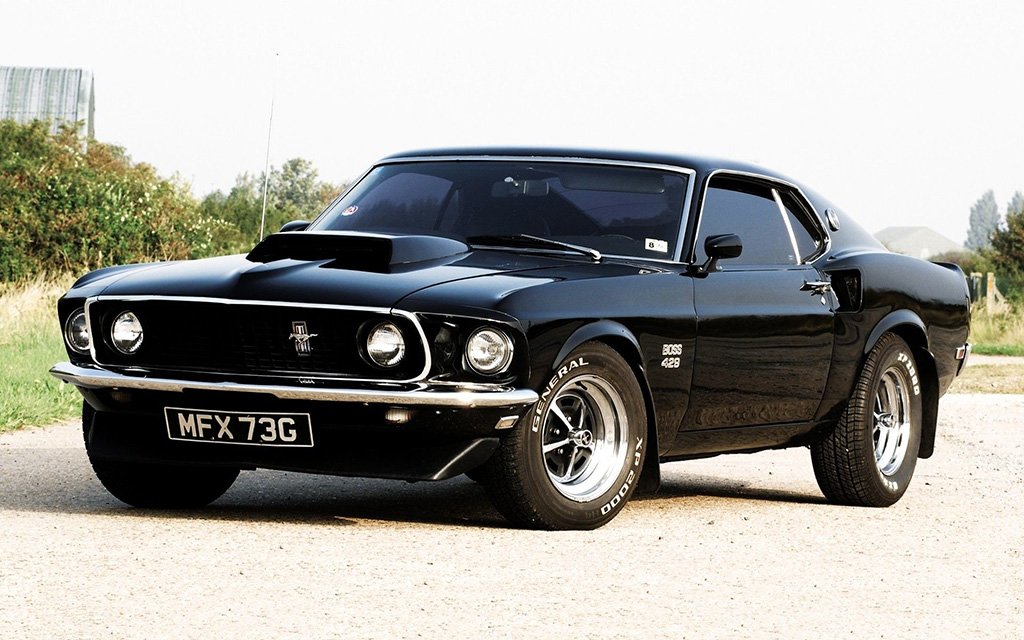
Muscle cars, with their roots firmly planted in American automotive history, are defined by a simple yet potent formula: a large, powerful V-8 engine shoehorned into the smallest possible car body. This pursuit of affordable performance, capable of achieving impressive quarter-mile times, has long captivated enthusiasts. While the concept originated in the United States during the 1960s, the appeal of V-8 power in a relatively compact package has transcended borders. Foreign automakers, inspired by this American ingenuity, began developing their own V-8-powered models based on their standard offerings. From Britain to Australia and even Germany, manufacturers embraced the challenge of fitting potent V-8s into engine bays not necessarily designed for them. This global adoption of the muscle car ethos has resulted in some truly remarkable vehicles. Here are 10 of the most notable non-American offerings that deliver serious V-8 performance in a relatively compact package.
10. Jensen Interceptor & Jensen FF
British car manufacturers have a notable history of producing V-8-powered vehicles, often leveraging American V-8 engines for their robust performance. Among the most distinguished is the Jensen Interceptor, a full-size grand tourer produced from 1966 to 1976. This iconic model was available in hatchback, convertible, and coupe body styles. The Jensen FF, a four-wheel-drive variant, also graced the market between 1966 and 1971, though in significantly limited numbers. The Interceptor offered a choice of three Chrysler-derived V-8 engines: a 360 cubic inch (5.9-liter) Small Block LA V-8, a 383 cubic inch (6.3-liter) V-8 (standard on the FF), and a larger 440 cubic inch (7.2-liter) V-8. Transmission options included Chrysler’s three-speed Torqueflite A727 automatic and a four-speed manual.
9. Mercedes C63 AMG
While the latest Mercedes-AMG C63 E Performance has embraced a complex hybrid powertrain centered around a turbocharged inline-four, earlier iterations of this C-Class performance model earned the moniker “German Muscle” for their unabashed V-8 power. The M156-powered C63, introduced in 2007, stands out as one of the last Mercedes-AMG models to feature a naturally aspirated 6.2-liter V-8 engine. This potent powerplant was paired with a seven-speed 7G-Tronic automatic transmission. The W/S/C204-series C63 AMG was renowned for its thunderous V-8 exhaust note and its appetite for rear tires, offering a brutish yet sophisticated performance experience. The M156 V8 remains a celebrated engine in the AMG lineage.
8. Holden/Vauxhall Monaro
Australia has a proud tradition of building formidable muscle cars, and the Holden Monaro is a prime example. First introduced in 1968, the Monaro, under the General Motors (GM) umbrella, consistently offered V-8 power. Throughout its three generations, the Monaro maintained its identity as a two-door, two-plus-two-seater. It was also sold in various markets under different names, including the Vauxhall Monaro and, in North America, as the Pontiac GTO. The final generation was equipped with GM’s potent 5.7-liter LS1 and later, a 6.0-liter LS2 engine. Mated to a Tremec T56 six-speed manual transmission, these models could achieve 0 to 60 mph (97 km/h) in as little as 4.5 seconds.
7. Aston Martin V-8/Vantage
While Aston Martin vehicles are typically positioned in the luxury performance segment and far from the “affordable” characteristic of classic American muscle cars, their V-8 and Vantage models share the core philosophy of installing a substantial engine into a relatively compact and sporting package. Since 1969, these designations have graced Aston Martin’s lineup. In more recent years, Aston Martin has utilized AMG-derived V-8 engines, though the marque also boasts its own V-12 powertrains. Whether one considers the early variants produced between 1969 and 1992 or the contemporary models, Aston Martin, famously associated with James Bond, offers a compelling blend of performance and refinement that can be described as a “Gentleman’s Muscle car.” The brand’s performance heritage is undeniable.
6. Lexus RC-F
Toyota and Lexus have a history with V-8 engines, and the Lexus RC-F stands as a prominent example of this in their current lineup. While the LC 500 is positioned as a more luxurious grand tourer, the RC-F, based on a standard compact executive coupe, offers a distinctly performance-oriented experience. The key differentiator lies beneath the hood: a 5.0-liter naturally aspirated V-8 engine, shared with models like the LC 500, IS 500, and GS-F. This powerhouse delivers 472 horsepower and 395 pound-feet (535 Nm) of torque, enabling the RC-F to accelerate from 0 to 60 mph (97 km/h) in just 4.3 seconds. Buyers can choose between a mechanical limited-slip differential or an electronic differential with torque vectoring. The Lexus RC-F represents a modern interpretation of V-8 performance in a sporty coupe.
5. HSV GTS & Vauxhall VXR8
Holden Special Vehicles (HSV) and Vauxhall VXR8, both leveraging the GM Zeta platform that also underpinned models like the Chevrolet Camaro and Pontiac G8, represent significant V-8 performance offerings. While GM offered a range of V-8 engines across its platforms, the performance-oriented HSV and VXR8 models truly stood out, featuring supercharged LS9 and LSA engines. These potent units produced up to 595 horsepower and 546 pound-feet (740 Nm) of torque, delivered exclusively to the rear wheels. Coupled with a six-speed automatic or manual transmission, these vehicles could reach 60 mph (97 km/h) in as little as 4.0 seconds. For context, the closest American equivalent was the LS3-powered Chevy SS, which lacked a factory supercharger. GM’s V-8 engine options have always been a strong suit.
4. Porsche 928
While Porsche is most famously associated with the iconic 911, the German automaker ventured into front-engine, V-8 territory with the Porsche 928, produced from 1977 to 1995. Designed as a potential successor to the rear-engined 911, the 928 ultimately evolved into a more GT-oriented car. It featured a range of V-8 engines, with displacements varying from 4.5 to 5.6 liters. U.S. market versions were often criticized for being underpowered, typically producing just over 200 horsepower. European variants, however, offered significantly more power, with the GTS model boasting up to 350 horsepower. While most 928s were equipped with automatic transmissions, a limited number featured a five-speed manual gearbox. The Porsche 928 represented a bold departure for the brand.
3. Jaguar XK
The Ford era of Jaguar saw the creation of the seductive XK-badged GT coupes, which, while not budget-friendly, embodied the spirit of performance with their V-8 engines. Produced in two generations between 1996 and 2015, these models utilized Ford-derived V-8s ranging from 4.0 to 5.0 liters. A key distinction within the XK lineup was the choice between naturally aspirated and supercharged variants, with power outputs ranging from 275 to 542 horsepower. While the 5.0-liter engine might be mistaken for a version of the Mustang’s Coyote V-8, it was actually a Ford Cologne design. The top-tier XK-RS could accelerate to 60 mph (97 km/h) in approximately 4.2 seconds, albeit with a compromise in its grand touring character. Jaguar’s high-performance models have always aimed for a blend of luxury and speed.
2. BMW M3 E92
BMW, renowned for its potent inline-six engines, took a significant and bold step with the E92 M3, introducing a groundbreaking V-8 powerplant. This generation of the M3 stands out due to its high-revving S65 V-8 engine. Derived from the S85 V-10 found in the E60 M5 (itself based on a Formula One engine), this 4.0-liter V-8 produced 414 horsepower and 325 pound-feet (440 Nm) of torque. When paired with either the seven-speed DCT or a six-speed manual transmission, the E92 M3 could achieve 0 to 60 mph (97 km/h) in 4.4 to 4.6 seconds. The limited-production M3 GTS variant offered even more power. The S65 engine remains a unique and highly regarded unit in BMW’s performance history.
1. Mercedes 500E & E60 AMG “Hammer”
The W124 Mercedes-Benz is celebrated for its exceptional engineering and durability, and it also served as the foundation for modern AMG sedans, notably with assistance from Porsche. Porsche played a crucial role in integrating the M119, 5.0-liter V-8 engine into the W124 chassis, creating one of the most remarkable German sedans of its era – the 500E. This collaboration resulted in 322 horsepower and 354 pound-feet (480 Nm) of torque, allowing for a 0 to 60 mph (97 km/h) sprint in around 6.0 seconds with its four-speed automatic transmission. Later, the tuner Affalterbach developed the E60 AMG “Hammer,” increasing displacement to 6.0 liters and boosting output to 381 horsepower and 428 pound-feet (580 Nm). The W124 Mercedes-Benz 500E is a testament to German engineering and a true modern classic.
These 10 vehicles demonstrate that the spirit of the muscle car, characterized by powerful V-8 engines and engaging performance, is not exclusive to American shores. They offer compelling alternatives for enthusiasts seeking that quintessential V-8 experience in a globally diverse automotive landscape.
References:
- Muscle cars originated in the United States back in the 1960s. (n.d.). Retrieved from https://www.topspeed.com/category/muscle-cars/
- Jensen FF. (n.d.). Retrieved from https://www.youtube.com/watch?v=sWYHBaeXCZw
- The M156-powered C63. (n.d.). Retrieved from https://group-media.mercedes-benz.com/marsMediaSite/en/instance/ko/C-63-AMG-some-40000-vehicles-sold-worldwide—The-C-Class-from-AMG-a-success-story-with-eight-cylinders.xhtml?oid=9914067&ls=L2VuL2luc3RhbmNlL2tvL01lcmNlZGVzLUFNRy1DLTYzLnhodG1sP29pZD05MjY2NDQ1JnJlbElkPTYwODI5JmZyb21PaWQ9OTI2NjQ0NSZyZXN1bHRJbmZvVHlwZUlkPTQwNjI2JnZpZXdUeXBlPXRodW1icyZzb3J0RGVmaW5pdGlvbj1QVUJMSVNIRURfQVQtMiZ0aHVtYlNjYWxlSW5kZXg9MSZyb3dDb3VudHNJbmRleD01JmZyb21JbmZvVHlwZUlkPTQwMjg4&rs=1
- Holden Special Vehicles (HSV) and Vauxhall VXR8. (n.d.). Retrieved from https://www.topspeed.com/cars/guides/the-10-best-chevy-crate-engines/
- The Porsche 928. (n.d.). Retrieved from https://www.topspeed.com/cars/porsche/1979-porsche-928-risky-business/
- Jaguar’s high-performance models. (n.d.). Retrieved from https://www.topspeed.com/cars/car-news/the-jaguar-f-type-will-be-the-last-ice-powered-jaguar-sports-car-but-what-comes-next/
- The S65 engine. (n.d.). Retrieved from https://bmwtuning.co/s65-engine-problems/
- The W124 Mercedes-Benz 500E. (n.d.). Retrieved from https://www.topspeed.com/things-that-make-the-w124-mercedes-benz-500e-special/
- Lexus RC-F. (n.d.). Retrieved from https://www.topspeed.com/2022-lexus-rc-f-performance-price-and-photos/