
If you’ve ever owned a cat or dog, chances are you’ve dealt with fleas at some point — those tiny, fast-moving insects that seem to appear out of nowhere and cause endless itching. But there’s far more to fleas than their reputation as a household nuisance. These wingless, blood-feeding insects belong to the order Siphonaptera, and with roughly 2,500 species found across the globe, they represent one of the most specialized and successful groups of parasites in the animal kingdom. Understanding how fleas are built, how they reproduce, and how they survive can help pet owners, researchers, and curious readers alike appreciate — and better manage — these remarkable little creatures.
What Exactly Is a Flea?
Fleas are ectoparasitic insects, meaning they live and feed on the outside of a host’s body rather than inside it. The vast majority — more than 94% — depend on mammals for survival, while a smaller percentage parasitize birds, and a rare few even turn up on reptiles or switch between mammalian and avian hosts depending on circumstance.
Like all insects that undergo complete metamorphosis, fleas pass through four distinct life stages: egg, larva, pupa, and adult. Only the adult stage feeds on blood; the larvae survive on organic debris such as dried feces, skin flakes, and other decaying matter in their environment. This split lifestyle — bloodsucking adults and detritus-eating larvae — is part of what makes fleas so difficult to eliminate once they’ve established themselves in a home or nest.
Beyond being a source of itching and irritation, fleas are medically significant. They act as vectors for several bacterial and rickettsial diseases affecting both humans and animals, most famously the transmission of bubonic plague, caused by the bacterium Yersinia pestis, from rodents to people. In pets, repeated flea bites can also trigger an itchy skin condition known as flea allergy dermatitis, which remains one of the most common reasons cat and dog owners seek veterinary care.
Size and Body Structure
Adult fleas are remarkably small, typically measuring between 0.039 and 0.13 inches (1 to 3.2 mm) in length. The largest known species, the mountain beaver flea, can reach about 0.5 inches (13 mm), while the smallest, Tunga penetrans, measures barely 0.03 inches (1 mm) across.
Their bodies are flattened from side to side — an adaptation that lets them slip easily through fur or feathers without getting stuck. Like all insects, a flea’s body is divided into three sections: the head, thorax, and abdomen.
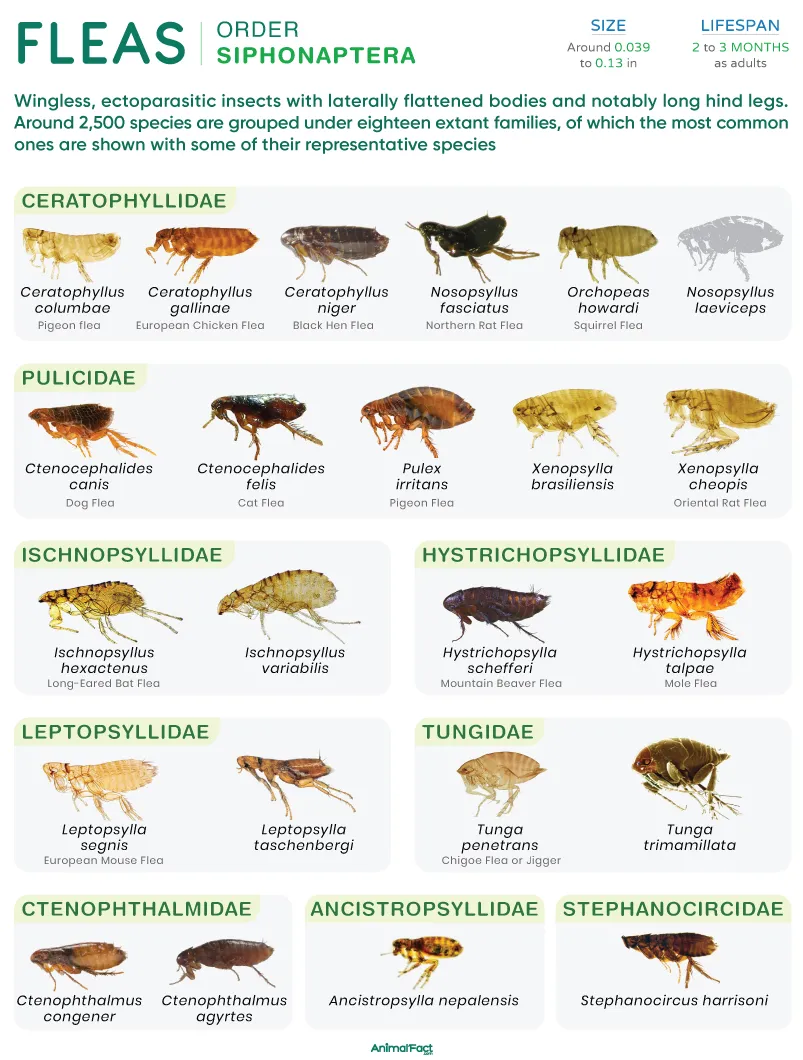
The head is small and rounded, carrying a pair of short, clubbed antennae that tuck into protective grooves when not in use. Some species have simple eyes offering limited vision, while others have none at all. What makes the head especially notable are the specialized mouthparts: needle-like structures called stylets pierce the host’s skin, while the labrum and maxillae form a narrow feeding channel through which blood is drawn.
The thorax houses three pairs of legs. The front and middle legs are relatively short, but the hind legs are dramatically elongated and packed with muscle, giving fleas their famous jumping ability. Each leg ends in sharp, curved claws that anchor the insect firmly to the host’s body — essential for staying put while the animal grooms, scratches, or moves around.
The abdomen consists of ten flexible, ring-like segments covered in an elastic cuticle that expands considerably after a blood meal. This region also contains the reproductive organs, with distinct structures in males and females that allow for mating and, eventually, egg-laying.
Where Fleas Come From: Taxonomy and Evolutionary History
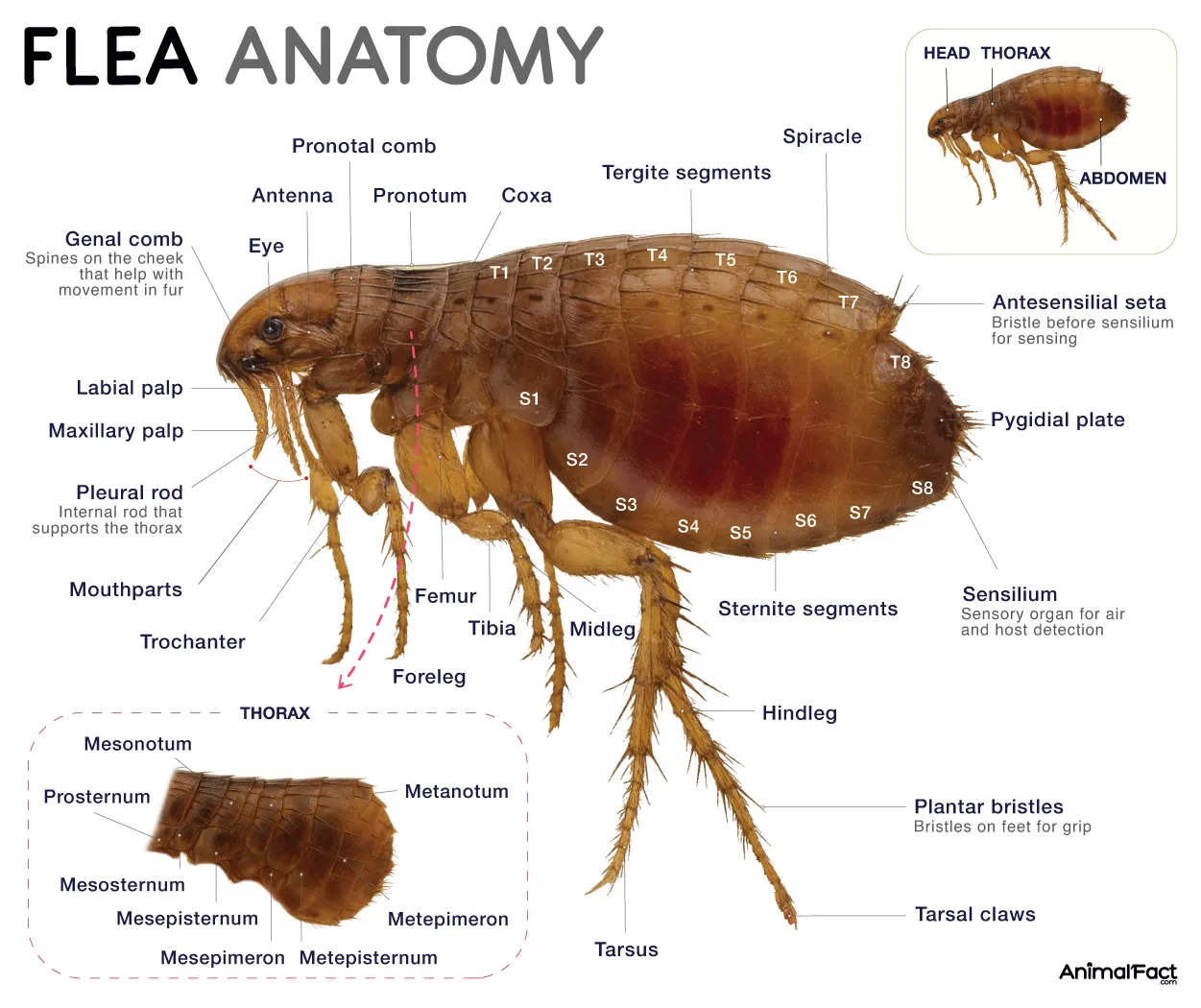
Fleas have an interesting classification history. Early naturalists, including Carl Linnaeus, initially grouped wingless invertebrates together based purely on the absence of wings. It wasn’t until the early 19th century, when French zoologist Pierre André Latreille reorganized insect classification around mouthpart structure as well as wings, that fleas were separated into their own order — Siphonaptera, derived from Greek words meaning “tube” and “wingless.”
Today, all known flea species are organized into 18 living families, ranging from the widespread Pulicidae (which includes common cat and dog fleas) to highly specialized groups like Ischnopsyllidae, which parasitize bats almost exclusively.
Evolutionarily, fleas are believed to have descended from scorpionflies. The earliest fossil evidence of flea-like ancestors dates back to the Middle Jurassic through Early Cretaceous periods, found primarily in northeastern China and Russia. Most of the flea families we recognize today emerged later, during the Paleogene period, as mammals diversified and provided new hosts for these parasites to exploit.
Where Fleas Live
Fleas thrive nearly everywhere in the world, but they reach their greatest diversity in warm, humid tropical and temperate regions — conditions that favor rapid development through their life cycle. Remarkably, fleas aren’t limited to warm climates alone; the Antarctic flea, which parasitizes Antarctic sea birds, holds the record as the most southerly insect species on Earth.
Host specificity varies enormously across flea species. Some are extreme specialists, found only on a single type of animal — armadillo fleas, bat fleas, and elephant shrew fleas are prime examples. Others, like the common cat flea, are generalists capable of infesting a wide range of mammals, which is part of why they spread so easily between pets and households.
Beyond the host’s body itself, flea eggs, larvae, and pupae are commonly found in soil, sand, animal nests, burrows, cracks in flooring, and household carpets — making thorough environmental cleaning just as important as treating the animal when managing an infestation.
What Fleas Eat
A flea’s diet changes dramatically depending on its life stage. Adult fleas are obligate blood-feeders, relying entirely on the blood of birds and mammals to survive and reproduce. Reproducing female cat fleas are particularly voracious, consuming an average of 13.6 microliters of blood daily — roughly 15 times their own body weight.
Larvae, on the other hand, lack the piercing mouthparts needed to feed on blood. Instead, they consume organic debris in their environment, including the feces of adult fleas (which is rich in undigested blood), decaying plant matter, and dead skin flakes shed by humans and animals.
How Fleas Feed and Move
When feeding, a flea pierces the host’s skin with its stylets and injects saliva containing anticoagulant compounds that keep the blood flowing freely, allowing it to be drawn up continuously through the epipharynx.
Fleas navigate through fur by grasping individual hair shafts with their clawed legs, often moving against the direction of hair growth to burrow closer to the skin’s surface.
Their jumping ability, however, is what truly sets them apart. Cat fleas can leap vertically up to 7 inches (18 cm) and horizontally up to 13 inches (33 cm) — a jump that, scaled to human proportions, would be equivalent to a person jumping over a hundred meters in the air. This extraordinary feat is powered not by muscle alone but by a special elastic protein called resilin, stored in the leg joints. Much like a compressed spring, the resilin pad stores energy as the flea prepares to jump, then releases it almost instantaneously to launch the insect forward.
Lifespan
Given adequate food and favorable environmental conditions, most adult fleas live for two to three months. Some species, such as the human flea, can survive over a year under the right circumstances. Without access to a blood meal, however, fleas typically survive only a few days — a vulnerability that underlies many flea-control strategies aimed at interrupting their feeding cycle.
Reproduction and the Flea Life Cycle
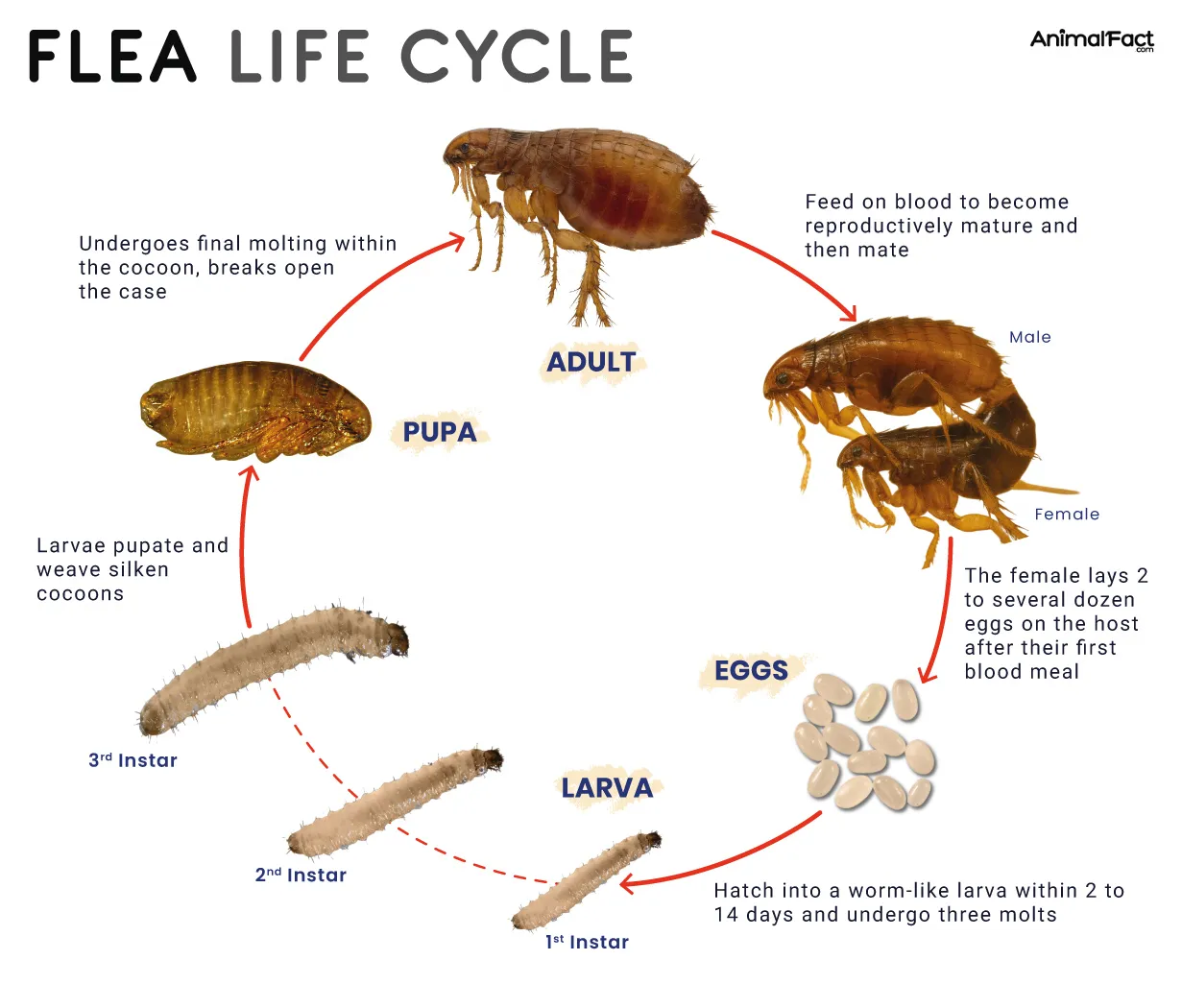
Mating occurs on the host’s body after the female has taken her first blood meal. While many flea species breed continuously, others have evolved to synchronize reproduction with their host’s biology — female rabbit fleas, for instance, respond to hormonal changes in a pregnant rabbit’s blood, timing their own reproductive maturity to coincide with the birth of the host’s young.
After mating, females lay eggs in batches ranging from a couple to several dozen at a time, and can produce more than 5,000 eggs over a lifetime. Eggs laid on the host’s fur typically fall off into the surrounding environment — bedding, carpets, or nesting material — where development continues.
The eggs hatch into legless, eyeless larvae that avoid light and feed on organic debris in dark, humid hiding spots. Over roughly 4 to 18 days, larvae molt three times before spinning silken cocoons and entering the pupal stage. After a final molt, the adult flea emerges from its cocoon, ready to find a host and begin the cycle anew.
Natural Predators
Despite their resilience, fleas face threats at every life stage. Eggs and larvae are preyed upon by ants, beetles (particularly lady beetles and carpet beetles), predatory bugs, and occasionally wolf spiders. Certain parasitic wasps lay their eggs directly on flea larvae, allowing their offspring to develop at the flea’s expense. Some nematode species are also effective natural enemies, infecting and killing flea larvae, pupae, and newly emerged adults.
Adult fleas aren’t safe either — birds such as swallows and chickens, along with lizards like geckos and skinks, frequently prey on them. Small mammals such as shrews and bats may consume fleas incidentally while hunting other insects, and fleas that end up in water can fall prey to dragonfly nymphs and certain fish species.
Final Thoughts
Fleas may be tiny, but their biology is anything but simple. From their spring-loaded jumping mechanism to their complex four-stage life cycle and remarkable host specificity, fleas represent millions of years of evolutionary fine-tuning as parasites. For pet owners, understanding this biology isn’t just a matter of curiosity — it explains why flea infestations are so persistent and why effective control requires addressing every stage of the life cycle, not just the adult fleas visible on an animal’s coat. Whether you’re dealing with an infestation at home or simply fascinated by the natural world, fleas are a striking reminder of how even the smallest creatures can be extraordinarily well-adapted survivors.
References
- Catalogue of Life. “Siphonaptera Taxonomic Overview.” catalogueoflife.org, 2023.
- Guinness World Records. “Most Southerly Insect.” guinnessworldrecords.com.
- Peer-reviewed entomological literature on flea evolutionary origins and Mecoptera ancestry.
- Published research on cat flea (Ctenocephalides felis) blood-feeding rates and reproductive biology.
- Studies on rabbit flea (Spilopsyllus cuniculi) reproductive synchronization with host hormonal cycles.
- Research on natural predators and parasitoids of flea larvae, including entomopathogenic nematodes such as Steinernema carpocapsae.