
For anyone passionate about Oldies music, few places offer a more meaningful glimpse into the origins of a global icon than the Elvis Presley Birthplace in Tupelo, Mississippi. Long before Elvis Presley transformed popular music and became the “King of Rock and Roll,” he was a humble boy growing up in modest surroundings, shaped by faith, family, and the rich musical traditions of the American South.
The Elvis Presley Birthplace Park preserves these early memories through carefully designed exhibits, historic buildings, and symbolic sculptures. Together, they tell the remarkable story of how an ordinary child developed into one of the most influential entertainers in music history. For international audiences interested in the golden era of American music, this historic site provides valuable cultural context that helps explain the roots of Elvis’ extraordinary career.
Elvis at 13: A Symbol of Humility and Hope
One of the park’s most recognizable landmarks is the life-sized bronze statue titled “Elvis at 13.” The sculpture was commissioned by the Elvis Presley Foundation following a suggestion from devoted Elvis fans Maurice and Maureen Colgan from Swords, Dublin, Ireland.
Rather than portraying the future superstar, the statue captures Elvis as a young teenager wearing oversized overalls, a loose open-collar shirt, and simple shoes. These details intentionally reflect the poverty and humble lifestyle experienced by the Presley family during Elvis’ childhood.
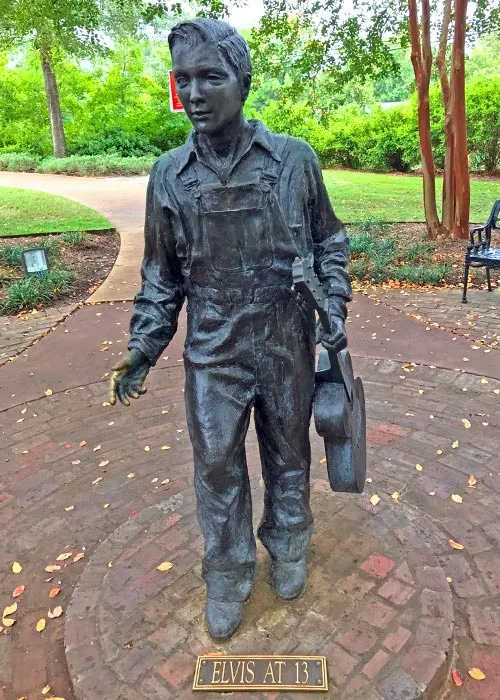
The sculpture stands at ground level instead of on a pedestal, allowing visitors to connect with Elvis as an ordinary person rather than an untouchable celebrity. To achieve historical accuracy, the sculptor carefully studied childhood photographs preserved in the museum, examining Elvis’ facial features, hairline, and body proportions. His height was even estimated by comparing him with classmates in a sixth-grade class photograph and measuring the bricks visible in the background.
The artist imagined young Elvis walking toward the Tupelo Overlook, where he might have sat with his guitar while dreaming about a brighter future. The statue’s placement carries deep symbolism: the chapel stands on one side, representing the spiritual values he learned in Tupelo, while the museum on the other side symbolizes the material success and challenges he would later encounter after moving to Memphis.
Unveiled in August 2002 and dedicated to Elvis fans worldwide, the statue has become one of the most photographed attractions in the park.
Elvis’ Childhood Church and the Birth of His Musical Passion
Music played a defining role in Elvis’ early life, and much of that inspiration came from the church his family faithfully attended.
The original church building has been relocated to the Elvis Presley Birthplace, allowing visitors to experience the environment that introduced Elvis to Southern gospel music—an essential influence on both his personal life and his musical career. Gospel music remained one of the strongest foundations of his artistic identity, even after he achieved worldwide fame.
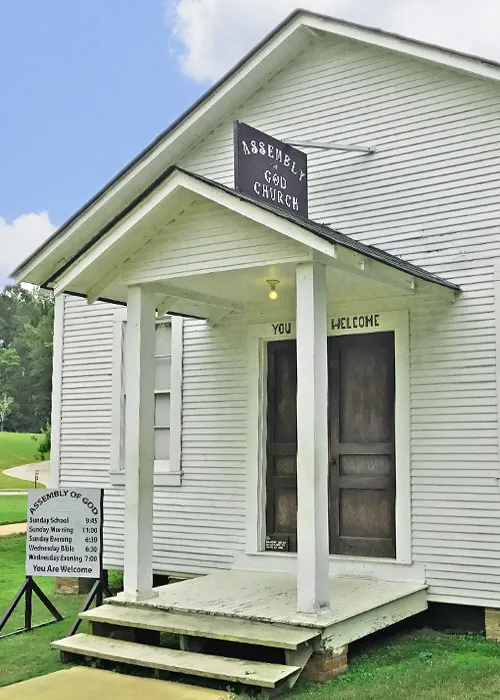
According to Assembly of God minister Brother Frank Smith, Elvis displayed an early fascination with music and eagerly wanted to learn the guitar. Brother Frank taught him three basic guitar chords—D, A, and E—which were enough for Elvis to play the beloved song “Ole Shep.” That simple lesson became one of the first important milestones in the musical journey that would eventually reshape American popular music.
Today, visitors can experience recreated Assembly of God Pentecostal services from the 1940s through an immersive multimedia presentation. The modest wooden church creates a striking contrast with the energetic worship services of the era. Guests witness a preacher moving passionately through the congregation, a spirited choir singing gospel hymns, and worshippers swaying joyfully to inspiring music.
Although Elvis never fulfilled his youthful dream of joining famous gospel quartets such as the Statesmen or the Blackwood Brothers, the influence of gospel never disappeared. Throughout his career, he continued recording many of the cherished church songs from his youth, preserving the emotional depth and spiritual power that defined his early musical experiences.
Becoming: The Transformation from Boy to Global Entertainer
Among the park’s most meaningful artistic installations is “Becoming,” a pair of statues that symbolize one extraordinary life at two different stages.
The artwork is inspired by stories that Elvis and his childhood friends often explored the hills and valleys surrounding the family’s property. According to this imaginative interpretation, one evening after playing outdoors, Elvis picked up his guitar and climbed to the overlook.
His messy hair, worn clothing, oversized garments, and hole in his sock all represent the difficult economic circumstances faced by the Presley family during those formative years.
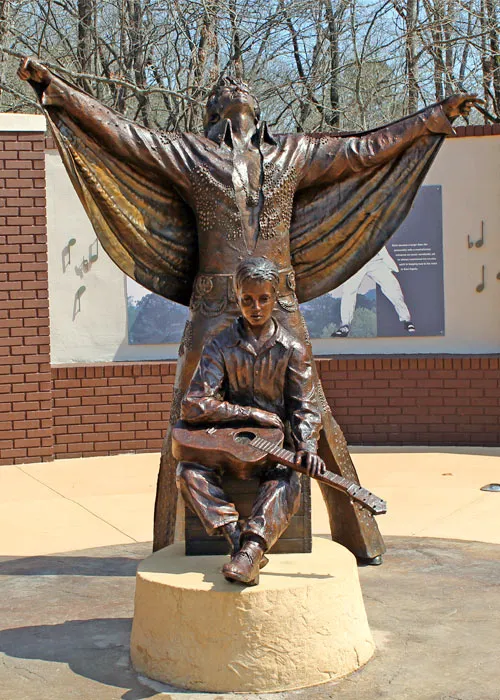
Sitting on a simple milk crate, the young Elvis gazed toward the lights of Tupelo while playing his guitar. Perhaps it was there that he first imagined a better future for himself and his family. While history cannot confirm the exact moment, the symbolism captures the universal power of dreams, determination, and hope.
Standing prominently at the overlook, the two sculptures together tell the story of transformation—from Elvis, the Boy, to Elvis, the Entertainer. Both figures rise from the same common ground, emphasizing that despite his worldwide success and revolutionary influence on music, Elvis remained deeply connected to the humble values and upbringing that shaped his character.
Why the Elvis Presley Birthplace Matters to Oldies Music Fans
For enthusiasts of Oldies music, the Elvis Presley Birthplace is more than a tourist attraction. It offers valuable insight into the cultural, spiritual, and historical influences that helped create one of the defining voices of the golden era of American music.
By preserving Elvis’ childhood home, church, and symbolic monuments, the site allows visitors to understand how family, faith, hardship, and perseverance contributed to the development of a performer whose music continues to inspire generations around the world. These experiences help explain why Elvis remains a central figure in discussions of music before 1975, classic rock and roll, Southern gospel, and the history of American popular music.
Conclusion
The Elvis Presley Birthplace tells a deeply human story—one of humility, faith, perseverance, and extraordinary ambition. Every statue, historic building, and exhibit reminds visitors that behind the international icon was once a young boy with simple dreams and an unwavering love of music.
For anyone interested in the history of Oldies music and the cultural roots of American musical heritage, exploring the Elvis Presley Birthplace offers a richer appreciation of the remarkable journey that transformed Elvis Presley into one of the world’s most influential entertainers. Discover these timeless stories and continue exploring the unforgettable melodies that shaped generations of music lovers.