
The mid-1950s represent a pivotal moment in music history, a time when a young truck driver from Memphis would step into a small recording studio and inadvertently change the cultural landscape of America and the world. This period, often referred to as the birth of “Oldies music” or the dawn of rock and roll, saw the meteoric rise of Elvis Presley from a local hopeful to an international phenomenon. For international audiences, understanding this era is key to grasping the foundation of modern pop culture, as it was here that the sounds of country, blues, and gospel fused to create something entirely new and unstoppable. This article chronicles the crucial early years of Elvis Presley’s career, from his first demo at Sun Studio to the cusp of his military service, exploring the moments that defined a legend and cemented his place as the undisputed King of Rock and Roll.
The Birth of a Sound: The Sun Studio Years
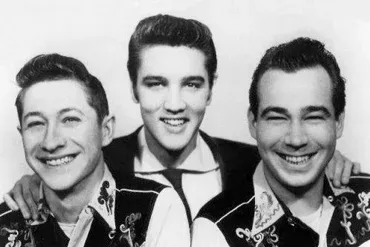
Elvis’s journey began not with a grand plan, but with a series of small, serendipitous steps. In January 1954, at the age of 19, he made a demo acetate at the legendary Sun Studio, a modest recording space that would become hallowed ground in music history. It was a humble start, with Elvis still working various day jobs. By April, he had joined Crown Electric Company, driving a delivery truck and studying to become an apprentice electrician at night. The turning point came on June 6, 1954, when Sun Records owner Sam Phillips, acting on a suggestion from assistant Marion Keisker, called Elvis in to record a ballad. The session was unremarkable until Phillips asked the young singer what he could sing. What followed was a raw display of energy that led Phillips to pair Elvis with local musicians Scotty Moore (guitar) and Bill Black (bass) to see if they could find a unique sound.
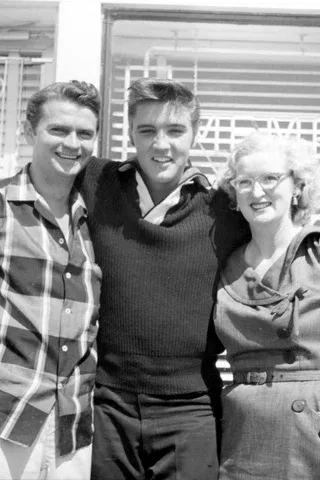
The chemistry wasn’t immediate. It was during a break on July 5, 1954, that everything clicked. As the session was winding down, Elvis and the band broke into a sped-up, energetic version of Arthur “Big Boy” Crudup’s blues number, “That’s All Right.” It was a spontaneous moment of creativity that captured the very essence of what would become rock and roll. Sam Phillips knew he had something special. The song, backed with a reimagined version of Bill Monroe’s “Blue Moon of Kentucky,” became the first of five singles released on the Sun label. This was the birth of the “Oldies music” sound that would soon captivate a generation. Throughout the summer of 1954, Elvis, Scotty, and Bill began performing together, playing small clubs throughout the South while Elvis kept his day job at Crown Electric. Their early success was modest, but the raw energy and unique blend of musical styles were beginning to draw attention.
Breaking Through: From the Louisiana Hayride to National Attention
While the local success was encouraging, a major breakthrough was still elusive. On October 2, 1954, Elvis made his only appearance on the “Grand Ole Opry,” the premier stage for country music at the time. The performance was not well-received; legend has it that an Opry official suggested the young singer go back to driving a truck. It was a painful disappointment, but not a career-ender. Just two weeks later, on October 16, 1954, the trio found a more welcoming home on the “Louisiana Hayride,” a live, Saturday night radio show broadcast from Shreveport, Louisiana. The “Hayride” was the “Opry’s” chief competitor, reaching 190 stations across 13 states. The show embraced Elvis’s new sound, and he signed a contract for 52 Saturday night appearances. This regular exposure was a crucial stepping stone, but it also tethered him to the South, limiting his ability to travel and expand his audience on a larger scale.
By early 1955, Elvis had signed with manager Bob Neal and was introduced to a man who would become the most influential figure in his career: “Colonel” Tom Parker. A savvy promoter with a history in country music, Parker began taking an interest in the rising star. As 1955 progressed, Elvis, Scotty, and Bill continued touring, often in package shows with established country stars, with Parker increasingly involved. Drummer D.J. Fontana joined the band, solidifying their sound. Elvis’s live performances were becoming legendary for the frenzied reaction they provoked. His unique style, combined with his good looks and what was then considered scandalously provocative hip movements, caused a sensation. Teenagers, especially young women, would storm the stage, creating near-riot conditions. This raw, unbridled energy was a new phenomenon, and it was starting to attract national media attention.
The RCA Revolution and the Explosion of a Phenomenon
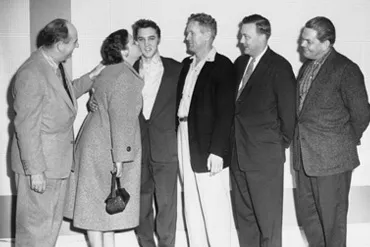
The year 1956 was the year Elvis Presley exploded onto the world stage. It began with a landmark business deal. On November 20, 1955, Elvis signed his first contract with RCA Records. Colonel Parker negotiated the sale of Elvis’s Sun contract to RCA for an unprecedented $35,000, a sum that included a $5,000 bonus for the singer himself. This was a massive vote of confidence in the young star. RCA immediately re-released his five Sun singles, and in January 1956, Elvis entered RCA’s Nashville studio for his first major-label recording session. Among the early Elvis songs recorded that day was a moody, blues-infused track that would become his first smash hit: “Heartbreak Hotel.”
Released on January 27, 1956, “Heartbreak Hotel” b/w “I Was the One” sold over 300,000 copies in its first three weeks. It went on to top Billboard’s pop singles chart for eight weeks, also hitting #1 on the country chart and #5 on the R&B chart. It was Elvis’s first single to sell over a million copies, earning him his first gold record. The momentum was unstoppable. On January 28, Elvis made his first network television appearance on the Jackie Gleason-produced “Stage Show,” marking the beginning of his relationship with the small screen. Just months later, on March 23, RCA shipped his debut album, “Elvis Presley,” which became the first album in his discography to reach #1 on the pop album chart and earn a gold award.
Controversy, Television, and Hollywood
As Elvis’s fame grew, so did the controversy. His energetic performances and the “black-influenced” sound of his music drew criticism from established cultural and religious figures. Yet this only seemed to fuel his popularity. His appearances on national television became major cultural events. His second appearance on “The Milton Berle Show” on June 5, 1956, featured a playful but sensuous performance of “Hound Dog” that drove the studio audience wild and outraged many adult viewers and the press. This was followed by a more subdued, and famously bizarre, performance on “The Steve Allen Show,” where Allen had Elvis dress in a tuxedo and sing “Hound Dog” to a live basset hound—a deliberate attempt to lampoon the earlier controversy.
Despite the criticism, the ratings were undeniable. Ed Sullivan, who had initially sworn he would never have Elvis on his show, paid an unprecedented $50,000 for three appearances. On September 9, 1956, Elvis made the first of these appearances on “The Ed Sullivan Show,” attracting a record-breaking 80% of the national viewing audience. His final appearance on January 6, 1957, is remembered for the censorship that had him filmed only from the waist up—a humorous footnote given the context of the time, especially as he performed the gospel standard “Peace in the Valley.” Sullivan himself praised Elvis on air, calling him “a decent, fine boy,” helping to diffuse some of the controversy and cementing his acceptance into mainstream American households.
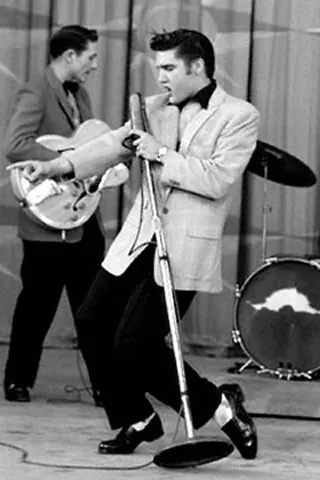 Elvis Presley performing on the Milton Berle Show, a performance that sparked nationwide controversy and captivated youth
While conquering music and television, Elvis also began his film career. His first movie, “Love Me Tender,” premiered in November 1956 and was a box office smash. The film was a Civil War-era melodrama that showcased Elvis’s on-screen charisma. By the end of 1956, the phenomenon was in full swing. The Wall Street Journal reported that Elvis merchandise had grossed $22 million in sales in just a few months, with everything from hats and t-shirts to lipstick and cologne bearing his image. He had become the primary symbol of a new youth culture, a figure who, whether intended or not, had begun a cycle of change in music, pop culture, and the social mores of America. His unique blend of white country, black R&B, and gospel, combined with his raw charisma, had set a new course for the future.
A Star at Home and Abroad: 1957 and the Road to Graceland
The year 1957 began with Elvis continuing his unprecedented run of success. He began production on his second film, “Loving You,” and started dyeing his hair black, a stylistic change that would become iconic. In February, the New York Times ran a story titled “Presley Records a Craze in Soviet Union,” noting that bootleg recordings on discarded X-ray plates were being sold on the black market in Leningrad for a high price, a testament to his international appeal even behind the Iron Curtain. That spring, he made a significant personal and symbolic investment, purchasing the Graceland Mansion for $102,500, a home for himself, his parents, and his grandmother. It would become his sanctuary and the spiritual home of his legacy.
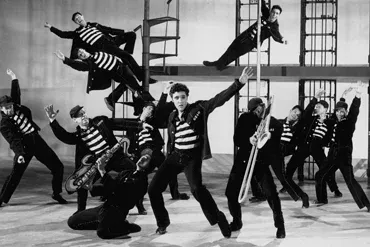
In April 1957, he performed outside the U.S. for the first time with shows in Toronto and Ottawa, Canada. Later that year, he began work on what would become one of his most iconic films, “Jailhouse Rock.” The film’s title song was a smash hit, and the elaborate production number for the song is now recognized as a forerunner to the modern music video. Critics and fans alike would later consider this film one of his best acting performances, second only to “King Creole.” In November, he performed in Hawaii for the first time, shows that would also be his last public appearances before a life-changing event loomed on the horizon: military service.
Conclusion
The period from 1954 to 1957 was not merely the beginning of a career; it was the forging of a cultural icon. From the humble concrete walls of Sun Studio to the bright lights of Hollywood and the living rooms of millions through television, Elvis Presley’s early years laid the groundwork for modern music and celebrity. His journey from a truck driver with a unique voice to the King of Rock and Roll was rapid, chaotic, and transformative. The early Elvis songs recorded during this time—”That’s All Right,” “Heartbreak Hotel,” “Hound Dog,” and “Jailhouse Rock”—remain timeless classics of the Oldies music genre, representing a pure, raw energy that still resonates today. As he enjoyed his first Christmas at Graceland in December 1957, he also received his draft notice, marking the end of one incredible chapter and the beginning of another. His legacy, however, was already secure. For those looking to understand the roots of rock and roll and the birth of modern pop culture, the story of Elvis’s formative years is essential, offering a captivating glimpse into a moment when music changed forever.
To explore more about the life and career of Elvis Presley, including his journey from 1958 to 1961 and beyond, be sure to visit Graceland and follow the official channels for the latest news and historical insights into this enduring American legend.