
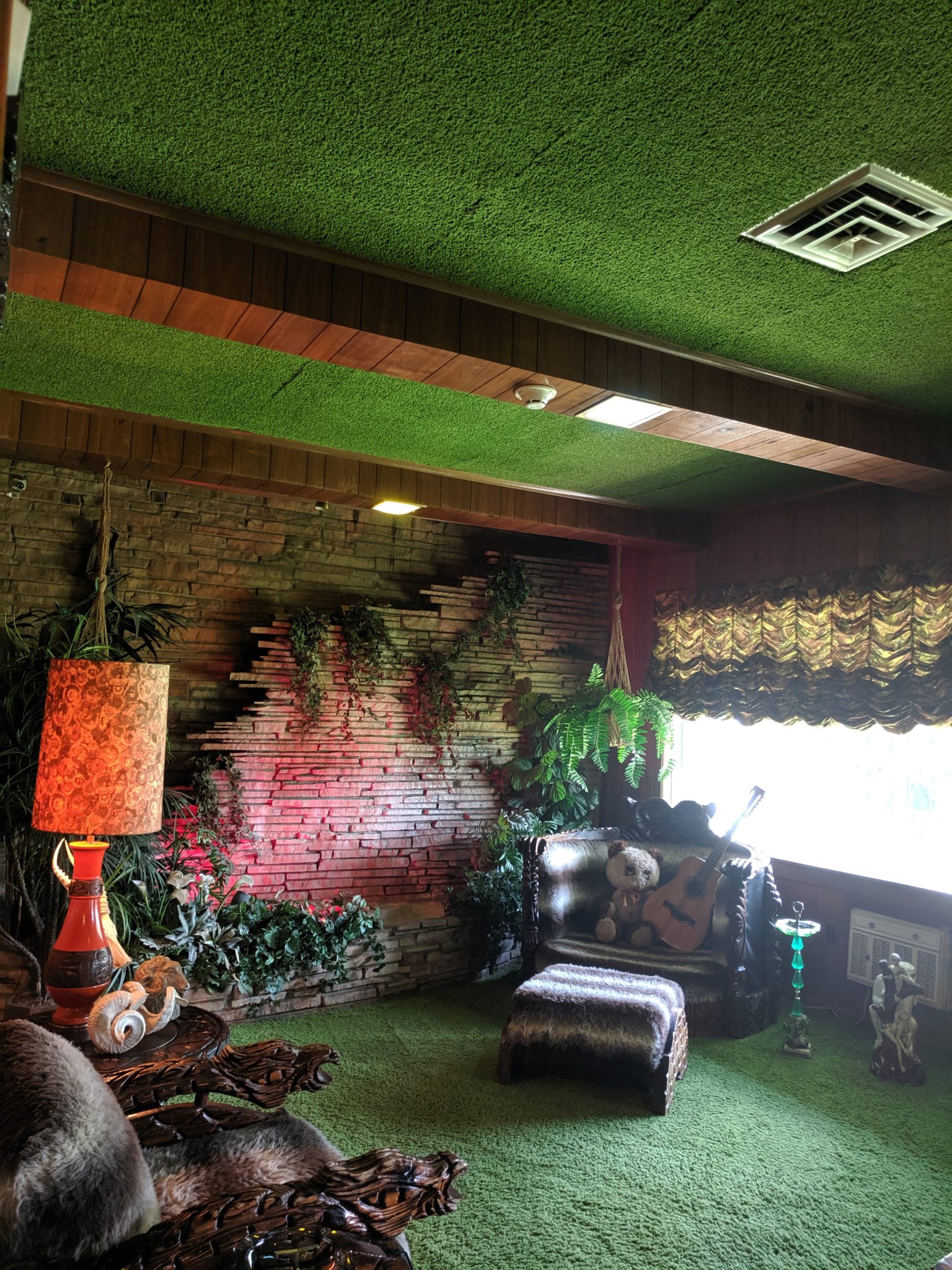
Elvis Presley’s Graceland mansion in Memphis, Tennessee, holds many iconic spaces, but perhaps none as evocative and personal as the room he affectionately called “the den,” later immortalized as the “Jungle Room.” More than just a uniquely decorated space, it served as the nerve center of his home life and, crucially, as the location for his final recording sessions. This room, with its distinctive décor and rich musical history, offers a captivating glimpse into the King of Rock and Roll’s personality and his enduring legacy.
The Genesis of the Jungle Room
Originally constructed in 1965 as an addition to Graceland, the room was initially conceived as a den. Its transformation into the now-famous “Jungle Room” began with its furnishings and a striking, built-in waterfall of cut fieldstone. The space, measuring 14 by 40 feet, was part of a larger section at the rear of the house that also included a four-car garage, later remodeled into an apartment and now serving as additional exhibit space.
The “Jungle Room” moniker, however, was bestowed by a journalist years after Elvis’s death, upon Graceland’s opening to the public in 1982. Despite its unofficial name, the room quickly became a fan favorite. It offered visitors a more intimate connection to Elvis’s personality, a space where his eccentric style, playful humor, and sheer bravado were palpable. Today, it continues to draw hundreds of thousands of visitors annually, eager to immerse themselves in its unique ambiance.
Recording in the Heart of Graceland
The Jungle Room’s significance extends beyond its aesthetic. In 1976, RCA set up a mobile recording studio within the den, allowing Elvis to record some of his most poignant material in the comfort of his own home. These sessions, conducted in February and October of that year, produced tracks that would form the basis of his final two albums released before his death: From Elvis Presley Boulevard, Memphis, Tennessee (1976) and Moody Blue (1977).
The The Jungle Room Sessions FTD CD offers an unvarnished look at these recordings, featuring 17 undubbed alternate takes that, for many, surpass the released versions in emotional depth. Songs like “The Last Farewell,” “I’ll Never Fall in Love Again,” “Solitaire,” and “Bitter They Are, Harder They Fall” showcase Elvis’s vulnerability and soulful delivery, often mirroring his personal struggles. Yet, the sessions also captured his ability to lighten the mood with tracks such as “Moody Blue” and “Way Down,” demonstrating the versatility and enduring power of his voice.
A Personal Sanctuary and Creative Space
Elvis Presley never referred to the room as the “Jungle Room”; for him, it was simply “the den.” This personal sanctuary was a place where he could relax and entertain his inner circle. The den’s design, with its thick drapery casting the room in perpetual dimness, made it an ideal retreat. Initially decorated by his father, Vernon, with furniture from Sears, the room evolved over time. The iconic flagstone waterfall, a focal point of the north wall, was added around 1966.
Despite its intended purpose as a refuge, the Jungle Room was not without its challenges. The waterfall feature, while visually striking, proved problematic, leading to occasional flooding. Even a small fire, sparked by the waterfall shorting out during Graceland’s 1971 Christmas party, added a dramatic chapter to the room’s history.
The room also bore witness to Elvis’s changing personal life. Gifts from his former wife, Priscilla, remained in the den, juxtaposed with the arrival of his new girlfriend, Linda Thompson, who influenced a significant redecoration in the early Seventies. This period, often described by scholars as the “red period,” saw Graceland, including the den, adorned with heavy red velvet, ornate chairs, and lavish décor, reflecting a flamboyant aesthetic that pushed the boundaries of taste.
The Final Encore
The decision to bring a mobile recording studio to Graceland stemmed from Elvis’s increasing disinterest in traveling to professional studios and the closure of prominent Memphis recording facilities. RCA’s producer, Felton Jarvis, proposed the innovative solution, a concept previously explored with success on a smaller scale for the Raised on Rock album.
The Jungle Room, with its expansive floor plan and sound-absorbing shag carpeting, provided an unexpectedly suitable environment for recording. Despite the makeshift setup—with band members and instruments squeezed into the room and engineers operating from a truck outside—the sessions produced remarkable results. Elvis, often entering the studio late at night, fed off the energy of the musicians, creating an intimate and dynamic recording atmosphere.
The recordings from these sessions, particularly tracks like “Hurt,” showcased a raw power and passion that harked back to the peak of his vocal prowess. Although the sessions were eventually cut short due to Elvis’s declining health and personal turmoil, the Jungle Room sessions remain a testament to his enduring artistry and a cherished part of his legacy.
The Jungle Room stands as more than just a quirky, tiki-inspired space; it is a monument to Elvis Presley’s final creative endeavors and a deeply personal sanctuary that offers a unique window into the life of the King of Rock and Roll. It remains a pilgrimage site for fans, a place where the echoes of his legendary voice continue to resonate.