
Elvis Presley, a figure universally hailed as the king of rock and roll, was, in his personal life, the antithesis of the rebellious, delinquent persona often associated with his music. Far from being “animalistic,” as his performance style was sometimes denounced, Presley was known for his shyness, deference, and deep devotion to his parents. The word “nice” frequently described him, painting a portrait of a man far removed from the rebellious archetype.
Presley never truly saw himself as a rock and roll singer, despite his indelible association with the genre. While he performed rock and roll songs, his repertoire spanned various musical styles. He was acutely aware that popular music was a lucrative business, and he was content to sing rock and roll if it offered greater financial rewards. As he stated, “I have to do what I can do best.” However, his motivation wasn’t solely financial; he sang because he was, at heart, a singer. His immense popularity, in turn, introduced a diverse audience to musical genres they might otherwise have overlooked.
Born in East Tupelo, Mississippi, in 1935, Presley’s father, Vernon, was a laborer who moved frequently for work. The family resided for a period in a Black neighborhood in Tupelo, though they occupied a “White” house and harbored no apparent racial intolerance. Elvis, an only child—his twin brother was stillborn—shared a particularly strong bond with his mother, Gladys, a dynamic and well-liked woman. Despite this closeness, the family was somewhat insular. In school, Elvis was perceived as an outsider, occasionally facing bullying. His distinctiveness stemmed not from exceptional talent, but from his teenage fashion sense, which included bolero jackets, ascots, and striped dress pants. His demeanor remained reserved and respectful. In 1948, the family relocated to Memphis, where Presley attended Humes High School.
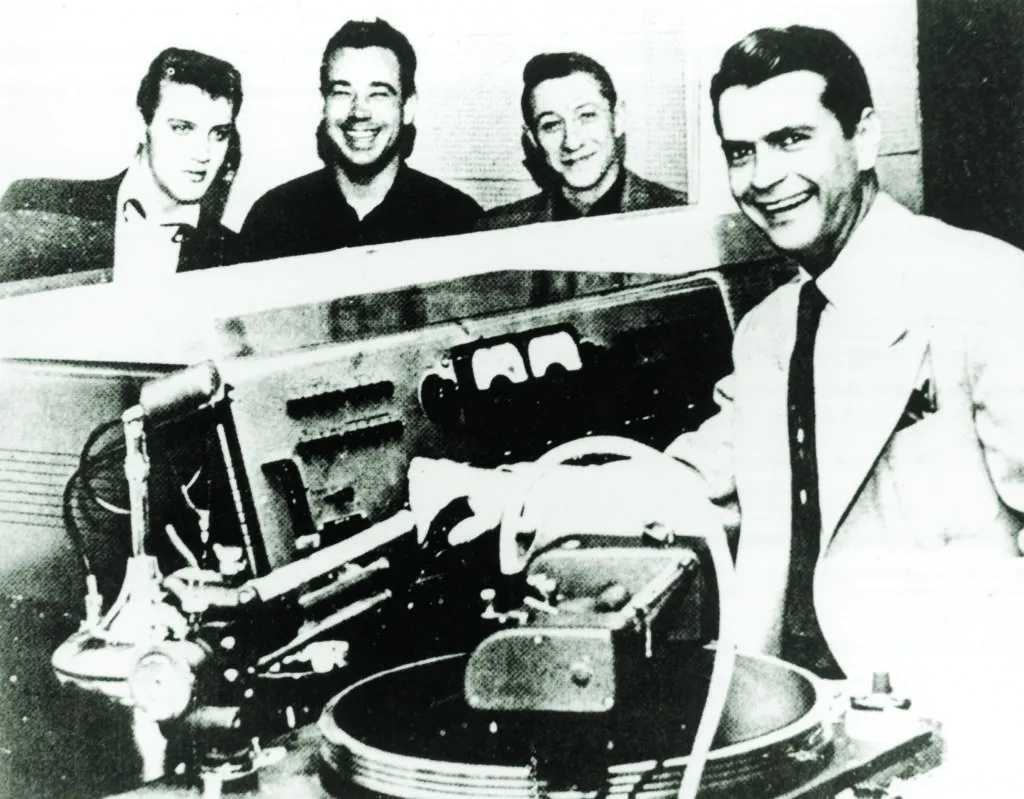
The Memphis Recording Service, founded by Sam Phillips, was more than just a recording facility; it was born from Phillips’s vision. Like Presley, Phillips hailed from the Deep South, born in Lovelace Community, Alabama, in 1923. After gaining experience in radio, he moved to Memphis in 1945, viewing it as a cultural epicenter. In 1950, he established the Memphis Recording Service in a modest space on Union Avenue, near Beale Street, the vibrant heart of Memphis’s music scene.
The studio’s slogan, “We record anything—anywhere—anytime,” encompassed a wide array of events, from church services to weddings and funerals. Yet, Phillips’s underlying ambition was to create a space where any aspiring musician could freely experiment and record. Phillips offered guidance and encouragement, recording promising talent and allowing performers to produce their own records for a fee.
Phillips was known for his patience with musicians, his technical expertise, and his supportive nature. He believed music was a profound form of self-expression, with a particular fondness for blues songs and anything that sounded unique. In contrast to the smooth, harmonic pop sound prevalent in 1950, Phillips favored imperfection, as it lent music a sense of spontaneity and authenticity—qualities that would define rock and roll. Consequently, the Memphis Recording Service became a haven for musicians overlooked by others, many of them Black artists. Phillips played a pivotal role in shaping the sound of rock and roll, being among the first to record influential artists like Howlin’ Wolf, Ike Turner, and B.B. King.
To distribute his recordings, Phillips initially partnered with independent labels such as Modern Records and Chess. However, encountering untrustworthy dealings, he launched his own label, Sun Records, in 1952.
Presley’s initial visit to the Memphis Recording Service was reportedly to record a song for his mother, though accounts suggest the family did not own a phonograph. He paid $3.99 plus tax to record “My Happiness,” a popular song previously covered by artists like Ella Fitzgerald, and “That’s When Your Heartaches Begin,” an Ink Spots classic. Whether Sam Phillips was present during this recording session remains debated, but a note beside Presley’s name read, “Good ballad singer. Hold.” A year later, Phillips invited Presley back to explore a ballad. When the song didn’t quite work, Phillips, following his usual practice, asked Presley to perform all the material he knew. After three hours, the session concluded without a breakthrough. Nevertheless, Phillips decided to continue the experiment, forming a trio with Presley, guitarist Scotty Moore, and bassist Bill Black. On July 5, 1954, they entered the studio.
Their initial attempts included a Bing Crosby song, “Harbor Lights,” followed by a ballad and a country tune. After multiple takes yielded no satisfactory results, and as the musicians prepared to leave, Presley recalled a song he’d heard years before and began improvising. This song was “That’s All Right, Mama,” an R&B track originally recorded by Arthur “Big Boy” Crudup. Moore recounted, “Elvis just started singing this song, jumping around and acting the fool, and then Bill picked up his bass, and he started acting the fool, too, and I started playing with them.” Phillips, hearing the commotion, emerged from the control room and requested they start from the beginning. After several more takes, they had a recording. Phillips shared the acetate with local White disc jockey Dewey Phillips (no relation), who played it repeatedly on his WHBQ radio show, resulting in an overnight sensation.
To create a commercially viable single, a B-side was needed. Presley, Moore, and Black recorded an upbeat cover of the bluegrass song “Blue Moon of Kentucky.” In July 1954, Elvis Presley’s debut single was released. Sam Phillips, in his promotional efforts, highlighted the record’s broad appeal across pop, country, and rhythm and blues audiences. A press release stated, “Operators have placed [‘That’s All Right’] on nearly all locations (White and Colored) and are reporting plays seldom encountered on a record in recent years… According to local sales analysis, the apparent reason for its tremendous sales is because of its appeal to all classes of record buyers.”
The music industry trade press quickly recognized Presley’s potential. A Billboard article noted, “Presley is the potent new chanter who can sock a tune for either the country or the r. & b. markets… A strong new talent.”
Interestingly, Arthur Crudup never received royalties from Presley or Sun Records. However, Crudup himself had drawn heavily from a Big Joe Turner boogie-woogie number, “That’s All Right, Baby,” recorded in 1939 with Pete Johnson on piano, for both lyrics and music.
Sam Phillips was widely reported to have said, “If I could find a White man who had the Negro sound and the Negro feel, I could make a billion dollars,” a claim he later denied. Nevertheless, it’s evident that if such an individual were sought, Elvis Presley would not have been the initial choice. Phillips had brought Presley in as a ballad singer, and Presley largely identified himself as such. His personal favorite among his own recordings was “It’s Now or Never,” a song far removed from blues or rock and roll, being a Neapolitan-style rendition of “O Sole Mio.”
“That’s All Right, Mama” originated as a spontaneous moment, even considered a joke by Moore and Black. Its success was unpremeditated, with Presley later admitting he had never sung in that style before.
The fact that Presley remembered the song and Moore and Black knew how to play it is noteworthy, as they had not typically associated it with White artists. The creation of rock and roll in Memphis by Phillips, Moore, and Presley was a process of experimentation and discovery, not a manufactured product, much like the artistic developments of Jackson Pollock and Lee Krasner.
While “That’s All Right, Mama” achieved regional success, it wasn’t the top-selling single in Memphis. “Blue Moon of Kentucky” garnered similar popularity. Presley didn’t break onto the national charts for another year. By this time, many White performers had transitioned from adapting R&B songs into a pop style to directly imitating them. In 1954, WDIA, a powerful radio station, expanded its reach across the mid-South, and by 1955, over six hundred stations in 39 states were programming for Black listeners, indicating a broader audience. This shift signaled a clear direction for the evolving sound of popular music.
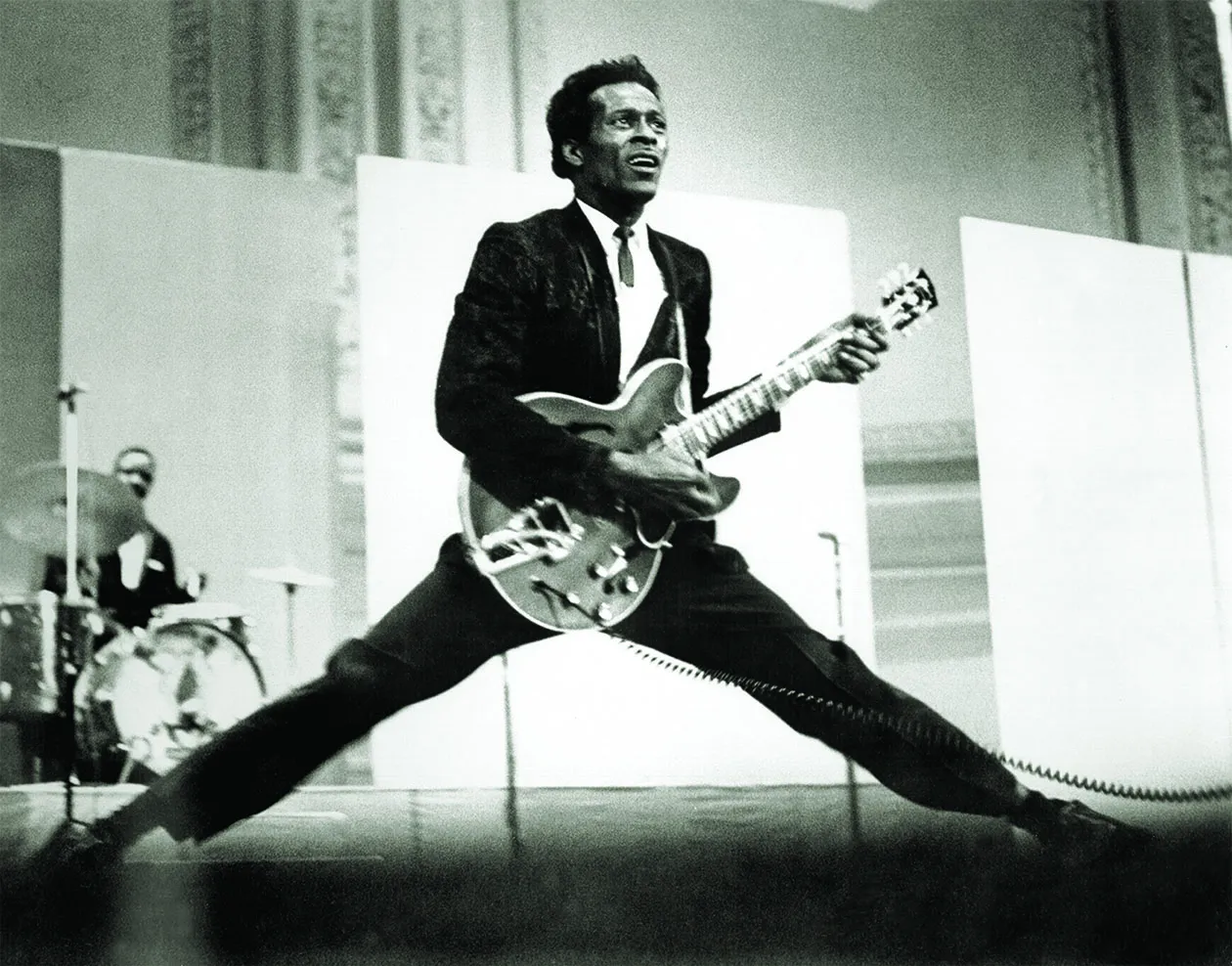
Consequently, when Pat Boone approached Dot Records in Gallatin, Tennessee, in the summer of 1955—prior to Presley’s national breakthrough—he was surprised to be asked to perform a rhythm and blues song. Like Presley, Boone initially identified as a ballad singer. However, his rendition of Fats Domino’s “Ain’t That a Shame” reached number one on the pop chart. That same summer, Bill Haley’s “Rock Around the Clock” topped the charts after its inclusion in the film Blackboard Jungle. Black artists also began to reap the benefits of the burgeoning sound. In May 1955, Chuck Berry recorded “Maybellene” for Chess Records; the label promptly sent it to prominent New York disc jockey Alan Freed, propelling it to number one on the R&B chart and number five on the pop chart. Little Richard’s “Tutti Frutti,” released shortly after, reached number 17 on the pop chart by January. Both Boone and Presley covered the song, with Boone’s version hitting number 12 and Presley’s reaching number 20 as the B-side to “Blue Suede Shoes.”
Thus, Presley was one of many artists, both Black and White, striving to meet the growing demand for R&B-influenced music. Initially, Presley was associated not with rock and roll, but with country, or “rockabilly,” music. An early national profile in Life magazine in April 1956 referred to him as a “hillbilly singer.” His transformation into a pivotal figure in the evolution of pop music was significantly influenced by television.
In 1948, only 2 percent of American households owned a television set. By 1952, this figure rose to approximately one-third, and by 1955, a remarkable 65 percent of households had televisions, with ownership reaching 86 percent by 1959. Primetime programming was dominated by variety shows featuring musical acts, hosted by personalities like Ed Sullivan, Steve Allen, Milton Berle, and Perry Como. With limited channels available, these shows attracted enormous audiences, often numbering in the tens of millions. Television exposure became the most effective method for selling records.
Television’s visual medium made an artist’s race undeniable. Many sponsors were hesitant to support racially mixed shows, fearing alienation of White viewers in certain regions, a concern also present in radio advertising but less pronounced due to the greater number of stations and perceived listener choice. In its early national broadcasts, American Bandstand notably did not feature any Black performers. The limited number of local television stations offered little diverse programming, inadvertently leading television to re-segregate the media audience. While radio had opened musical doors to different demographics, television, in this regard, appeared to close them.
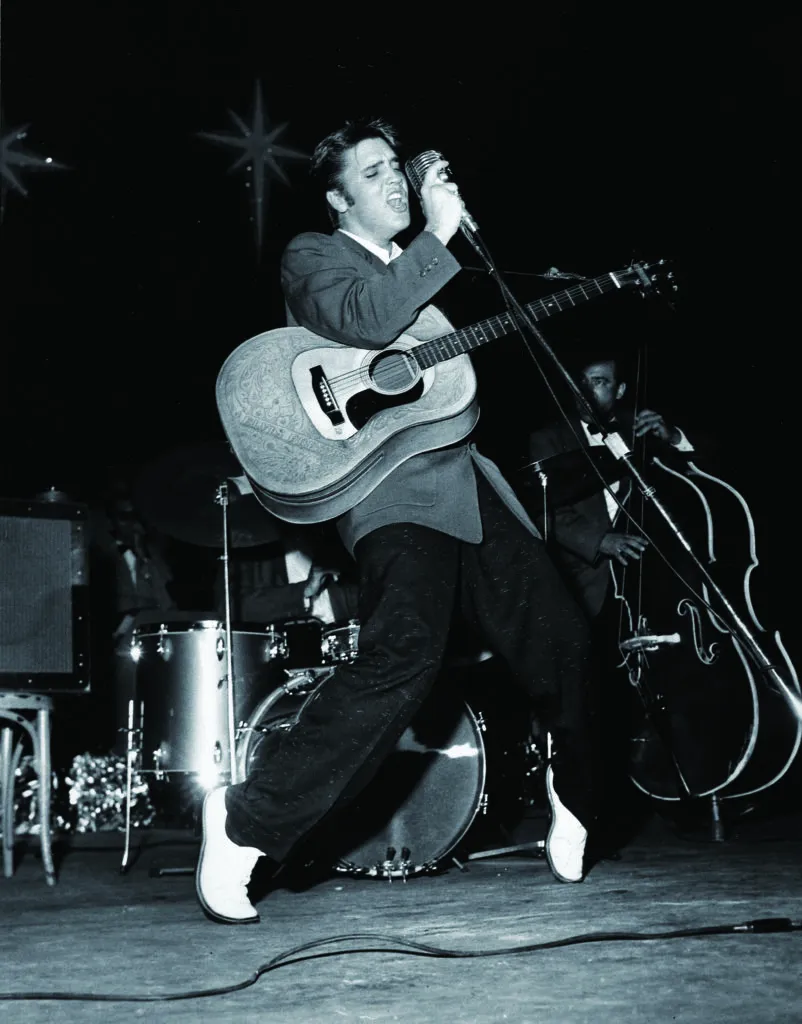 Performing transformed Elvis—here in Miami
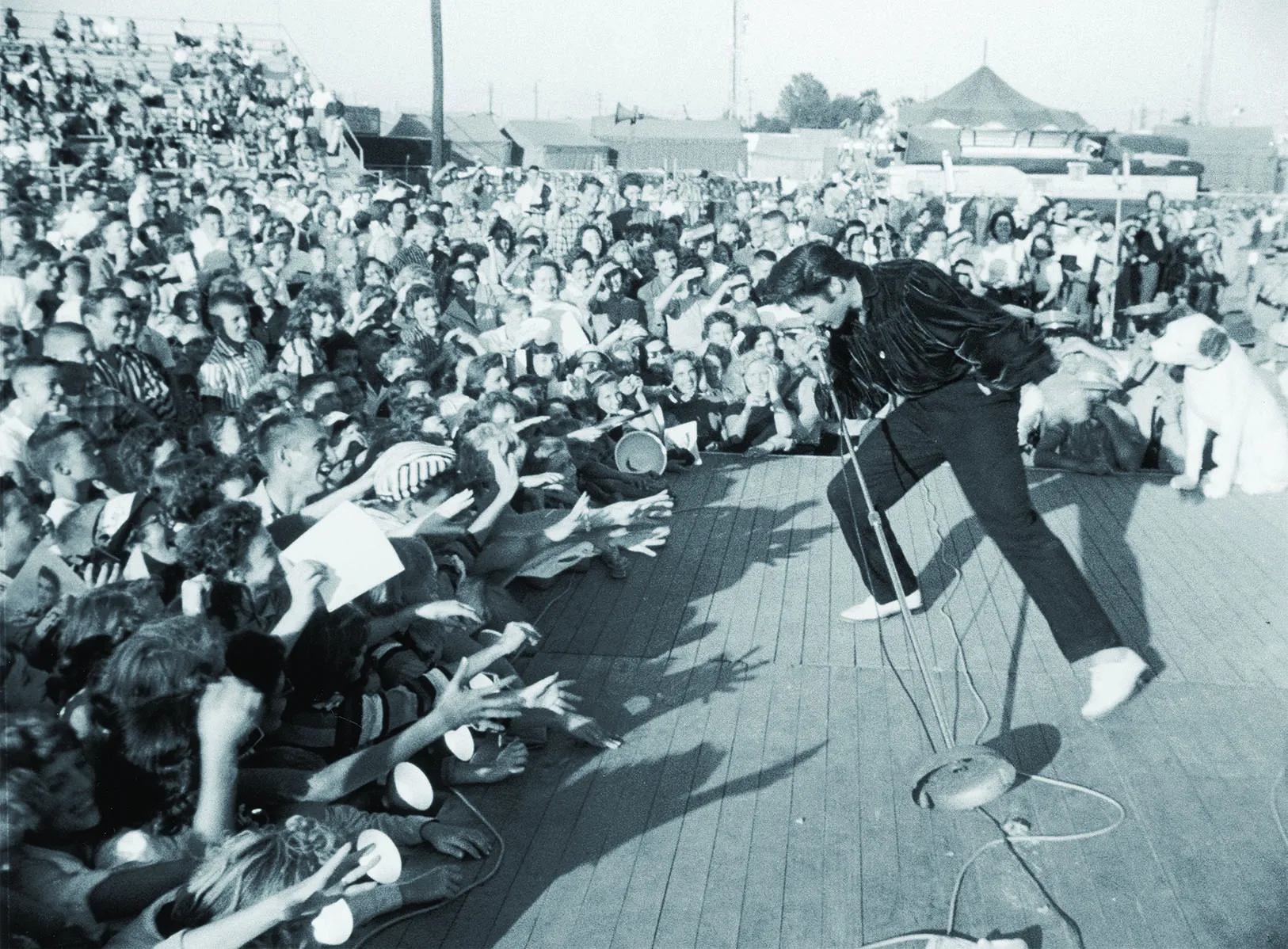
Presley was exceptionally suited for television, and not solely due to his race. Onstage, before an audience, the shy, mumbling young man transformed into a gyrating, charismatic performer with a captivatingly sexy sneer. His debut television appearance was on the Jimmy and Tommy Dorsey’s Stage Show in January 1956. However, his major breakthrough occurred in June of that year when he performed “Hound Dog” twice on The Milton Berle Show, the second rendition featuring a slow-motion bump-and-grind routine. An estimated forty million viewers watched, and Berle later claimed to have received 500,000 negative letters, solidifying Presley’s burgeoning stardom. Presley delivered a similar performance of “Hound Dog” in September during his first appearance on The Ed Sullivan Show, which attracted an astounding sixty million viewers, representing 83 percent of the television audience at the time. By then, “Hound Dog,” coupled with its B-side “Don’t Be Cruel,” had already become the first single to dominate all three Billboard charts.
In October, Presley’s debut album, Elvis Presley, was released by RCA Victor, reaching number one on the pop albums chart and remaining there for ten weeks. The song that introduced Presley to European audiences, “Heartbreak Hotel,” entered the British pop charts in May 1956.
The album was subsequently released in Britain on the HMV (His Master’s Voice) label in October, also reaching number one. The musical revolution was well underway.
From a reception standpoint, White performers were adopting a “Black sound,” as reflected in chart performance. However, the production side presented a more complex picture, as the concept of a distinct “Black sound” or “White sound” is an oversimplification. “Hound Dog,” one of Presley’s most significant hits, was originally recorded in 1953 by Big Mama Thornton on the Peacock label, reaching number 3 on the national R&B charts. Notably, Thornton did not write the song; it was penned by Jerry Leiber and Mike Stoller, two 20-year-old songwriters, on commission from Thornton’s producer, Johnny Otis. While Otis was widely believed to be Black, he was, in fact, Greek-American.
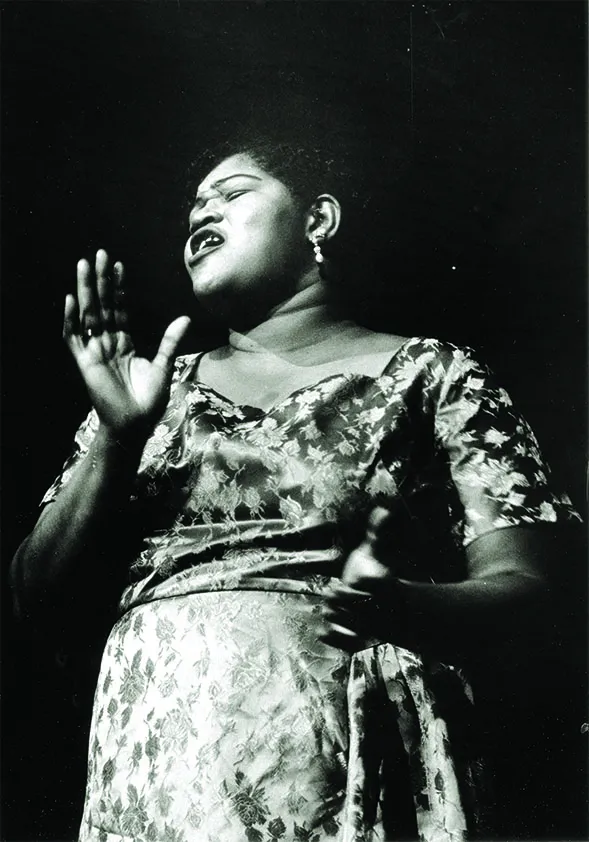
According to Leiber and Stoller, they wrote “Hound Dog” in a matter of minutes. Initially intended as a raunchy blues number, Thornton insisted on a more crooning delivery. Leiber had to demonstrate the intended style for her. Otis, also a musician, played drums during the session and received co-writing credit.
Thornton’s rendition on the record, therefore, can be seen as an imitation of the blues style, as she was adapting a specific sound.
Leiber and Stoller went on to write numerous rock and roll standards, including “Kansas City,” “Jailhouse Rock,” and “Stand By Me.” “Hound Dog” itself was covered over 200 times and inspired a parody version, “Bear Cat,” by Rufus Thomas, recorded on the Sun label.
However, Elvis Presley did not cover Big Mama Thornton’s version. He added the song to his repertoire after seeing it performed by Freddie Bell and the Bellboys, an all-White act, during his brief engagement in Las Vegas. The group had altered Leiber and Stoller’s lyrics, transforming the song from a narrative about a persistent lover into a humorous piece about a dog. This comedic interpretation is how Elvis performed it, in a similar improvisational spirit to his rendition of “That’s All Right, Mama.” When he performed “Hound Dog” on The Steve Allen Show, a basset hound was brought on stage, and Presley sang to the animal.
Presley’s provocative performances of “Hound Dog” on The Milton Berle Show and The Ed Sullivan Show were, in this context, tongue-in-cheek, a joke stemming from Freddie Bell and the Bellboys’ version, which had stripped the song of its sexual undertones. The song’s journey involved Jewish songwriters, an African American singer who required guidance, a White lounge act that spoofed it, and ultimately, a “hillbilly singer” who performed it as a burlesque number. Presley’s version of “Hound Dog” is not inauthentic, as the song’s history is complex and multifaceted. Presley recorded “Hound Dog” in July 1956, requiring 31 takes. Its B-side, “Don’t Be Cruel,” featured a distinctly different, doo-wop country sound, written for Presley by Otis Blackwell, who also penned “Return to Sender” and “All Shook Up.”
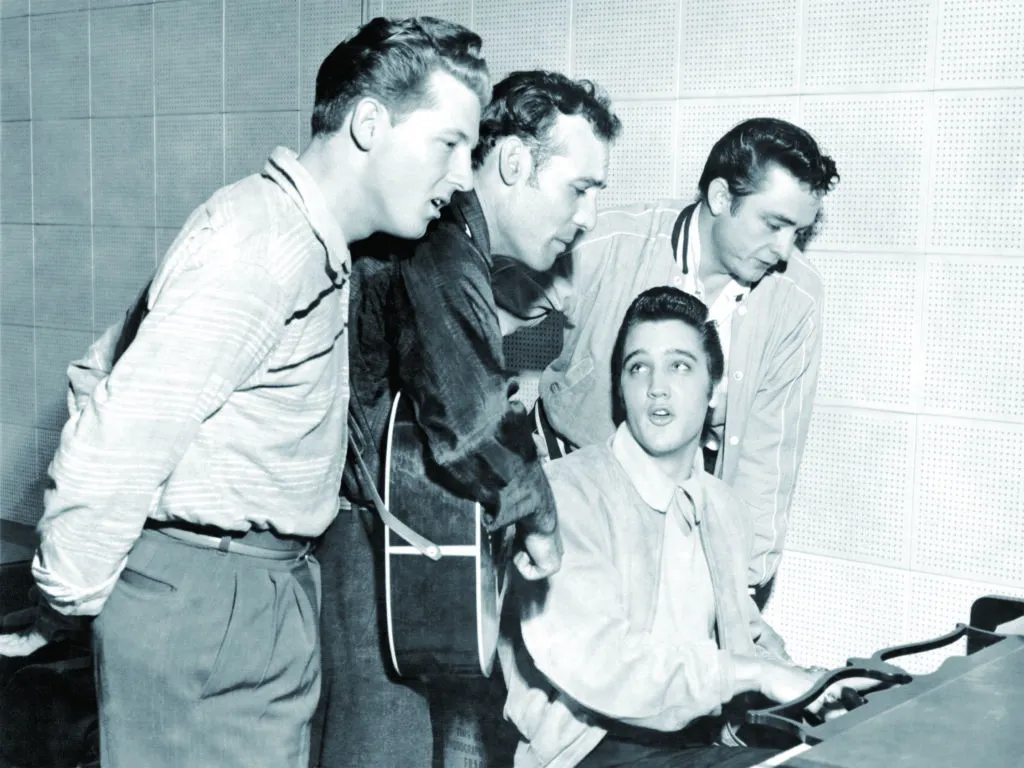 Elvis in Memphis, Tennessee, singing hymns with Jerry Lee Lewis, Carl Perkins, and Johnny Cash.Elvis in Memphis, Tennessee, singing hymns with Jerry Lee Lewis, Carl Perkins, and Johnny Cash.
Musicians’ tastes often extend far beyond their fans’. Presley, along with fellow Sam Phillips discoveries Jerry Lee Lewis, Carl Perkins, and Johnny Cash, frequently sang gospel music. A recording of these four jamming in 1956 was discovered and released posthumously. Other artists, like Muddy Waters and Robert Johnson, also explored diverse genres. James Brown admired Sinatra and disliked the blues, while Lead Belly was a fan of Gene Autry. Chuck Berry’s “Maybellene” was a cover of the country and western song “Ida Red,” originally recorded in 1938 by the White band Bob Wills and His Texas Playboys. While race played a significant role in the United States music business, its influence on the music itself was often less pronounced.
This article was originally published in the October 2021 issue of American History Magazine. To subscribe, click here.