
When American newspapers ran their headlines on August 16, 1977, the words felt almost impossible to believe: “Elvis Is Dead.” For millions of fans, it was as though a piece of the American musical fabric had suddenly torn away. The death of Elvis Presley, the man widely remembered as the King of Rock ‘n’ Roll, remains one of the most talked-about and mysterious moments in the history of American music. Nearly five decades later, questions still linger about what truly happened inside his Memphis mansion that summer afternoon, and why the official explanation shifted so dramatically in the weeks that followed.
Understanding Elvis Presley’s death is not just about medical facts. It’s about grasping how a single figure could embody an entire era of American culture, and how his sudden passing at just 42 years old closed a chapter that had opened the golden age of American popular music. For international readers discovering this story, it’s worth remembering that Elvis wasn’t merely a singer; he was the cultural bridge between rhythm and blues, country music, and the emerging sound of rock and roll that would define generations of American oldies music.
A Nation Stunned: The Day Elvis Died
Elvis Presley’s death occurred at his beloved Graceland estate in Memphis, Tennessee, where he had been resting between concert dates. Around 2:30 p.m. on August 16, 1977, his fiancée at the time, actor and model Ginger Alden, discovered him unresponsive on the floor of his bathroom.
Within minutes, an ambulance from Memphis Fire Station No. 29 arrived at Graceland’s iron gates. The paramedics found Elvis lying on his back, pajama-clad, surrounded by nearly a dozen people. His skin had already turned a dark, cold blue, and there was no detectable pulse. It took several men to carry his body, as Presley had gained considerable weight in his final years, a detail later linked to his declining health.
Dr. George Nichopoulos, known to friends as “Dr. Nick,” Presley’s personal physician, rode with him to Baptist Memorial Hospital, choosing a facility roughly 21 minutes away over a hospital just five minutes from Graceland. Reports suggest this decision was made because the staff at Baptist was known for discretion, an early sign that Presley’s inner circle understood how carefully his image needed to be managed, even in his final moments. He was pronounced dead at 3:30 p.m.
The Confusing Search for a Cause of Death
What followed was one of the most debated medical investigations in celebrity history. A team of nine physicians, led by Dr. E. Eric Muirhead, performed Presley’s autopsy at Baptist Memorial. They found no evidence of heart failure, stroke, or lung disease in the traditional sense, but they did discover signs of chronic illness, including diabetes and long-term digestive problems. The doctors suspected prolonged drug use, though confirmation would require toxicology testing.
That evening, medical examiner Dr. Jerry Francisco addressed the press, announcing that Presley had died of cardiac arrhythmia, essentially a fatal irregular heartbeat. He explicitly denied that drugs played any role, a statement that contradicted the private suspicions of the autopsy team, who hadn’t even finished their analysis.
Weeks later, toxicology results told a different story. High levels of prescription medications, including Dilaudid, Quaalude, Percodan, Demerol, and codeine, were found in Presley’s system. This discovery launched a formal investigation by the Tennessee Board of Health into Dr. Nichopoulos, who had reportedly prescribed more than 8,000 doses of medication to Presley since 1975.
During hearings, Nichopoulos defended himself by claiming he was trying to manage Presley’s addiction and keep him away from more dangerous illegal substances. The jury ultimately cleared him of negligence, though his medical license was permanently revoked in 1995 after a pattern of overprescribing to other patients came to light.
Was It Genetics, Not Just Prescription Drugs?
While the overdose narrative has dominated public perception for decades, some researchers argue it oversimplifies what actually happened. Author Sally A. Hoedel, who published Destined to Die Young in 2020, has argued that Elvis Presley’s death resulted from a cardiac event rooted in family genetics rather than drug abuse alone.
According to Hoedel, four of Presley’s relatives, including his mother, Gladys, died of heart- or liver-related illnesses in their 40s or 50s. Gladys herself experienced a similar four-year period of declining health before her death in 1958. Hoedel has pointed out that Elvis had disorders in nine of the eleven major systems of the human body, with at least five of those conditions present since birth. In her view, much of his poor health was inherited rather than self-inflicted, and his reliance on prescription medication was, in many respects, an attempt to manage pain from conditions beyond his control.
This perspective doesn’t erase the role prescription drugs played in his final years, but it does complicate the simple “rockstar overdose” story that has circulated in American pop culture for generations.
Graceland Opens Its Gates to a Grieving Nation
The scale of public mourning after Presley’s death illustrated just how deeply he had woven himself into American identity. On August 17, the day after his death, Graceland opened for public viewing. An estimated 100,000 people gathered outside the gates within hours, ranging from young fans to older generations who had grown up alongside Presley’s music.
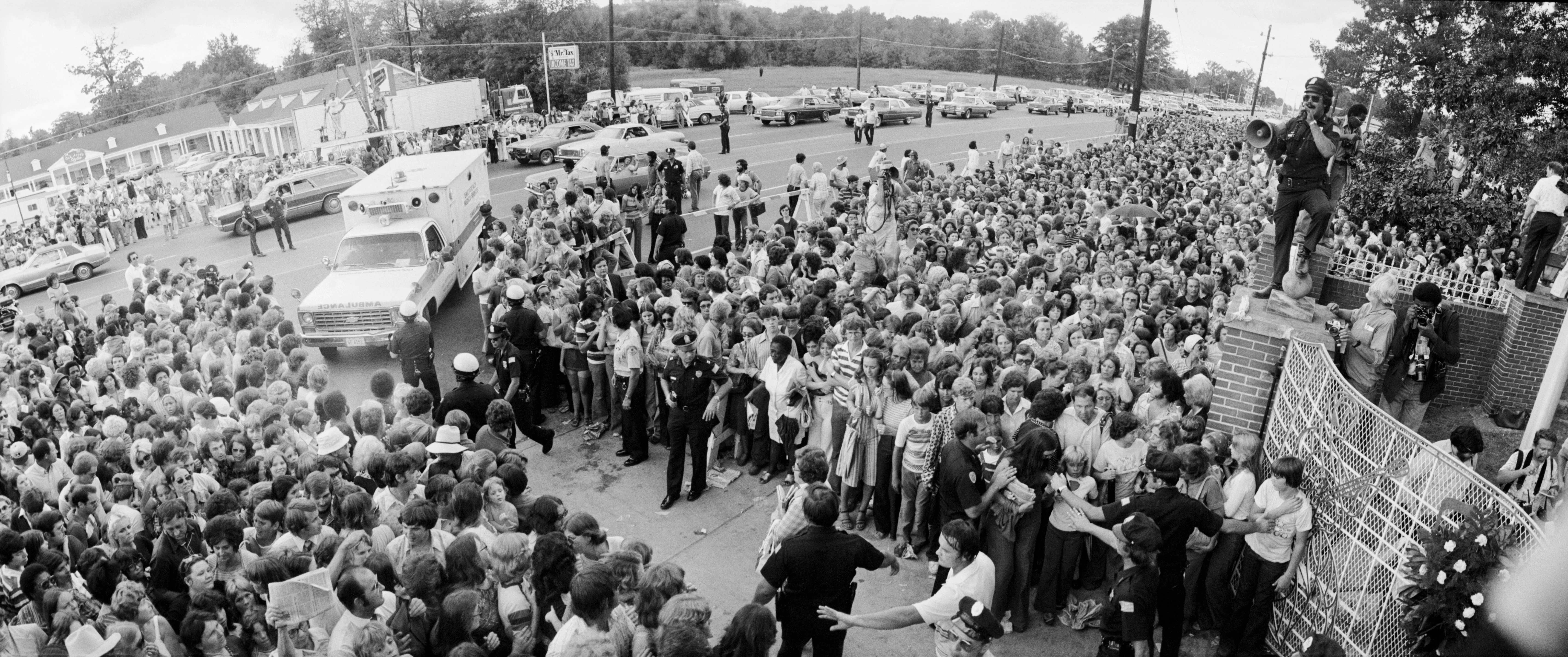
Extreme summer heat forced organizers to cut the viewing short out of concern for preserving Presley’s body. The following day, a solemn funeral procession made its way from Graceland to Forest Hill Cemetery, consisting of 17 white Cadillacs and a hearse.
Family members present included his ex-wife, Priscilla Presley, his daughter, Lisa Marie Presley, his father, Vernon, and his grandmother, Minnie Mae Presley. Celebrities such as Chet Atkins, Ann-Margret, Caroline Kennedy, James Brown, Sammy Davis Jr., and manager Colonel Tom Parker also attended to pay their respects. Presley was initially laid to rest beside his mother, though after an attempted theft of his coffin, both bodies were relocated to Graceland’s Meditation Garden, where Presley now rests alongside his parents, his daughter Lisa Marie, and his grandson, Benjamin Keough.
Why Elvis Presley’s Legacy Still Resonates Today
Elvis Presley’s career spanned just over two decades, yet his influence on American oldies music, and on global pop culture, remains unmatched. He helped popularize a sound that merged gospel, country, and rhythm and blues into something entirely new, laying the foundation for the golden era of American music that continues to inspire artists and fans worldwide.
His death, shrouded in confusion, contradiction, and eventual scandal, only deepened the mythology surrounding him. Whether one views his passing as a tragic consequence of prescription drug misuse or the culmination of inherited health struggles, the reality is that Elvis Presley’s story reflects both the glamour and the pressures of American celebrity culture in the 20th century.
For those captivated by the golden age of American music, revisiting Elvis Presley’s life and death offers more than historical curiosity. It’s an invitation to explore the deeper roots of rock and roll, country, and rhythm and blues that continue to shape the songs we listen to today. Dive deeper into these timeless melodies, and discover why, decades later, the King still reigns.