
Few television moments in the history of oldies music capture the collision of two eras quite like the night Elvis Presley stepped onto Frank Sinatra’s stage in 1960. It was a broadcast that divided critics and captivated millions — a defining moment in the golden era of American popular music that still resonates with fans of classic American music today.
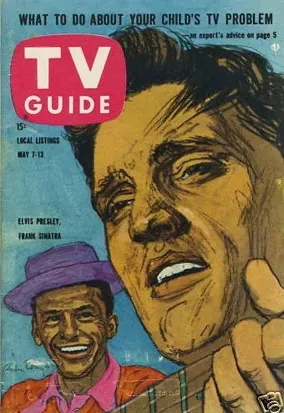
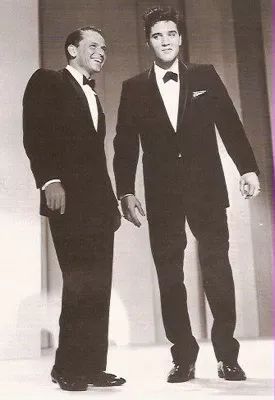
May 12, 2010, marked the 50th anniversary of one of the most talked-about television events of its time: Elvis Presley’s guest appearance on The Frank Sinatra Timex Special. The show was taped on March 26, 1960, in the grand ballroom of the Fontainebleau Hotel in Miami, sponsored by the Timex Company, and aired nationally on ABC-TV from 9:30 to 10:30 p.m. on Thursday, May 12, 1960.
A Comeback Moment Loaded With Stakes
Compared to Elvis’ other television appearances — both before and after — surprisingly little has been written about the Sinatra special over the decades. Yet at the time of its airing, its significance in Presley’s career was enormous.
Elvis had not appeared on television since his final Ed Sullivan Show performance in January 1957, and had not performed before any live audience since November 1957 in Hawaii. He had just been discharged from the U.S. Army, and the entertainment world — fans and industry insiders alike — was watching closely. For a young man returning to civilian life and the spotlight, everything was riding on this comeback.
The Sinatra special brought together an impressive roster of talent from the Rat Pack era: Sammy Davis Jr., Joey Bishop, Peter Lawford, and Nancy Sinatra, Frank’s daughter. Yet all eyes were on Elvis.
What the Critics Said
To read the reviews published in the days following the broadcast, one might assume Elvis’ return to show business had been a catastrophic failure. Three prominent publications weighed in — and none of them were kind.
The New York Times: “Merely Awful”
Writing in The New York Times on May 13, 1960, the morning after the broadcast, critic John P. Shanley offered one of the most withering assessments. He acknowledged that Elvis’ behavior in the Army had been “acceptable” but suggested his return to performing was “one of the most irritating events since the invention of itching powder.”
Shanley dismissed Elvis’ musical contributions to the show, noting that while there was “nothing morally reprehensible” about his performance, it was “merely awful.” He praised the other performers — Nancy Sinatra, Sammy Davis Jr., Joey Bishop, and Peter Lawford — while reserving his sharpest words for the headline act.
Decades later, Shanley’s son Don left a reader comment reflecting on his father’s review: “My dad was like many critics at the time. He was 45 and totally out of touch with the music of the time. His seven children were not always happy with what he wrote.” Don also noted that in 1964, his father turned down a Beatles interview assignment for The Times — earning days of the silent treatment from his teenage children.
Billboard: “Much to Learn”
Billboard magazine published its review in its May 16, 1960, issue, taking a somewhat gentler tone but still finding fault. The trade publication noted that for his reported fee of $125,000, Elvis performed just two songs — “Stuck on You” and “Fame and Fortune” — before engaging in brief banter and a duet with Sinatra.
In that duet, Elvis sang “Witchcraft” while Sinatra sang “Love Me Tender,” a charming inversion of their respective catalogs. The review acknowledged that the harmony on “Love Me Tender” came off well, but criticized Elvis for having difficulty with the melody of the Sinatra standard.
The Billboard critic concluded that Presley had “much to learn” before he could work comfortably alongside seasoned professionals like Sinatra, Bishop, and especially Sammy Davis Jr., who reportedly “broke up the show” with his impressions. Elvis was faulted for nervous mannerisms and a lack of stage polish, though his singing itself was left largely unchallenged.
Variety: A Missed Climax
Variety, the entertainment industry’s trade bible, offered perhaps the most detailed critique. The publication acknowledged that the star power assembled — with a talent cost estimated at $250,000 — guaranteed a mass audience. But it found that the show failed to deliver commensurate excitement.
The Variety reviewer pointed to several production shortcomings that undermined Elvis’ segment: poor microphone placement left his vocals sounding weak; the screaming of fans in the background lacked visual confirmation, making it feel staged; and the songs chosen — both current chart hits — were deemed unsuitable for television presentation. The Presley-Sinatra duet was described as failing to “jell.”
One Final Blow
Several months later, columnist Eve Starr delivered perhaps the harshest verdict of all in her “Inside TV” column in The Morning Call (Allentown, PA) on August 30, 1960. She called Elvis’ appearance “one of the most outrageous turkeys of the season, if not of all time.”
What the Ratings Revealed
And yet — none of it mattered to the audience.
The critical consensus was almost unanimously negative. But the viewing public told a completely different story. Variety reported that the overnight ratings for the Sinatra special ranked among the highest for a prime-time one-shot program in recent years. Trendex gave the show a 41.5 rating and a 67.7% share of sets in use during that hour — extraordinary numbers by any standard, in any era.
The numbers revealed something the critics had entirely missed: Elvis’ fans were desperate to see him again. They had waited through two years of his Army service, through the absence of live performances and television appearances, and they showed up in force. Remarkably, Elvis appeared on screen for only 8 minutes of the full hour-long broadcast — yet tens of millions tuned in for the whole show just to catch that brief glimpse of their idol.
A Moment That Defined the Transition
The 1960 Sinatra special stands today as a fascinating artifact of the pre-1975 American music landscape — a moment when two generations of popular music came face to face. Frank Sinatra represented the polished, sophisticated sound of the postwar era; Elvis embodied the raw, visceral energy of rock and roll that had electrified American youth in the mid-1950s.
Critics rooted in the older tradition saw Elvis’ performance through that lens and found it lacking. But the ratings proved that the American public — particularly younger audiences who would go on to shape the course of popular music for the next several decades — saw something entirely different. They saw their hero returning home.
The Enduring Legacy of That Night
Looking back through the lens of music history, the Sinatra-Presley special was not a failure by any honest measure. It was a cultural event — one of those rare television moments when the generational fault lines of American popular culture were laid bare in prime time.
The poor reviews reflect the critical establishment’s resistance to rock and roll as a legitimate art form, a bias that would take years to overcome. The massive ratings, meanwhile, reflect the unstoppable momentum of a new musical era that no amount of critical dismissal could hold back.
For fans of classic American music and the golden age of oldies, this broadcast remains a must-study chapter — proof that audience connection and cultural resonance have always mattered far more than critical approval. Elvis may have appeared on screen for only eight minutes, but those eight minutes reverberated for decades.
If you love the music of this remarkable era, dive deeper into the stories behind the songs, the artists, and the televised moments that made American music history. The golden age of oldies is waiting to be rediscovered.
Written by Alan Hanson | © May 2010
References
- Shanley, J. P. (1960, May 13). Presley performs on the Sinatra show. The New York Times.
- Billboard Staff. (1960, May 16). Elvis projection needs face-lift. Billboard.
- Variety Staff. (1960). Frank Sinatra show review. Variety.
- Starr, E. (1960, August 30). Inside TV. The Morning Call (Allentown, PA).
- Hanson, A. (2010, May). Sinatra ’60 special with Elvis: Poor reviews but high ratings. Elvis History Blog. Retrieved from http://www.elvis-history-blog.com