
Elvis Presley’s impact on music and culture was monumental, fundamentally changing the global landscape of popular music. Beyond his legendary performances and genre-bending sound, The King is indelibly associated with his signature jet-black hairstyle. Evolving from a ’50s quiff to the prominent sideburns of the ’70s, this iconic look was a deliberate choice. Contrary to popular belief, Elvis was naturally blonde, and his famous dark locks were a carefully cultivated aspect of his persona. This exploration delves into the story behind Elvis Presley’s cultivated black hair, the reasons for his choice, and the methods he employed throughout his career.
The Early Life and Musical Beginnings of Elvis Presley
Born Elvis Aron Presley on January 8, 1935, in Tupelo, Mississippi, Elvis’s upbringing was marked by deep family devotion and a strong religious faith, heavily influenced by his attendance at an Assembly of God Church with his parents. Gospel music played a significant role in his early musical development. His family, experiencing financial hardship, relocated to Memphis, Tennessee, in 1948 when Elvis was thirteen.
Lacking formal musical training and unable to read music, Elvis developed his skills by ear. His early musical talents were recognized at a high school talent show. A pivotal moment arrived when he met producer Sam Phillips of Sun Records, a local blues label. Phillips took the young artist under his wing, and Elvis soon began touring and recording, eager for his breakthrough.
His debut single, a cover of Arthur Crudup’s “That’s All Right,” released in 1954, marked the beginning of his ascent. By the mid-1950s, Elvis had become a household name, effortlessly blending genres like rock ‘n’ roll, country, blues, pop, and gospel. His prolific career also extended to acting, with starring roles in hit films such as Blue Hawaii (1961) and Viva Las Vegas (1964).
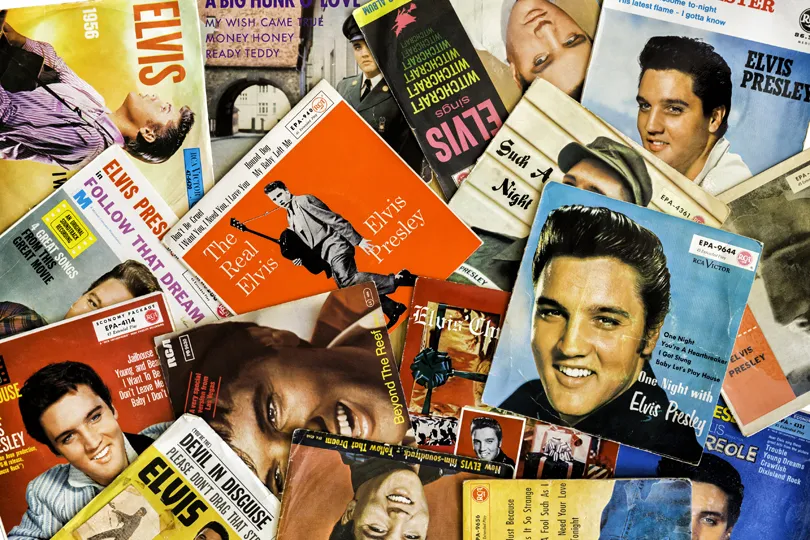
The Transformation: From Blond to Black
Elvis Presley was born with naturally blonde hair and blue eyes. While his hair did darken to a dirty blond or light brown shade in his late teens, it was a far cry from the dramatic black that became his trademark. Jerry Schilling, a member of the “Memphis Mafia,” recalled meeting a 19-year-old Elvis and noting his hair as an “average-looking sandy brown,” far from the jet-black style that would later define him.
In his late teens and early twenties, affordability was a concern, leading Elvis to use black shoe polish as a temporary hair dye. This period also saw him adopt sideburns, a style considered somewhat rebellious at the time. As his financial situation improved, Elvis transitioned to using commercial hair dyes, specifically Miss Clairol 51D and Black Velvet/Mink Brown by Paramount. This consistent application is why almost every photograph of him, barring his childhood images, features his distinctively dark hair.
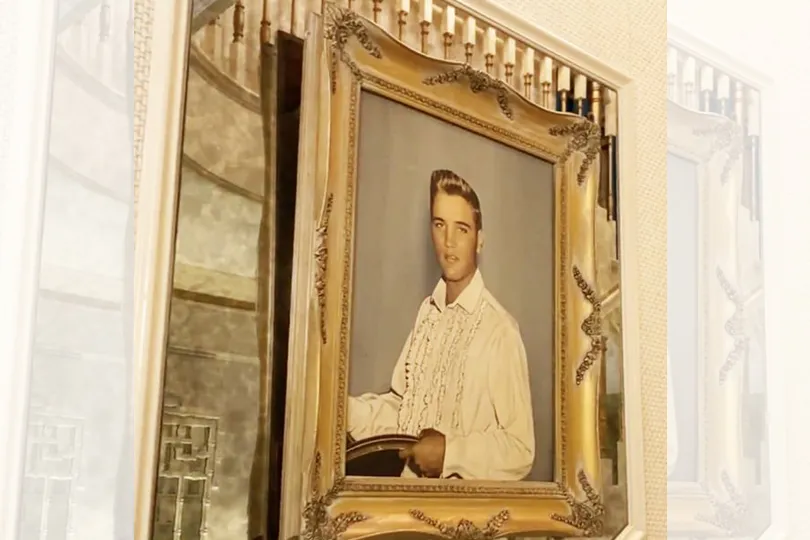
A notable exception exists: a portrait at Graceland displays Elvis in his natural blond hair color. Graceland archivist Angie Marchese explained that this portrait was taken in Texas during Elvis’s army service (1958), a period when he was not permitted to dye his hair. His military service in the United States Army lasted from 1958 to 1960. Upon his discharge, he immediately resumed dyeing his hair jet black.
Priscilla Presley: A Shared Black Hair Aesthetic
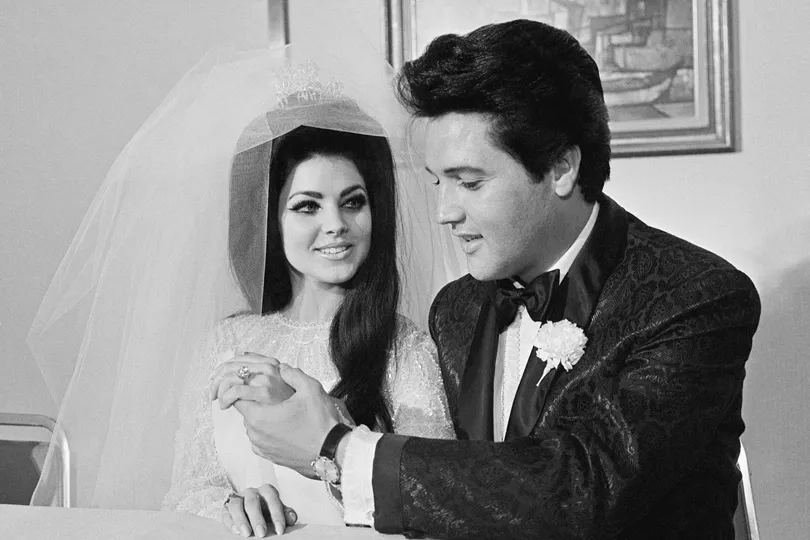
Elvis’s affinity for black hair extended to his wife, Priscilla Presley. When they married on May 1, 1967, Priscilla’s long, black hair complemented her appearance. However, her natural hair color was light brown. Elvis, deeply invested in his own black hair, encouraged Priscilla to dye hers black as well, a decision she later revealed was influenced by his desire for them to have a similar look.
In a 2015 interview, Priscilla admitted that Elvis persuaded her to dye her hair black, partly so they could “look alike a little bit.” He also encouraged her to style it significantly, particularly in a teased beehive. Sonny West, a former bodyguard, noted in his memoir that Elvis insisted Priscilla dye her hair jet black to enhance the contrast with her blue eyes and to achieve a voluminous beehive hairstyle. Priscilla herself shared that her initial attraction to Elvis was his captivating voice, but she also acknowledged his striking good looks, stating, “He wasn’t bad to look at either.”
The couple separated in February 1972, with their divorce finalized in October 1973. Elvis passed away on August 16, 1977. Priscilla has since experimented with various hair colors, favoring shades of red in recent years.
The Reasons Behind the Black Hair Obsession
While some fans have suggested Elvis dyed his hair black in tribute to his mother, Gladys, who had dark hair, he was already consistently coloring his hair black before her passing in August 1958. The dramatic contrast between his jet-black hair and ice-blue eyes created a striking, “bad-boy” image that was highly photogenic and captivating on screen. Graceland’s Angie Marchese stated, “He thought it brought out his facial features better on film.”
Elvis’s cousin, Billy Smith, offered another perspective, suggesting that Elvis was told dark hair would make his striking blue eyes stand out more. Linda Thompson, who dated Elvis from 1972 to 1976, confirmed that he used hairspray, not gel, to maintain his hairstyle and that he dyed his hair black “for drama.” Joanie Shoofey, who dated Elvis in the 1950s, recounted instances of Elvis and his entourage playfully causing messes with black hair dye in hotel suites.
Expert Hair Care and the Lasting Legacy
Larry Geller, who opened one of Hollywood’s first high-end men’s salons in 1964, became Elvis’s personal hairstylist in 1964. Geller was instrumental in maintaining Elvis’s signature look for years. He meticulously colored Elvis’s hair every few weeks using the previously mentioned dye combination to ensure consistency. Geller also emphasized daily hair washing and extensive scalp massages to promote hair health, regularly alternating hairsprays to prevent buildup and achieve the desired pompadour style.
Geller shared in 2015 that he used a homemade blend of benign base shampoo, vitamin capsules, aloe vera, and herbs for Elvis’s hair, with Elvis’s explicit instruction to “make sure I keep it!” This dedication to his hair underscores how integral it was to his overall image. Elvis’s perfectly coiffed jet-black pompadour, much like other facets of his life, became a defining and recognizable element of his enduring legacy.
Discover more captivating stories from our The Story Of series here.