
Elvis Presley remains one of the most influential figures in Oldies music and American popular culture. His death on August 16, 1977, marked the end of an era and triggered an emotional reaction unlike anything the entertainment world had experienced. For millions of fans across generations, the passing of “The King of Rock ’n’ Roll” was more than the loss of a singer—it was the loss of a cultural icon whose music helped define the golden era of American music.
In the early hours of August 16, Elvis spent time with family and staff at Graceland while preparing for a scheduled tour. He was expected to fly to Portland, Maine, that evening for a concert on August 17. Instead, the world awoke to devastating news that would forever become part of Oldies music history.
The Final Hours of Elvis Presley
Elvis retired to his master suite at Graceland around 7:00 a.m. to rest before his planned flight. Later that morning, he suffered heart failure. Paramedics rushed him to Baptist Memorial Hospital, but efforts to revive him were unsuccessful. Dr. George Nichopoulos officially listed the cause of death as cardiac arrhythmia, an irregular heartbeat.
The news spread rapidly across America and around the world. Radio stations immediately interrupted programming and filled the airwaves with Elvis songs. Listeners called stations simply to share memories and express their grief.
Many fans later recalled the moment they heard the news with the same clarity Americans remembered the assassination of President John F. Kennedy. Mick Fleetwood of Fleetwood Mac described the announcement as “like a ton of bricks.”
Media Coverage Reflected His Enormous Influence
Television networks quickly recognized the magnitude of the event. NBC and ABC reorganized their evening broadcasts to lead with coverage of Elvis’ death. NBC even postponed The Tonight Show to prepare a special documentary about his impact on American music.
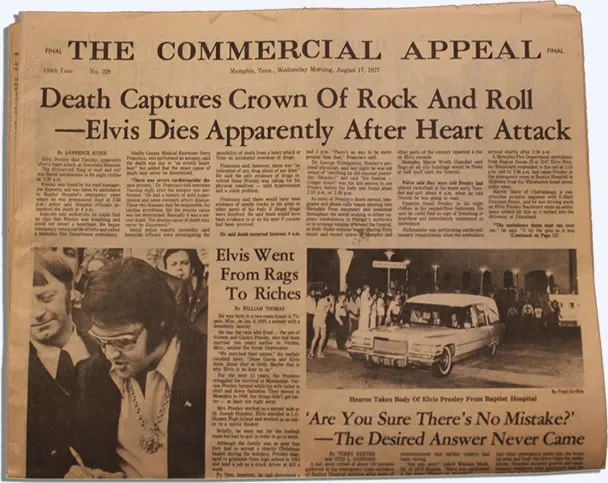
CBS, however, chose not to open with the story. Instead, it placed Elvis-related coverage after other news segments. The decision proved unpopular, resulting in unusually low ratings for the network.
According to Arbitron television ratings, millions of viewers switched channels to follow coverage elsewhere. The response demonstrated how deeply Elvis had become woven into American culture.
Radio Luxembourg and Europe’s Tribute
Even though Elvis had never performed in Europe, his influence extended across the continent. Radio Luxembourg, Europe’s most popular pop station, canceled advertisements and played Elvis music continuously after announcing his death.
Bob Moore Merlis of Warner Bros. Records remarked, “This is the end of rock ‘n’ roll,” while Pat Boone acknowledged that the void left behind would be impossible to measure.
Fans Gathered at Graceland
Within an hour of the announcement, mourners began arriving outside Graceland. By the following day, approximately 20,000 people had gathered. By evening, nearly 80,000 fans had passed by his coffin.
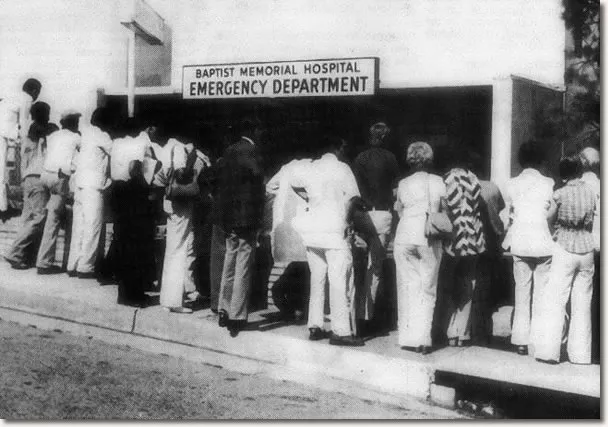
People traveled from across the United States and from overseas to say farewell. Despite concerns about crowd control, mourners remained peaceful. Memphis’ intense summer heat caused many people to faint, and emergency personnel treated hundreds suffering from exhaustion.
An unrelated tragedy also occurred when a drunk driver struck three teenagers gathered near Graceland, killing two of them.
The atmosphere outside Graceland became both sorrowful and communal. Fans exchanged stories, comforted strangers, and struggled to explain why they had come. Most simply said they wanted to be close to Elvis one last time.
The Funeral and Worldwide Mourning
Flowers poured into Memphis from around the country. More than 2,150 arrangements were delivered, making it one of the busiest days in the history of FTD floral services. The tributes included guitars, stars, lightning bolts, hound dogs, and traditional wreaths.
Numerous celebrities attended the funeral, including Caroline Kennedy, Chet Atkins, Ann-Margret, George Hamilton, Rex Humbard, Jackie Kahane, Jake Hess, J.D. Sumner, James Blackwood, and Kathy Westmoreland.
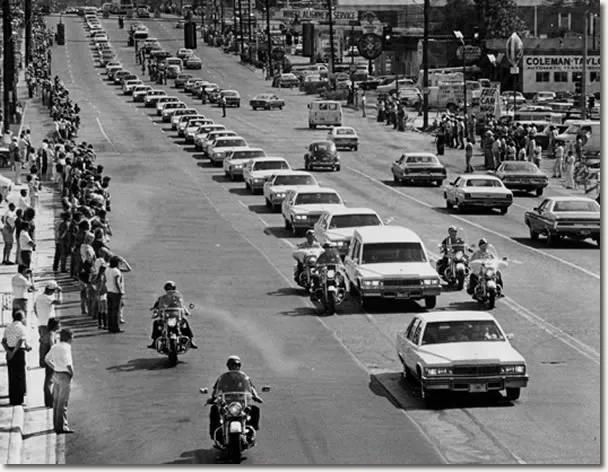
Initially buried at Forest Hill Cemetery, Elvis’ remains were later moved to the Meditation Garden behind Graceland after threats against the gravesite. His mother Gladys Presley was also reinterred there, followed by Vernon Presley in 1979 and Minnie Mae Presley in 1980.
The Life That Changed American Music
Born on January 8, 1935, in Tupelo, Mississippi, Elvis grew up in a deeply religious household. His parents, Vernon and Gladys Presley, encouraged his love of gospel music. At age eleven, he received his first guitar.
His career began when he recorded “My Happiness” and “That’s When Your Heartaches Begin” for his mother. Sun Records owner Sam Phillips recognized the unique quality of his voice and released “That’s All Right” backed with “Blue Moon of Kentucky.”
By blending black rhythm and blues with white country music, Elvis created a revolutionary sound that transformed popular music. Hits such as “Heartbreak Hotel,” “Blue Suede Shoes,” “Don’t Be Cruel,” and “Jailhouse Rock” made him the face of a new youth culture.
His performances on The Ed Sullivan Show sparked controversy and excitement, while critics struggled to understand his appeal. Yet audiences embraced him, and record sales soared.
Movies, Army Service, and Comeback
Elvis starred in 33 films and served in the U.S. Army between 1958 and 1960. After returning, he shifted toward romantic ballads like “It’s Now or Never” and “Are You Lonesome Tonight?”
The arrival of the Beatles in the 1960s temporarily overshadowed him, but his famous 1968 NBC television special reignited his career. With musicians James Burton and Glen D. Hardin, Elvis returned to touring and once again became one of the biggest names in music before 1975 and beyond.
He married Priscilla Beaulieu in 1967, and their daughter Lisa Marie Presley was born in 1968. Although the marriage ended in 1973, Elvis remained devoted to his daughter.
Health Problems and Final Years
Reports of declining health increased after his divorce. Despite battling exhaustion and fluctuating weight, Elvis continued performing.
His final concert took place on June 26, 1977, at Market Square Arena in Indianapolis, Indiana. Few realized it would be his last appearance.
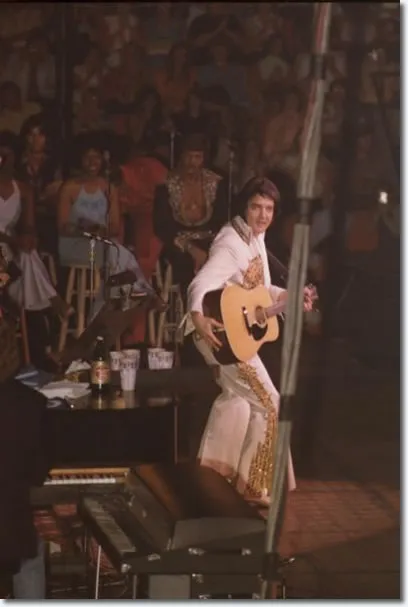 Elvis Presley performing during his final concert in Indianapolis in June 1977
Fans who attended his concerts remembered not imperfections, but the warmth and generosity that made him feel like family.
A Legacy Beyond Music
The reaction to Elvis’ death illustrated the scale of his impact. Newspapers around the world stopped their presses. Radio stations changed programming. Telephone systems in Memphis became overwhelmed by calls from grieving fans.
John Lennon declared, “The King is dead. But rock ‘n’ roll will never die. Long live the King.”
President Jimmy Carter issued a statement emphasizing that Elvis permanently changed American popular culture by blending white country traditions with black rhythm and blues. Carter described him as “unique and irreplaceable.”
More than one billion records sold, thirty-three films, countless awards, and generations of devoted listeners testify to his remarkable legacy. Few artists have shaped the cultural identity of America and influenced world music as profoundly as Elvis Presley.
Conclusion
The story of Elvis Presley is inseparable from the history of Oldies music and the golden era of American music. His death on August 16, 1977, brought immense sadness, but it also revealed the extraordinary bond between an artist and his audience. Nearly five decades later, his voice, charisma, and revolutionary spirit continue to inspire musicians and fans around the world.
Rock ‘n’ roll did not end with Elvis—it evolved because of him. Explore these timeless melodies and rediscover why generations still call him The King.
References
Rohter, L., & Zito, T. (1977). Rock Idol Elvis Presley Dies at 42. The Washington Post Co.
Official Elvis Presley archives and historical records concerning events of August 1977.
Statements by President Jimmy Carter, August 17, 1977.
Contemporary reports from NBC, ABC, CBS, Radio Luxembourg, and Arbitron television ratings data.