
Long before Elvis Presley became the undisputed King of Rock and Roll, he was a quiet, guitar-strumming boy from Tupelo, Mississippi — growing up poor, deeply religious, and absorbing every note of gospel, blues, and country music that surrounded him. Understanding Elvis Presley’s childhood is essential to understanding the man who would forever transform American music. His early years were shaped by hardship, family devotion, and an almost instinctive pull toward song that no amount of struggle could suppress.
Born Into Humble Beginnings: January 8, 1935
Elvis Aaron Presley entered the world just before dawn on January 8, 1935, in a tiny two-room house in Tupelo, Mississippi — a home built by his father, Vernon Presley, and his uncle. Gladys Presley gave birth to twin sons that morning. The first, Jessie Garon, was tragically stillborn. The second, Elvis Aaron, came into the world alive and healthy.
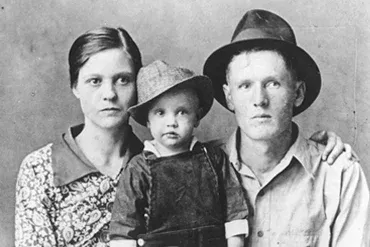
Elvis would be his parents’ only child, a fact that deepened the bond between him and Gladys in particular. That fierce maternal love — and the loss of Jessie — would cast a quiet shadow over Elvis’s emotional life for years to come.
Growing Up in Tupelo: 1935–1948
The Presley family was working class in the truest sense of the term. Vernon and Gladys moved from one modest home to another around Tupelo, always striving to give Elvis what little they could. Money was perpetually scarce, but warmth and togetherness were not. Elvis grew up surrounded by grandparents, aunts, uncles, and cousins — a tight-knit extended family that provided a sense of belonging even when material comforts were lacking.
From an early age, music wound itself into every corner of his life. The family worshipped at the Assembly of God Church, where the passionate energy of gospel singing left a deep impression on young Elvis. Outside church walls, the sounds of the American South poured in from every direction — Black blues musicians from the neighborhood, country music drifting from the radio, field hollers and spirituals carried on the wind.
These were not passive influences. They were the raw material of everything Elvis would later become.
A First Taste of the Stage: October 3, 1945
At the age of ten, Elvis stepped up to a microphone at the Mississippi-Alabama Fair and Dairy Show in Tupelo. Standing on a chair to reach the mic, he sang “Old Shep,” a sentimental ballad about a boy and his dog. The performance was broadcast live over WELO Radio, and Elvis walked away with fifth prize — five dollars’ worth of fair ride tickets.
It was a small victory by most measures, but it was one of the first public musical performances of Elvis Presley’s childhood, and it pointed unmistakably toward the future.
The Guitar That Changed Everything: 1946
The following year, Elvis set his heart on a bicycle. Vernon and Gladys simply could not afford one. In a moment that would alter the course of American music history, Gladys persuaded her son to accept a guitar instead. That first instrument — purchased at the Tupelo Hardware Company for $12.95 — became Elvis’s constant companion.
He taught himself to play with the same quiet determination that defined so much of his early character. No formal lessons, no conservatory training — just a boy, a cheap guitar, and an ear attuned to every sound the South had to offer.
Farewell to Tupelo: November 6, 1948
On November 6, 1948, a thirteen-year-old Elvis said goodbye to his classmates at Milam Junior High the only way that felt natural: he played his guitar and sang “Leaf on a Tree.” That evening, the Presley family packed their belongings into a trunk, strapped it to the roof of their 1939 Plymouth, and drove north to Memphis, Tennessee, in search of better economic prospects. Other members of the extended Presley and Smith families would eventually follow.
Memphis and the Making of a Teenager: 1948–1953
Life in Memphis was not dramatically easier. The Presleys settled into public housing and low-rent homes in the poor neighborhoods of north Memphis, and Elvis continued to work odd jobs alongside his studies at L.C. Humes High School to help support the family.
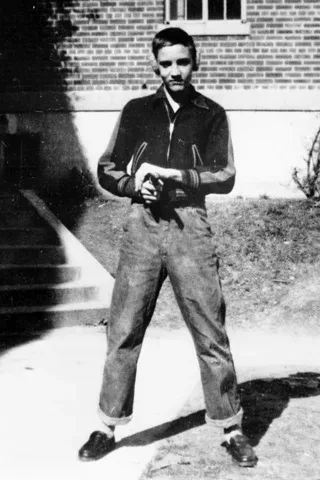
But Memphis was also a revelation. Beale Street — the legendary corridor of blues clubs, record shops, and Black musical culture — became a kind of informal classroom for the teenager. Elvis bought his distinctive clothes there and, more importantly, soaked in the blues and gospel he heard pouring from doorways and street corners. He was a regular at the all-night gospel sings held downtown, events where both Black and white performers took the stage in a rare mingling of traditions.
At Humes High, Elvis stood out in ways that made other students take notice. He wore his hair longer than the norm, kept his sideburns grown out, and dressed with a flair that set him apart. He was, by most accounts, a good-natured misfit — sensitive, shy, yet unmistakably different. When he finally performed at a school talent show, nervously strumming his guitar for his peers, the applause surprised even him. He came back for an encore. The feeling of acceptance through music stayed with him.
Graduation and the First Recording: 1953
Elvis graduated from Humes High School on June 3, 1953, and took a job at Parker Machinists Shop shortly after. That same summer, he wandered into The Memphis Recording Service — home of the fledgling Sun Records label — and paid roughly four dollars to record a personal demo: “My Happiness” and “That’s When Your Heartaches Begin,” intended as a birthday gift for his mother, Gladys.
Sam Phillips, the visionary producer behind Sun Records, happened to be present. After the session, he told his assistant Marion Keisker something worth noting. She wrote it down: “Good ballad singer. Hold.”
Four words. A future entire.
The Foundation of a Legend
Elvis Presley’s childhood was not one of privilege or formal musical training. It was shaped by poverty, devotion, loss, and an extraordinary sensitivity to the music that surrounded him in the American South. Gospel fervor, Delta blues, and country radio — all of it poured into a boy who had no other outlet quite so natural as song.
By the time he recorded those first tentative demos at Sun Records in 1953, Elvis was already carrying the full weight of those years inside him. The King had not yet arrived. But the foundation had been laid, note by note, in the churches of Tupelo, on the streets of Memphis, and in the hands of a boy who once traded a bicycle for a twelve-dollar guitar.
To discover what happened next in the life of America’s most iconic singer, explore Elvis’ life and career from 1954–1957 — the years when everything changed.
Sources:
- Graceland Official Website — Elvis Presley Biography. Retrieved from graceland.com
- Guralnick, P. (1994). Last Train to Memphis: The Rise of Elvis Presley. Little, Brown and Company.
- Marsh, D. (1982). Elvis. Times Books.