
Oldies Music has long been more than just sound—it is a cultural memory shaped by icons, performance, and visual identity. In Baz Luhrmann’s Elvis, the legendary life of Elvis Presley is reimagined through a dazzling lens where fashion becomes just as powerful as music itself. One of the most striking aspects of the film is how costume designer Catherine Martin transforms Elvis’s wardrobe into a storytelling device, revealing the emotional and cultural evolution of the King of Rock ’n’ Roll.
Rather than simply reproducing historical outfits, the film explores how clothing shaped Elvis’s identity on stage and off stage. From rebellious rockabilly beginnings to the glittering Las Vegas era, each look reflects a different chapter in the evolution of American music history and its global influence on Oldies Music culture.
The Cultural Power of Elvis’s Wardrobe in Elvis
In Elvis, clothing is not decoration—it is narrative language. One of the early defining scenes shows Austin Butler as Elvis performing in a formal tuxedo with tails, a costume designed to make him appear more “respectable” to audiences of the time. However, the moment becomes pivotal when Elvis rejects the outfit’s restriction, declaring that he cannot perform if he cannot move freely.
This tension between authenticity and performance is central to Catherine Martin’s design philosophy. Drawing from extensive research at Graceland and the Elvis Presley estate, she reconstructed how Elvis Presley was not just a performer but also his own stylistic architect. His fashion choices—lace shirts, flowing trousers, bold eyeliner—were self-invented, emerging from a time before celebrity stylists shaped public images.
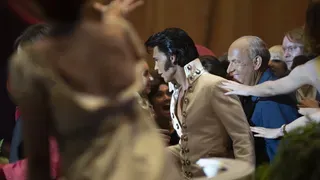
Martin emphasizes that Elvis’s style cannot be separated from his background. Coming from a financially modest family shaped by the Great Depression, his bold aesthetic choices became even more extraordinary. He was entirely self-created, assembling looks based on instinct rather than industry guidance—an approach that would later define the visual identity of Oldies Music icons.
Reimagining Rockabilly Elvis and Stage Persona
The film also revisits the early “Rockabilly Elvis,” where youth culture and musical rebellion collide. In the 1950s, Elvis represented something radically new: a performer whose movement, sexuality, and sound disrupted conservative American norms.
Catherine Martin and Baz Luhrmann intentionally emphasized Elvis’s physical expressiveness through costume. His lace shirts, often tied at the midriff, and sharply styled suits were designed to highlight his sensual performance style. This visual boldness reflected the emergence of rock ’n’ roll as a defining force in Oldies Music history.
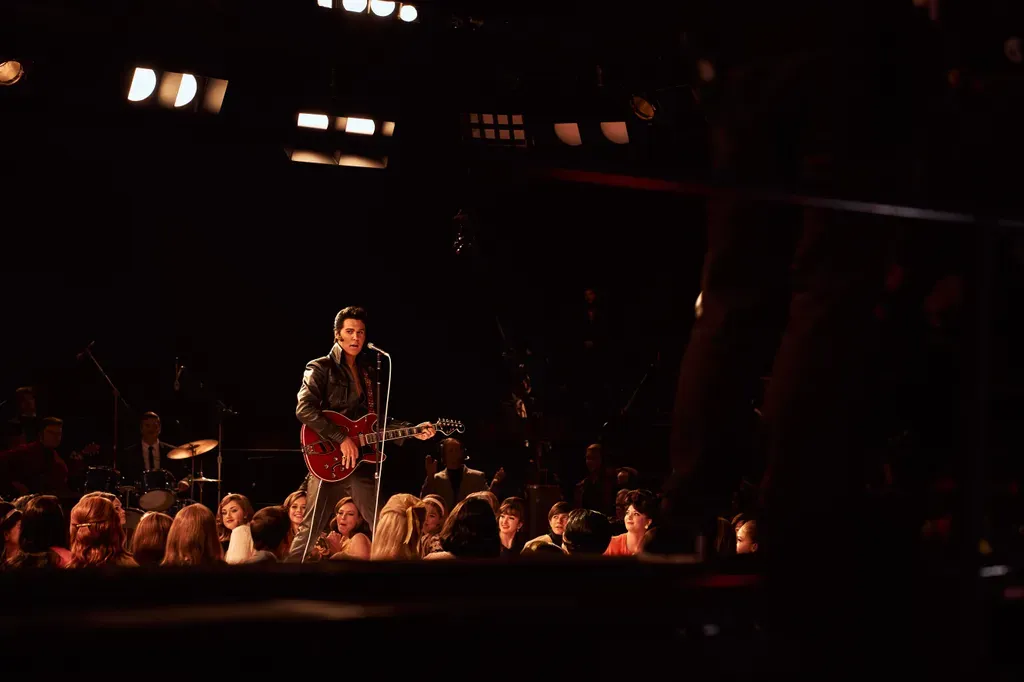
Elvis’s wardrobe also evolved through subtle but meaningful tailoring choices. One example is his signature habit of buttoning only the bottom button of his jacket, which allowed freer movement across his chest and shoulders. This seemingly small detail became essential to his performance style, enabling the iconic hip movements that shocked and captivated audiences.
Beyond aesthetics, these choices reflect a deeper cultural shift. Oldies Music during this era was not just heard—it was embodied. Elvis’s body became part of the music itself, turning fashion into choreography.
Vegas Era and the Reinvention of Spectacle
As Elvis’s career progressed, his style transformed dramatically. The film presents multiple eras, including Army Elvis, Hollywood Elvis, and ultimately the iconic Las Vegas Elvis. Each phase reflects changes in both his personal life and the evolving entertainment industry.
The Vegas era, in particular, is defined by extravagant jumpsuits, rhinestones, and theatrical silhouettes. These outfits were not just costumes—they were armor. Catherine Martin collaborated with specialist costume makers such as BK Enterprises to recreate these intricate designs, some of which included thousands of hand-applied embellishments.
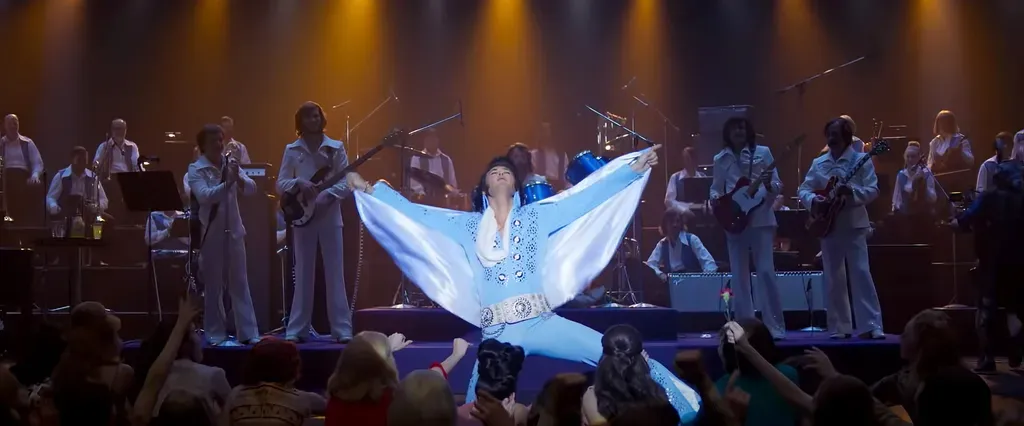
Interestingly, the Vegas aesthetic also maintained a paradox: despite their flamboyance, the costumes preserved Elvis’s sense of masculinity. Rather than diminishing his image, the exaggerated designs elevated him into a near-mythical stage figure—an embodiment of performance excess that influenced generations of Oldies Music performers.
This era also highlights the collaboration between fashion history and entertainment design. Costume elements such as the Napoleon-style collars, sequins, and custom tailoring were developed through partnerships with historical designers and artisans who had worked with Elvis himself. The result is a visual archive that bridges past and present.
Priscilla Presley and the Subtle Language of Fashion
While Elvis’s wardrobe is bold and theatrical, Priscilla Presley’s evolution in the film is quieter but equally significant. Her clothing reflects a journey from carefully constructed 1950s femininity to a more independent and self-defined identity.
Early in the film, Priscilla appears in polished, era-appropriate dresses that reflect traditional expectations of women in mid-century America. However, as her story progresses, her fashion begins to shift toward greater autonomy.
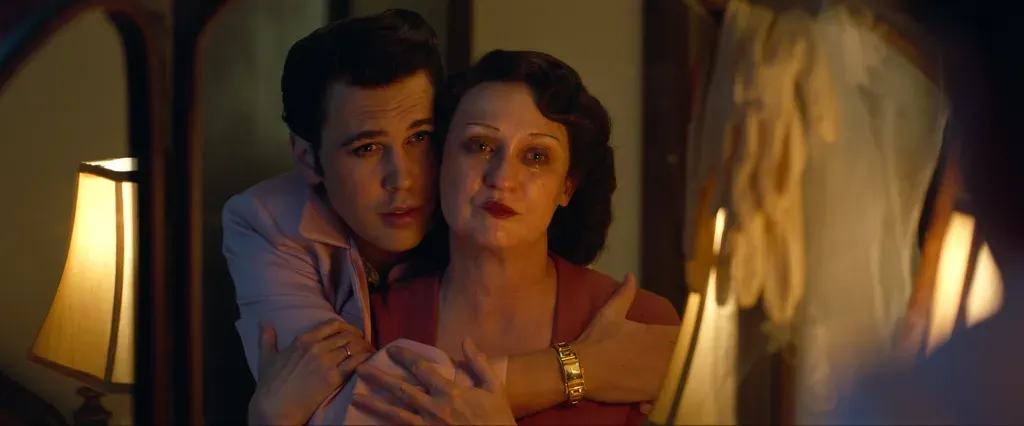 Austin Butler and Olivia DeJonge portraying Elvis and Priscilla Presley in a stylized intimate film scene reflecting 1960s fashion aesthetics
Catherine Martin notes that Priscilla’s wardrobe subtly incorporates trousers and more modern silhouettes, especially as she moves toward independence. This transformation mirrors broader social changes, where women in the 1960s and 1970s began redefining their roles both culturally and personally.
Her wedding dress, meticulously recreated by the costume team, stands as one of the most historically faithful pieces in the film. Yet even within this fidelity, the film emphasizes emotional storytelling over strict replication.
Priscilla’s style evolution demonstrates that Oldies Music culture was not only shaped by male performers like Elvis, but also by the women who existed within and around that cultural moment.
Conclusion: The Lasting Impact of Style in Oldies Music
Elvis demonstrates that Oldies Music is not only an auditory legacy but also a visual and cultural one. Through Catherine Martin’s costume design, Elvis Presley is reintroduced not just as a singer, but as a self-created style icon whose fashion choices shaped the identity of rock ’n’ roll.
From rebellious rockabilly outfits to extravagant Vegas jumpsuits, each stage of Elvis’s wardrobe reflects a broader transformation in American music history. These designs reveal how deeply fashion and performance are intertwined, turning clothing into a form of storytelling that transcends time.
Ultimately, the film reinforces the enduring influence of Elvis Presley on global music culture. His image continues to inspire artists, designers, and fans of Oldies Music worldwide.
Hãy khám phá thêm những giai điệu bất hủ và câu chuyện phía sau những biểu tượng đã định hình lịch sử âm nhạc.