
Acute diarrhea is one of the most common reasons dog owners rush to the vet — and one of the most common reasons veterinarians reach for metronidazole. Yet despite how routinely this antibiotic is prescribed, the clinical evidence supporting its use has long been surprisingly thin. A randomized, double-blinded, placebo-controlled trial published in the Journal of Veterinary Internal Medicine (Langlois, Koenigshof & Mani, 2020) set out to change that — and its findings offer a nuanced picture that every pet owner and clinician should understand.
What Is Metronidazole and Why Is It So Popular?
Metronidazole is a nitroimidazole antibiotic with broad activity against anaerobic bacteria, including potential intestinal pathogens like Clostridium perfringens. At higher doses, it also shows antiprotozoal activity against organisms like Giardia. Beyond its antimicrobial properties, the drug carries immunomodulatory and anti-inflammatory effects — making it particularly appealing for treating intestinal disorders in dogs.
Despite these attributes, metronidazole is not approved by the U.S. Food and Drug Administration for veterinary use. It remains an off-label treatment, and concerns about antimicrobial stewardship — particularly the risk of contributing to bacterial resistance when used for a typically self-limiting condition — have prompted calls for better clinical evidence.
How the Study Was Designed
Researchers at Michigan State University Veterinary Medical Center (MSU-VMC) enrolled dogs presenting with acute diarrhea lasting fewer than seven days. To qualify, dogs needed to be older than six months, weigh between 4 and 50 kg, and have no evidence of gastrointestinal parasitism, Giardia infection, or parvoviral enteritis on routine fecal testing. Dogs that had recently received antibiotics, probiotics, or anti-inflammatory medications were excluded, as were those with severe dehydration or abdominal pain.
Eligible dogs were randomly assigned in double-blinded fashion to receive either metronidazole (10–15 mg/kg orally every 12 hours for 7 days) or an identical placebo. Owners maintained detailed medication and fecal scoring logs using the Bristol Stool Scale — a validated human scoring system adapted for use in this study — and dogs returned for repeat evaluation and fecal cultures on day 7.
Of 48 dogs screened, 31 completed the study protocol: 14 in the metronidazole group and 17 in the placebo group. Baseline characteristics including age, sex, weight, and initial fecal scores were similar between the two groups.
Key Findings: A Modest but Meaningful Benefit
The primary finding was clear: dogs treated with metronidazole recovered from diarrhea approximately 1.5 days faster than placebo-treated dogs (2.1 ± 1.6 days versus 3.6 ± 2.1 days, P = .04). All metronidazole-treated dogs resolved their diarrhea within four days, with one exception who reached normal fecal scores by day 7.
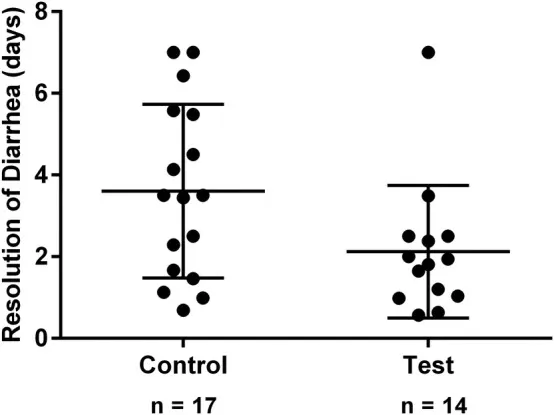
Among placebo dogs, seven experienced diarrhea lasting more than four days, and two still had persistent diarrhea at the seven-day mark. Those two dogs were subsequently treated with open-label metronidazole, and their diarrhea resolved 1.1 and 4.9 days after treatment began.
Importantly, no dog in either group relapsed through day 21, and no metronidazole-related adverse effects or signs of neurotoxicity were observed during the study period.
The Clostridium perfringens Connection
A secondary but significant finding involved C. perfringens — a bacterial species commonly associated with diarrheal syndromes in dogs. At baseline, 87.1% of all study dogs had positive fecal cultures for C. perfringens, reflecting rates consistent with prior research in diarrheic dog populations.
By day 7, the contrast between groups was striking: only 23.1% of metronidazole-treated dogs retained positive cultures for the organism, compared to 78.6% of placebo-treated dogs (P = .007). In other words, metronidazole cleared C. perfringens in roughly 80% of dogs that initially tested positive — a finding consistent with the antibiotic’s known efficacy against anaerobic bacteria.
However, the study was not designed to establish whether C. perfringens caused the diarrhea in the first place. As the authors note, isolation rates for this organism are similar in healthy and diarrheic dogs alike, and the presence of toxin-encoding genes does not always correlate with actual toxin production. The clinical significance of clearing C. perfringens therefore remains an open question.
Why This Doesn’t Mean Metronidazole Should Always Be Prescribed
Despite the statistically significant benefit, the study’s authors are careful to contextualize their findings. The vast majority of dogs — 88.2% of the placebo group — resolved diarrhea within one week without any antibiotic treatment. A reduction of 1.5 days, while appreciated by owners managing a messy situation at home, does not mean the drug is essential for recovery.
Several broader concerns also apply. Widespread antibiotic use for a self-limiting condition raises legitimate antimicrobial stewardship concerns. Evidence from other studies suggests metronidazole can substantially alter the intestinal microbiome of healthy dogs in ways that may persist long-term. Alternative approaches — including dietary modification, temporary fasting, fluid support, and probiotic supplementation — have shown variable but sometimes comparable benefits in reducing diarrhea duration without the risks associated with antibiotic use.
A previous randomized controlled trial, notably, found no significant benefit of metronidazole over placebo in a similar population, with resolution times of 4.6 and 4.8 days respectively. The discrepancy between that trial and the current one may reflect differences in study design, patient selection, or fecal scoring methodology — underscoring how much remains uncertain in this area.
Practical Implications for Dog Owners
For pet owners, the takeaway is nuanced. If your dog develops acute diarrhea, there are a few key points to keep in mind:
- Most cases resolve on their own within a few days, particularly in otherwise healthy, vaccinated adult dogs.
- Temporary dietary management, adequate hydration, and monitoring are reasonable first steps for mild, uncomplicated cases.
- Veterinary evaluation is important to rule out parasites, parvovirus, and other treatable causes — especially in puppies, immunocompromised dogs, or dogs with bloody diarrhea, vomiting, lethargy, or other concerning signs.
- Fecal flotation testing is particularly valuable — nearly 22% of dogs screened for this study were excluded due to unrecognized gastrointestinal parasitism, highlighting how common and often overlooked parasites can be.
- If your veterinarian recommends metronidazole, the decision should weigh the modest benefit in speed of recovery against the broader considerations of antibiotic use.
Conclusion
This randomized controlled trial represents one of the stronger pieces of clinical evidence evaluating metronidazole for acute nonspecific diarrhea in dogs. It suggests the drug can modestly shorten recovery time and reduce C. perfringens carriage — but it falls well short of establishing metronidazole as a necessary first-line treatment for every dog with loose stools. Most dogs get better on their own, and the antibiotic landscape demands careful judgment about when treatment is truly warranted.
As the researchers conclude, future studies with larger populations and longer follow-up periods are needed before routine metronidazole use for acute diarrhea in dogs can be broadly recommended. In the meantime, working closely with your veterinarian — rather than defaulting to antibiotics — remains the most responsible path forward for your dog’s digestive health.
References
Langlois DK, Koenigshof AM, Mani R. Metronidazole treatment of acute diarrhea in dogs: A randomized double blinded placebo-controlled clinical trial. J Vet Intern Med. 2020;34(1):98–104. https://doi.org/10.1111/jvim.15664