
By Jessica | March 22, 2021 | Lifestyle Design
For a significant portion of my life, I followed a predetermined path. At times, I believed I was forging my own way, but in reality, I was either adhering to societal expectations or reacting against what others advised. Growing up, I diligently pursued conventional achievements: excelling academically, participating in sports, learning musical instruments, engaging in youth group activities, and volunteering. I entered college immediately after high school, convincing myself that choosing a university 700 miles away was an act of independence.
My aspiration was for an extraordinary life. Post-graduation, I sought a career in international development. Corey and I briefly taught English in Nicaragua, but this endeavor was cut short due to my severe illness, which led to a 30-pound weight loss over three months and necessitated our return to the United States. This initial attempt at designing an extraordinary life did not unfold as anticipated.
Subsequently, we entered full adulthood, facing the immediate need for financially stable employment in the New York City metropolitan area. Our lives rapidly adopted a conventional narrative. Both of us embarked on careers demanding over 40 hours per week, living on a stringent budget. While we were working in nonprofits, the daily work and job requirements differed little from other demanding professions.
Gradually, we noticed a shift: our measure of success moved away from the extraordinariness of our lives towards raises and promotions. As we became more entrenched in the standard career trajectory, our capacity to envision an extraordinary life diminished, replaced by the self-assurance that it was simply unattainable. We rationalized our situation, focusing on gratitude for our employment and seeking silver linings in an unsatisfactory reality, believing we had little agency to alter our course.
Until 2018, I had resigned myself to a mediocre existence dictated by a pervasive sense of “shoulds.” I had lost touch with my own desires and joys. I was working excessively long hours, striving for promotions, driven by a feminist conviction that I should prioritize career advancement and that accepting a pay cut would signify failure and betray the cause of equal pay. The weight of this perceived responsibility was immense. SO MANY SHOULDS.
My entire perspective began to transform in 2018 with my introduction to the concepts of financial independence and, subsequently, lifestyle design. I was astonished to discover people who were genuinely loving their lives, defining success on their own terms, unswayed by external expectations. The concept of lifestyle designers who actively crafted fulfilling lives without waiting for full financial independence was particularly inspiring. They managed to integrate their passions into their income generation, even finding joy in their work—a notion previously unimaginable to me, as work had always felt like an obligation to be endured. The intentionality with which so many individuals identified their unique desires and took concrete steps toward them resonated deeply. This, I realized, is the essence of designing one’s life.
What is Lifestyle Design?
I prefer to conceptualize lifestyle design as both an action and an identity—the ongoing process of creating a life that brings me joy. To truly grasp it, I broke down the phrase.
What is Lifestyle?
Dictionary definitions consistently describe lifestyle as a person’s typical way of living, encompassing habitual patterns of spending one’s resources: money, time, and energy. I view lifestyle holistically, integrating all facets of life: work, finances, recreation, personal growth, relationships, and well-being. Therefore, a comprehensive definition emerges: Your lifestyle is the sum total of your decisions regarding how you habitually spend your time, energy, and money. These expenditures are the currency through which you communicate your priorities.
What is Design?
Recognizing that life is one of our most significant creations, I sought a definition of design from world-class designers. They view design as an action, a process, and a mindset known as “Design Thinking.” As defined by the Interaction Design Foundation, design thinking is “an interactive process in which we seek to understand the user, challenge assumptions, and redefine problems in an attempt to identify alternative strategies and solutions that might not be instantly apparent with our initial level of understanding.” This process is fundamentally iterative, involving deep user understanding, questioning assumptions, problem reframing, exploring alternative solutions, and continuous experimentation with feedback loops. Such an approach fosters novel solutions beyond initial comprehension.
What is Lifestyle Design?
Synthesizing these definitions, you are intentionally designing your life when you: actively seek self-understanding regarding your values and desires; challenge assumptions about societal expectations; define your unique version of success and its impact on your resource allocation; brainstorm diverse strategies to achieve this success; identify and bridge the gap between your current and desired life; experiment with various options; and adopt an iterative approach to refine your identity and aspirations.
Alternatively, viewing it as an identity, you are a lifestyle designer when you live intentionally, aligning your actions with your values and seeking balance across important life domains. Lifestyle designers prioritize continuous learning and experimentation to adapt their goals and paths. It’s crucial to understand that if you do not actively choose to design your life, you are, in essence, defaulting to a pre-existing pattern. David Cain’s article, “Your Lifestyle has Already Been Designed,” aptly illustrates this concept.
Examples of Lifestyle Designs
Within the financial independence community, there’s a common belief that early retirement is a prerequisite for designing one’s life. However, I contend that financial freedom exists on a spectrum. As illustrated in the chart below, various lifestyle design options become accessible with increasing financial freedom.
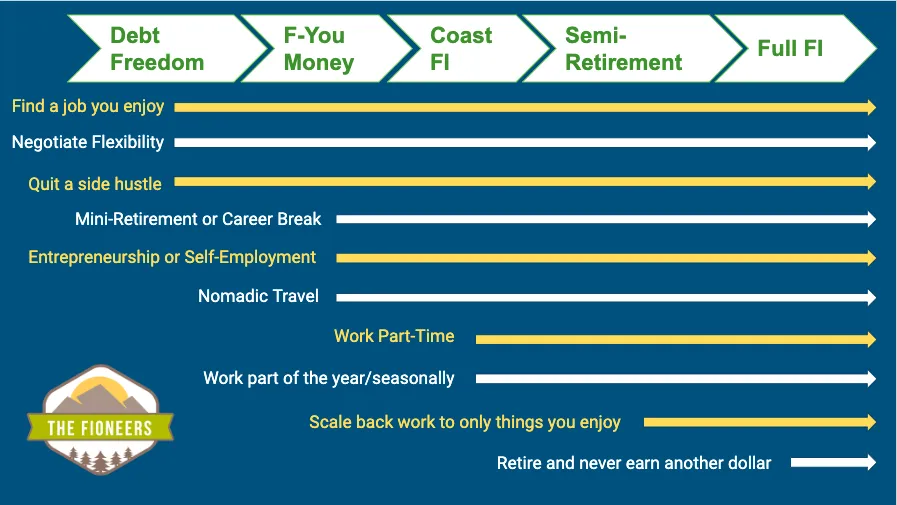
The sole lifestyle design unavailable until full financial independence is early retirement with no intention of future earnings. All other designs are attainable at earlier stages.
How to Get Started Designing Your Life
Every individual experiences a pivotal moment when the status quo becomes untenable. My defining moment arrived in 2018, amidst a toxic work environment that triggered severe anxiety and panic attacks. Your catalyst may be less dramatic—perhaps being overlooked for a promotion, experiencing persistent unhappiness, feeling consistently burned out, or simply being inspired by others pursuing unconventional paths. Regardless of the motivation, the process of designing your life remains consistent, involving three cyclical stages: identifying ideal life elements, envisioning future possibilities, and experimenting with adjustments based on learned insights.
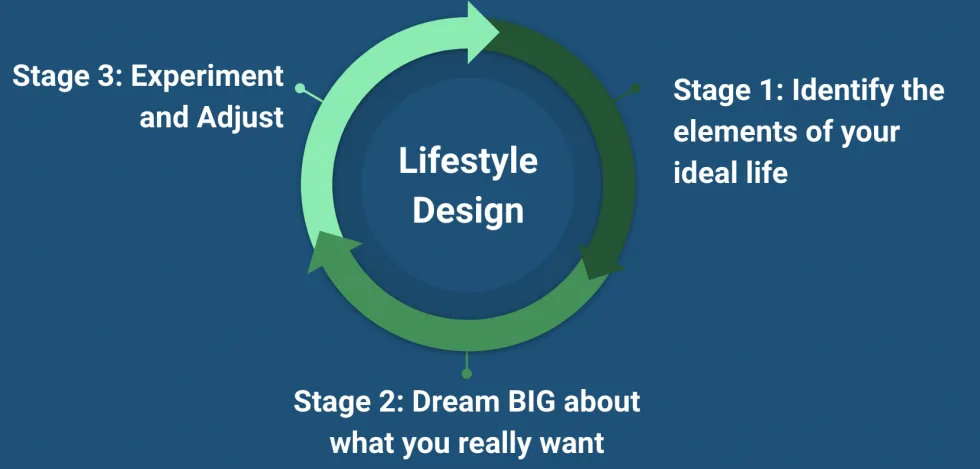
1. Identify the Elements of Your Ideal Life
This initial stage demands a profound understanding of yourself and your core values. It involves identifying activities, projects, conversations, and work that bring you joy; discerning your primary motivations, values, and sources of purpose; and recognizing your unique strengths, limitations, and optimal environments for thriving. Strategies for cultivating this self-awareness include mindfulness practices like journaling and meditation, reflection on ideal scenarios and peak experiences, and experimentation with life adjustments to ascertain what brings fulfillment and energy. For a deeper dive, explore the post on how to identify the elements of your ideal life.
2. Dream Big about What the Future Holds
This stage encourages expansive thinking. It involves learning about diverse types of lifestyle designs and career paths to broaden your perception of what’s possible. Employing strategies to quiet your inner critic allows for uninhibited brainstorming. Based on the most compelling ideas, develop multiple potential plans that align with your ideal life. Engaging with a supportive community is invaluable here; they can affirm your ideas, inspire bolder concepts, and reinforce the attainability of your goals.
3. Experiment and Adjust
With potential options in hand, critically assess them: Would I genuinely enjoy this? What would this look like daily? What resources are required? How do individuals generate income in this field? Is a full-time income necessary or achievable? How does one initiate such a venture? Addressing these questions through experimentation—conversations, observations, or scaled-down beta tests—is crucial. Experimentation provides a low-stakes environment to confront limiting beliefs, build confidence, and develop necessary skills and community support for larger aspirations. My Guide to Identifying Your Limiting Beliefs and accompanying 5-day email course can be helpful resources. Furthermore, experimentation deepens your understanding of your preferences, enabling course adjustments and turning daunting leaps into logical next steps.
My Experience Designing My Life
My lifestyle design journey began with an extensive search for tools and resources. I dedicated nearly a year to journaling, reflection, and self-discovery, consuming books like “Designing Your Life,” “The Desire Map,” and “The 4-Hour Workweek.” Despite accumulating ideas, I felt I was “playing small.” In 2019, participation in a group process focused on lifestyle design provided much-needed structure. A supportive community empowered me to dream bigger, posing questions like, “Could you dream bigger?” and “Why not?” when I expressed doubts. This environment fostered belief in my aspirations, such as starting a coaching business. They encouraged bolder ideas, helped navigate limiting beliefs, and offered encouragement. I experimented with organizing meet-ups and workshops, applying skills gained in HR to my projects, and discovering my passion. A clear process, coupled with community support, was instrumental. Two years prior, I could never have envisioned becoming a full-time entrepreneur with a life I truly love.
Lifestyle Design is Challenging But Worth It
Lifestyle design presents challenges, demanding discipline for self-discovery and courage to step outside comfort zones, dream boldly, and confront mental barriers. Embracing the identity of a lifestyle designer—living intentionally, aligned with values, and seeking balance—makes the effort profoundly worthwhile. As the saying goes, “the juice is worth the squeeze.” If this resonates, I invite you to explore my group coaching program, Design a Life You Love. Enrollment will reopen soon; join the waitlist to be informed of new opportunities.