
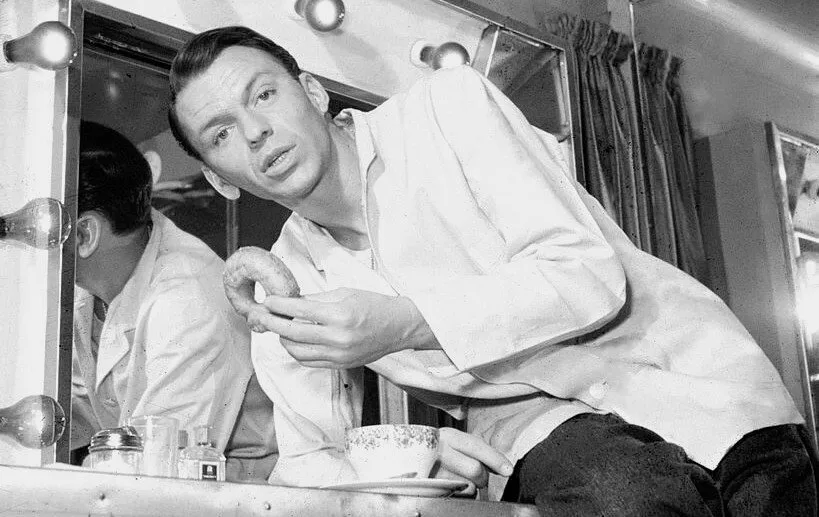
Frank Sinatra, born on December 12, 1915, in Hoboken, New Jersey, was more than just a singer—he was a cultural phenomenon. With a career spanning decades, Sinatra became one of the most iconic figures in 20th-century music, earning nicknames like “The Voice,” and “The Chairman of the Board.” His journey from a working-class neighborhood to global stardom is a testament to his talent, charisma, and unyielding determination. As he famously sang in My Way, “I did it my way,” Sinatra’s life was a blend of ambition, resilience, and an unapologetic embrace of his passions—music, food, and bourbon.
A Family of Grit and Ambition
Sinatra’s story begins with his parents, Natalina “Dolly” Garaventa and Saverio Antonino Martino “Marty” Sinatra, whose own lives were as colorful as their son’s. Dolly, born in Lumarzo, Italy, in 1896, immigrated to the U.S. as an infant. Known for her beauty and strong will, she worked as a midwife and was rumored to have performed illegal abortions. She was also a prominent member of the Democratic Party in Hoboken.
Marty, born in Lercara Friddi, Sicily, in 1892, arrived in America in 1903. He initially worked as a shoemaker’s apprentice but soon turned to boxing under the alias “Marty O’Brien”—a name chosen to avoid the anti-Italian sentiment of the era. After a career-ending injury, he transitioned into firefighting, securing a captain’s position without formal testing, thanks to Dolly’s political connections.
Their only child, Francis Albert Sinatra, was born after a traumatic delivery that left both mother and son with lifelong injuries. Despite his small stature, young Frank was charismatic, bold, and blessed with striking blue eyes. Though he dropped out of high school in 1931, his true passions were sports—especially boxing—and music.
The Marty O’Brien: A Bar That Shaped a Legend
During the Prohibition era (1920–1933), Marty and Dolly opened Marty O’Brien, a bar named after Marty’s boxing alias. Despite the legal ban on alcohol, the establishment thrived, likely due to Dolly’s political ties and rumored connections to the mafia. Young Frank often worked there as a waiter, earning tips and soaking in the atmosphere.
It was in this bar that Sinatra discovered two lifelong loves: whiskey and music. At just nine or ten years old, he performed his first songs, accompanied by a piano or a ukulele. Inspired by Bing Crosby and Al Jolson, Sinatra dreamed of stardom. His absolute pitch—a rare ability to identify or produce any musical note without reference—set him apart. With a voice ranging from baritone to bass-baritone, Sinatra mastered phrasing and delivery, captivating audiences with his whisper-like singing style.
A Life of Routine and Indulgence
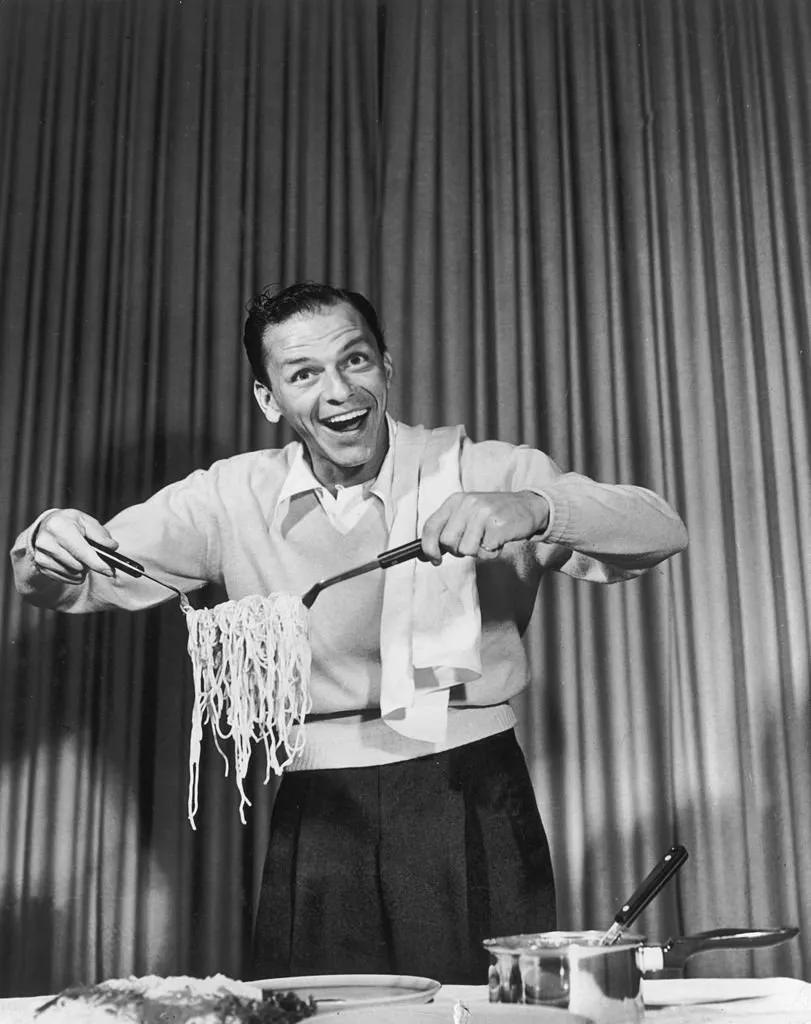
By the 1940s, Sinatra was a superstar. His daily routine was as legendary as his voice. He never woke before noon, skipped breakfast, and started his day with a cigarette and a glass of whiskey. Meals, especially dinner, were sacred. With Genovese and Sicilian roots, food was a cornerstone of his life—whether as sustenance, pleasure, or a social event.
Patsy’s: Sinatra’s New York Haven
One of Sinatra’s favorite dining spots was Patsy’s in New York, an Italian restaurant near Carnegie Hall. Opened in 1944 by Pasquale “Patsy” Scognamillo, it became a hotspot for celebrities. Sinatra’s go-to dishes included stuffed artichokes with anchovies, garlic, and mint, followed by veal cutlets Milanese—crispy, with basil, lettuce, and tomato. For dessert, he always chose ricotta cheesecake with lemon, a nod to his Italian heritage.
Villa Capri: The West Coast Retreat
In Los Angeles, Sinatra frequented Villa Capri, owned by another Patsy—Pasquale “Patsy” D’Amore. Located near the Capitol Records building, the restaurant became Sinatra’s base in L.A. He even referenced it in his song The Isle of Capri. Villa Capri was also where Sinatra helped his friend Jean Leon (born Ceferino Carrión) secure a job as a waiter. Leon, a Spanish immigrant with a fascinating backstory, later opened La Scala, a Hollywood favorite for stars like Marilyn Monroe and James Dean.
The Bourbon Legacy
Sinatra’s love for Jack Daniel’s Old No. 7 was legendary. He reportedly consumed 32 sips of bourbon daily, prepared with three ice cubes, two fingers of Jack Daniel’s, and a splash of water. His devotion to the drink was so deep that he allegedly requested a bottle of “nectar of the gods” to be buried with him after his death on May 14, 1998.
As Gay Talese famously wrote in Frank Sinatra Has a Cold, Sinatra’s image was incomplete without a glass of bourbon in one hand and a cigarette in the other. Whether in a dimly lit bar or on stage at the Madison Square Garden, Sinatra’s rituals were as iconic as his music.
A Culinary Passion
Sinatra’s connection to food extended beyond dining. He enjoyed cooking and even co-authored The Sinatra Celebrity Cookbook with his fourth wife, Barbara Marx Sinatra. The book featured recipes from Sinatra, Barbara, and their celebrity friends, including Kirk Douglas, Katharine Hepburn, and Whoopi Goldberg.
Conclusion: The Enduring Legacy of Ol’ Blue Eyes
Frank Sinatra’s life was a symphony of music, food, and bourbon. From his humble beginnings in Hoboken to his reign as a global icon, Sinatra’s journey was defined by his talent, resilience, and unapologetic passion for life’s pleasures. His voice, his charm, and his love for the finer things—whether a perfectly cooked veal cutlet or a glass of Jack Daniel’s—continue to captivate audiences worldwide.
Discover the timeless allure of Sinatra’s world—where every note, every bite, and every sip tells a story.