
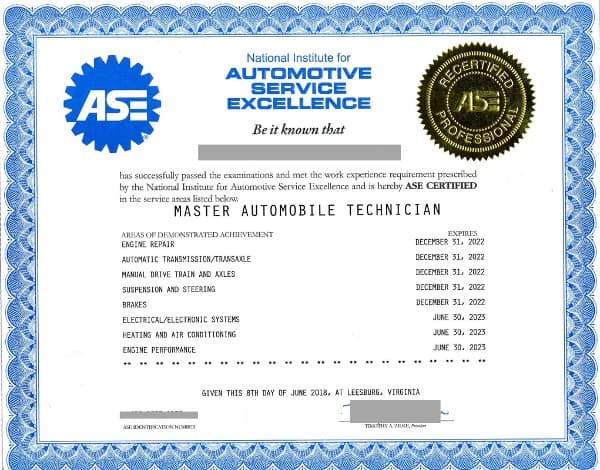
The automotive industry, like many others, relies on standardized credentials to ensure quality and expertise. The National Institute for Automotive Service Excellence (ASE) plays a pivotal role in this by testing and certifying automotive, diesel, and collision repair technicians. ASE certification signifies a technician’s proficiency and adherence to industry standards, enhancing their credibility and career prospects. This guide delves into the history, benefits, types of certifications, and the process of becoming ASE certified, offering valuable insights for aspiring and established automotive professionals.
Understanding ASE Certification
ASE certification is designed to uphold and enhance the quality of vehicle repair and service by setting industry benchmarks. While not a regulatory body, ASE offers a recognized standard of competence for technicians. Certification is awarded to individual technicians, not to repair facilities. Importantly, ASE also accredits automotive, diesel, and collision repair training programs, with institutions like Universal Technical Institute (UTI) holding this prestigious accreditation, preparing students for ASE certification.
A Brief History of ASE
Since its establishment in 1972, ASE has issued certifications to over 250,000 automotive service professionals. The program offers significant advantages: car owners gain confidence in the abilities of ASE-certified technicians for complex repairs; repair shops can achieve the Blue Seal of Excellence Recognition Program, boosting their market visibility; and auto professionals earn industry-wide respect and recognition for their knowledge and skills. The certification tests are developed by a panel of experienced industry professionals, including manufacturers, educators, and technicians, ensuring their relevance and accuracy.
Types of ASE Certifications and Tests
ASE provides a broad spectrum of certification tests catering to various specializations within the automotive service and repair sector. Key information to familiarize yourself with includes:
- Test Format: Tests generally consist of 40 to 75 multiple-choice questions designed to assess knowledge in specific content areas.
- Test Development: Questions are meticulously crafted and approved by industry experts, focusing on practical, real-world scenarios encountered by technicians.
- Recognition: Upon meeting work experience requirements and passing tests, technicians earn the Blue Seal of Excellence.
- Fees: A registration fee of $34 applies per window, with additional test fees of $59 per standard test and $118 for advanced tests (L1, L2, L3). Recertification tests are priced similarly.
- Work Experience: Candidates must possess full-time, hands-on work experience or a combination of formal training and experience.
For detailed information on specific tests, the ASE website offers comprehensive resources. The available certification series include tests for Automobile & Light Truck, Collision Repair & Refinish, Damage Analysis & Estimating, Automobile Service Consultant, Truck Equipment, Alternate Fuels, Auto Maintenance and Light Repair, Transit Bus, Advanced Engine Performance Specialist, Electronic Diesel Engine Diagnosis Specialist, Light Duty Hybrid/Electric Vehicle Specialist, Engine Machinist, Parts Specialist, School Bus, Medium-Heavy Truck, Undercar Specialist Exhaust Systems, Military Tactical Wheeled Vehicles, and Non-Certification Assessments.
For those new to the field, the Automobile & Light Truck Certification series (A1-A9) is a common starting point, with each test comprising 40-50 multiple-choice questions. Passing tests A1 through A8 can lead to Master Automobile Technician Status.
Benefits of Pursuing ASE Certification
Achieving ASE certification offers numerous advantages for automotive, diesel, and collision repair technicians:
- Customer Confidence: It signals to customers that a technician possesses a high level of expertise and can address their vehicle concerns effectively.
- Employer Recognition: Certification demonstrates a commitment to professional development and a dedication to mastering one’s craft, which is highly valued by employers.
- Enhanced Knowledge: The rigorous study required for ASE tests reinforces existing knowledge and strengthens understanding in areas needing improvement.
- Increased Earning Potential: As with many fields, enhanced skills and education levels often correlate with salary increases and career advancement opportunities.
- Job Market Demand: ASE certification serves as a universal and impartial benchmark, making certified technicians more attractive to potential employers, some of whom may prioritize hiring certified individuals. Completing ASE certification is a strategic career move for anyone in these fields.
The Path to ASE Certification
Graduates of programs like those at UTI, where instructors themselves hold ASE certifications, are well-prepared to pursue these credentials. Substituting formal training for a portion of the required work experience is a common pathway for graduates entering the automotive industry. The general requirements to become certified include documenting a minimum of two years of relevant hands-on work experience.
Preparing for ASE Certification Exams
ASE tests are developed by industry professionals, focusing on practical application rather than purely academic knowledge. This ensures the questions are relevant to the challenges technicians face daily. ASE provides study guides and official practice tests to aid in preparation. Sample questions are also available on their testing platform. Exams can be taken at ASE test centers, or at designated campus locations for UTI students. Creating a myASE account is the first step to registering for a test.
Achieving ASE Master Technician Status
To attain ASE Master Technician status, individuals must pass a specific group of tests within a particular series, in addition to documenting the required work experience. The specific tests vary by series:
- Automobile: A1 – A8
- Collision Repair: B2 – B5
- Medium-Heavy Truck: T2 – T8
- School Bus: S1 – S6
- Transit Bus: H1 or H2, and H3 – H8
- Truck Equipment: E1 – E3
Master Medium-Heavy Vehicle Technician status can be earned by passing specific tests in the Medium-Heavy Truck, Transit Bus, or School Bus series, covering areas like Diesel Engines, Drive Train, Brakes, Suspension & Steering, Electrical/Electronic Systems, and Heating, Ventilation & A/C. More detailed requirements can be found on the ASE test series page.
ASE Recertification: Maintaining Your Credentials
ASE certifications are valid for five years, after which technicians must pass a recertification exam to maintain their credentials. Failure to do so can result in the loss of Master Technician status, though it can be regained by passing the recertification tests. ASE offers a convenient myASE Renewal app that allows technicians to stay current with their certifications by answering a monthly question for each certification area via their desktop, tablet, or mobile device.
Frequently Asked Questions About ASE Certification
- Are ASE certifications worthwhile? Yes, ASE certifications are highly valued by employers and contribute significantly to professional growth, often being a requirement for employment according to the Bureau of Labor Statistics.
- How long do ASE certifications last? ASE certifications are valid for five years, requiring a recertification exam before expiry to remain active.
START PREPARING TO PURSUE AN EXCITING NEW CAREER AS A MECHANIC OR TECHNICIAN.
With classes starting frequently, there’s no need to wait to start your career path.
Hands-on training.*Get hands-on education with some of the industry’s leading brands.
No Pressure to commit.Get answers to your questions without any obligations.
Or Call Now 800.834.7308*UTI now offers all of its automotive, diesel, motorcycle and marine technician training in a blended learning format consisting of online lecture courses along with in-person, hands-on lab training.