
The Mercury Cougar Eliminator 429 Boss stands as one of the rarest and most formidable muscle cars ever produced in the United States. Built exclusively at Ford’s Kar Kraft facility, only a handful of these extraordinary vehicles were ever manufactured, making them the crown jewel of the Cougar Eliminator lineup and a testament to American automotive performance during the golden age of muscle cars.
The Birth of a Legend
The Mercury Cougar Eliminator was introduced in spring 1969 as Mercury’s direct response to Ford’s wildly successful Boss Mustang. The Eliminator nameplate carried significant weight in the muscle car community, signifying a high-performance variant engineered for serious driving enthusiasts and drag racing competitors. While the standard Eliminator came equipped with engines like the Boss 302 or 428 Super Cobra-Jet powerplant, the 429 Boss variant represented the pinnacle of aggressive engineering.
What makes the 429 Boss Cougar truly exceptional is its scarcity. According to enthusiasts and automotive historians, only two officially sanctioned Boss 429 Cougars were ever produced by Kar Kraft for drag racing legends Dyno Don Nicholson and Fast Eddie Schartman. A third example was constructed for demonstration and magazine testing purposes. All three of these genuine Boss 429 examples were built in 1969, making any surviving example an irreplaceable piece of American automotive history.
Powertrain: Raw Performance
At the heart of the Mercury Cougar Eliminator 429 Boss lies Ford’s formidable 385-series 429-cubic-inch V-8 engine. This muscular powerplant produces an impressive 380 horsepower and an extraordinary 490 pound-feet of torque, delivered at 3,400 RPM for maximum pulling power. The engine’s displacement of 7.0 liters represents some of the largest naturally aspirated displacement ever installed in a Mercury vehicle.
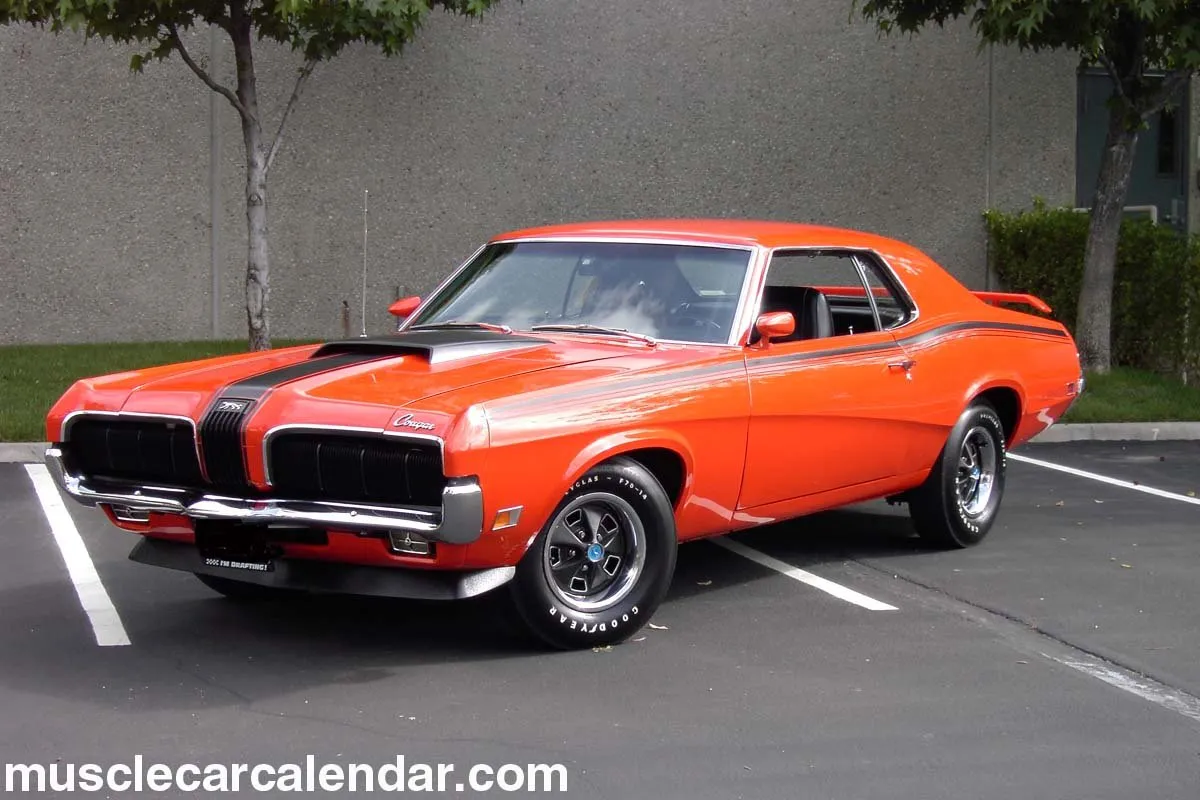
The power-to-weight ratio tells the real story of this car’s performance credentials. With 221 horsepower per ton and 386 Newton-meters of torque per ton, the 429 Boss Cougar delivers genuinely competitive acceleration and straightline performance. To manage this considerable power output, Mercury engineers equipped the Eliminator with a robust four-speed manual transmission featuring a 3.5 final drive ratio, optimized for both street driving and drag racing applications.
The front-engine, rear-wheel-drive layout provided the proper platform for harnessing the big block’s fury, while the engine’s substantial torque output at relatively low RPMs ensured quick launches off the line—precisely what drag racers demanded in factory-prepared competition vehicles.
Chassis and Dimensions
The Mercury Cougar Eliminator 429 Boss carried a curb weight of 1,718 kilograms (3,788 pounds), impressive considering the substantial engine package installed beneath its hood. The vehicle measured 4.69 meters in length, 1.90 meters in width, and 1.29 meters in height, with a 2.72-meter wheelbase that provided a balanced weight distribution crucial for drag racing stability.
As a coupe rather than a convertible, the Eliminator body structure offered the rigidity necessary for handling the immense power delivered through the rear wheels. The compact dimensions, combined with the low-slung stance typical of late-1960s Cougar design language, gave the Eliminator an aggressive presence that matched its performance capabilities.
Competition and Legacy
The Mercury Cougar Eliminator 429 Boss competed directly against some of the era’s most celebrated muscle cars. Its contemporaries included the legendary Dodge Charger R/T, the Ford Mustang Boss 429, and the Ford Mustang Boss 351 Ram Air. Each of these vehicles represented the ultimate expression of American automotive performance, but the Cougar’s relative rarity elevated its status among collectors and performance enthusiasts.
The Eliminator earned its place in muscle car lore not merely through raw statistics but through its purpose. These vehicles were purpose-built for competition and performance driving. The Boss 429 Cougars created for professional drag racers like Dyno Don Nicholson became legends in their own right, setting records and establishing the Cougar brand as a serious performance contender, even if Mercury’s muscle car heritage remained overshadowed by more famous nameplates.
Technical Excellence and Luxury
What distinguished the Mercury Cougar from other muscle car offerings was its positioning as a luxury-performance hybrid. Unlike the raw, stripped-down approach of some muscle car manufacturers, the Cougar Eliminator attempted to balance high-performance engineering with appointment-level features and interior refinement. This approach made the Eliminator somewhat unique within the muscle car landscape, occupying a middle ground between brute force performance and daily-driver functionality.
The 429 Boss variant took this philosophy to its logical extreme, combining the most powerful engine available with the Cougar’s sophisticated platform. Interestingly, the Boss 429 engine was rated conservatively at 375 horsepower and 450 pound-feet of torque in some factory literature—a rating that was intentionally kept modest to address insurance company concerns of the era, when horsepower ratings could significantly impact insurance premiums and policy availability.
A Vanishing Breed
Today, locating an authentic 1969 or 1970 Mercury Cougar Eliminator with a 429 Boss engine represents a formidable challenge for collectors and enthusiasts. Only a handful ever existed, and the passage of time has claimed many examples. Those that survive command respect and significant monetary value within the muscle car collecting community. Some remarkably preserved examples, like a 1970 Cougar found with just 4,000 original miles and an intact factory window sticker still affixed to the glass, exemplify the rarity and desirability of these machines.
The 429 Boss Cougar serves as a powerful reminder of an era when American automakers pursued extreme performance without compromise. It represents the intersection of luxury car building and unbridled performance engineering—a brief moment in automotive history when such combinations were not merely possible but celebrated.
Conclusion
The Mercury Cougar Eliminator 429 Boss occupies a unique and prestigious position in American automotive history. As one of only two to three examples ever produced, it represents peak muscle car engineering and the golden age of American performance vehicles. With its potent 429-cubic-inch engine delivering nearly 400 horsepower, responsive handling characteristics, and sophisticated luxury-performance packaging, this Cougar Eliminator variant stands as a testament to what happens when engineers and designers unleash their creativity in pursuit of pure performance.
For muscle car enthusiasts and collectors, the discovery of an original 429 Boss Cougar remains the automotive equivalent of finding treasure. Its rarity, combined with its formidable performance credentials and documented competition history, ensures that the Mercury Cougar Eliminator 429 Boss will continue to captivate automotive historians and performance car devotees for generations to come. If you’ve encountered or owned one of these exceptional machines, we’d welcome hearing your experiences with this legendary American muscle car.