
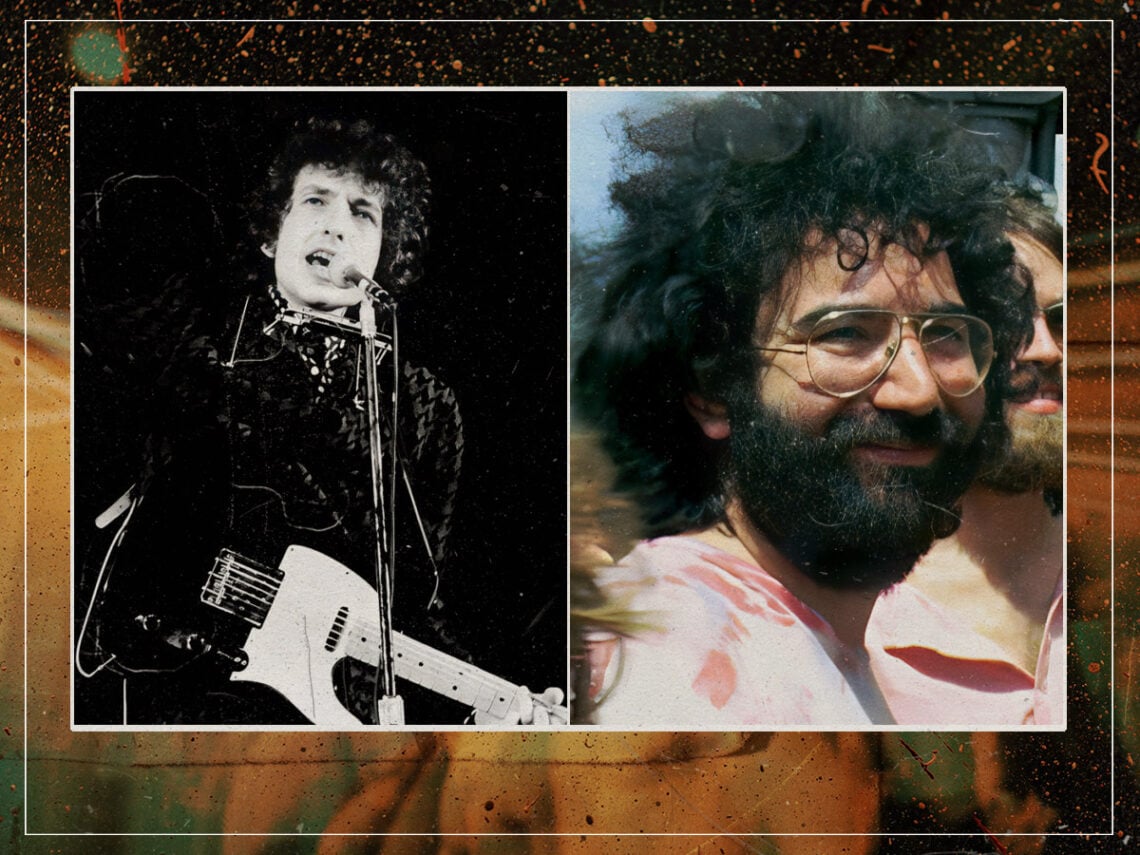
The intricate and often surprising nature of Bob Dylan’s songwriting and performance style was a topic of deep contemplation for Jerry Garcia. In an interview excerpt from April 28, 1981, with David Gans and Blair Jackson, Garcia shared his insights on what it was like to play alongside Dylan, highlighting the unique challenges and artistic merits of Dylan’s approach. This discussion offers a valuable glimpse into the mind of a legendary musician reflecting on another icon, revealing the complexities that lie beneath seemingly simple tunes.
The Deceptive Simplicity of Dylan’s Songs
Garcia’s initial surprise upon playing with Dylan stemmed from the unexpected complexity of the song structures. “A lot of the tunes that he writes are deceptively simple-sounding, when in reality they’re not,” Garcia observed. This lack of prior rehearsal meant Garcia was often in a state of constant learning during performances. He noted that Dylan rarely played Garcia’s preferred versions of songs, instead offering his own distinct interpretations. When questioned about this by Gans, who admitted to walking out of a Dylan show due to the rearrangements, Garcia defended Dylan’s artistic prerogative, stating, “He’s got a perfect right to do that, don’t you think?” However, Garcia also acknowledged Dylan’s tendency to “mutilate” his own tunes, but conceded that Dylan possessed a unique license to do so, a privilege perhaps not afforded to others.
Musical Renaissance and Collaborative Influence
Garcia mused on Dylan’s musical evolution, particularly his “Christian thing” in the late 1970s and early 1980s, which he felt coincided with Dylan appearing happier and more relaxed. While he found the lyrics to be less impactful during this period, he recognized a significant musical enhancement. Garcia drew a parallel between this era and Dylan’s work around the Blonde on Blonde album, attributing much of the melodic richness then to the influence of Robbie Robertson. He cited the two versions of “Forever Young” from the Planet Waves album as an example, contrasting Dylan’s country-and-western rendition with Robertson’s slower, more melodic arrangement. Garcia elaborated on the intricate musical signatures of that era, including passing chords and relative minor substitutions, which contributed to melodies that listeners could hear in their heads even if Dylan didn’t explicitly sing them. He described this as a “neat quality” of Dylan’s songwriting, where the music profoundly framed the lyrical delivery.
The Sideman’s Insecurity and Hunter’s Unconventionality
The experience of playing with Dylan, Garcia explained, often fostered a “deep-seated insecurity” among the musicians. This stemmed from Dylan’s tendency to alter songs spontaneously during performances, making rehearsals less of a security blanket and more of a starting point for unpredictable musical journeys. Garcia compared this dynamic to his own experiences working with lyricist Robert Hunter. While Hunter’s approach was unconventional and often “random,” Garcia found it more accepting than the constant uncertainty presented by Dylan’s performance style. Garcia recalled working on a collection of acoustic material intended for Hunter’s album, a process that involved significant repetition and training Hunter to achieve a desired consistency. He admitted to disliking this aspect of the collaboration, as it felt like policing a friend and potentially stifling spontaneity. However, he acknowledged the necessity of such guidance to capture the essence of the songs. Garcia concluded that Dylan was notoriously demanding in the studio, with collaborators often getting only one chance to perform a song, and sometimes no rehearsals at all.
The Universal Resonance of Dylan’s Lyrics
Despite the challenges of performing his music, Garcia recognized the profound impact of Dylan’s lyrical content. He stated that Dylan’s songs “speak to some kind of universal persona which you can pretty clearly recognize.” Garcia expressed no difficulty in embodying the persona of a song as cutting as “Positively Fourth Street,” admitting, “I was that guy, too.” He identified with the satisfaction of calling out inadequacy, a theme he also found in “Ballad of a Thin Man.” Garcia particularly appreciated how Dylan could articulate bitterness and critique with a beautiful musicality, citing “Positively Fourth Street” and “It’s All Over Now, Baby Blue” as prime examples. He described the potent combination of beauty and bitterness as a unique and powerful artistic achievement, suggesting that only Dylan had mastered such a synthesis in modern songwriting. The ability to deliver such a message with aesthetic grace, Garcia concluded, was a remarkable accomplishment.
This interview is included in my book Conversations with the Dead: The Grateful Dead Interview Book, which these days is available as an eBook and in paperback.