
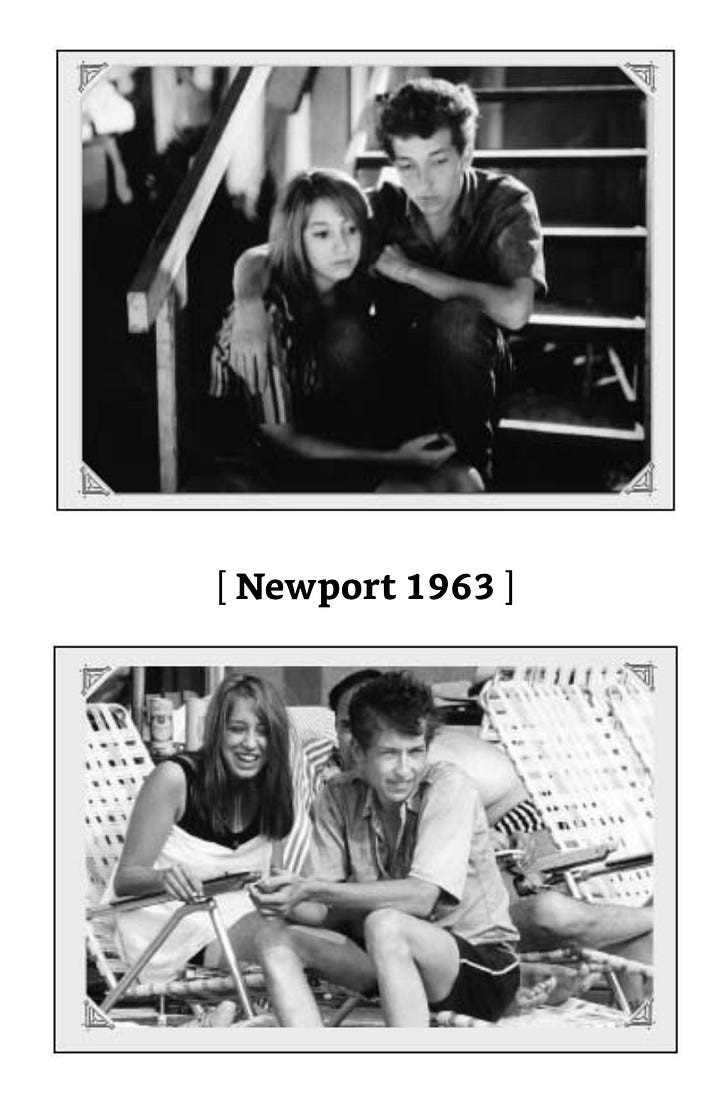
This is not a movie review; it is a critique of how art can seduce us with pleasure while obscuring the truth, particularly concerning the erasure of women’s experiences. It is a protest against the eclipse of real women in narratives often dominated by the male gaze.
Bob Dylan’s journey through the 1960s is a story with many interpretations, and the film A Complete Unknown chooses to focus on his transformation from a young folk singer in New York to an electric icon at the 1965 Newport Folk Festival. While the film is largely entertaining, drawing from Elijah Wald’s book Dylan Goes Electric, its dedication to the “enigmatic genius” narrative presents a significant challenge: how to portray the women in Dylan’s life? Director James Mangold aimed for an ensemble piece, interested in the “wake that this person has left on others,” using characters as “prisms and keyholes” to reveal Dylan’s multifaceted personality. However, the film’s portrayal, particularly of Suze Rotolo, falls short, offering a “complete fiction” that distorts her reality and agency.
The Narrative Choices in “A Complete Unknown”
Mangold’s directorial approach, while aiming for complexity, ultimately falters in its depiction of the women surrounding Bob Dylan. While Pete Seeger is rendered with apparent depth, thanks to both the script and Edward Norton’s portrayal, Joan Baez and the character of “Sylvie Russo” (a fictionalized Suze Rotolo) are presented far less convincingly. The film’s justification for changing Suze Rotolo’s name, as recalled by Elle Fanning who plays her, stems from Bob Dylan’s desire to protect Rotolo’s privacy, as she was not a public figure. Mangold echoes this, stating that Rotolo was not a celebrity like the others and that her name was not subjected to the same spotlight.
However, this narrative conveniently overlooks Rotolo’s own published accounts. She authored a book detailing her life with Dylan, and her perspective, corroborated by other sources like Anthony Scaduto’s biography, offers a starkly different portrayal of their relationship and breakup than what is depicted in A Complete Unknown. This erasure of Suze Rotolo’s experience and insights not only misrepresents Dylan but also perpetuates a pattern seen in many films about male geniuses, where women’s roles are often thinly and carelessly presented.
Suze Rotolo’s Reality vs. Sylvie Russo’s Fiction
The character of Sylvie Russo in the film presents a romanticized and ultimately inaccurate version of Suze Rotolo. The film depicts a young woman who is intelligent and political, supportive of Dylan’s burgeoning fame, but ultimately sidelined by his relationships with other women, particularly Joan Baez. This narrative culminates in Sylvie’s tearful departure at the Newport Folk Festival, quoting a line from the old movie Now, Voyager. This fabricated sequence, along with the invented details of Dylan’s interactions with Baez that night, serves to create a specific emotional arc for Sylvie, one of heartbreak and a poignant, albeit fictional, realization.
In stark contrast, Suze Rotolo’s own accounts reveal a more complex dynamic. While she deeply adored Dylan, her need for independence and autonomy, even in the pre-feminist era of the early 1960s, was a primary driver in the relationship’s end. She expressed her intolerance for the prevailing attitude towards musicians’ girlfriends, feeling reduced to a mere appendage rather than a whole person. Rotolo’s desire for her own pursuits, including theater and art, clashed with Dylan’s possessive nature and his expectation that she should be available to him at all times. Her journey to Italy, misrepresented in the film as a simple “school trip,” was partly to study Italian and, significantly, to gain distance from Dylan’s demands.
Dylan’s Emotional Landscape and Rotolo’s Influence
During Rotolo’s absence, Dylan experienced significant emotional turmoil, a stark contrast to the film’s portrayal of him moving on with Joan Baez. Friends described him as lost, neglecting himself, and deeply depressed, even fearing for his well-being. His prolific songwriting during this period, including songs like “Boots of Spanish Leather” and “It Ain’t Me, Babe,” reflected his internal struggles. While “Spanish Leather” is described as a “girl leaves boy” narrative, Dylan’s own explanation that it was a statement “to make me feel better” suggests a subversion of his own feelings of torment over Rotolo’s independence.
Rotolo’s time in Italy was also a period of profound self-discovery for her. Reading Françoise Gilot’s memoir, Life with Picasso, prompted her to reflect on the similarities between Picasso and Dylan, particularly their ability to prioritize their art above the needs and feelings of the women in their lives. This realization solidified her understanding of the societal permissions granted to men, especially male artists, allowing them to act without consequence, while women were often marginalized. This insight into Dylan’s need for unconditional love, akin to a mother’s, rather than a life partner, is a crucial aspect of his personality that the film’s narrative obscures by focusing on the trope of romantic heartbreak.
Conclusion: Reclaiming the Narrative
The film A Complete Unknown, by fictionalizing Suze Rotolo’s story and eclipsing her agency, fails to provide a complete or accurate picture of Bob Dylan or the era. It prioritizes a simplified narrative of male genius over the complexities of the women who influenced and were influenced by him. By creating “Sylvie Russo,” the film protects Dylan’s image as a resilient artist, while the real Suze Rotolo, a woman who sought her own path and articulated her experiences with remarkable clarity, is relegated to the shadows.
Ultimately, the film’s departure from factual representation, particularly concerning Suze Rotolo, not only diminishes her significance but also offers a less profound understanding of Bob Dylan himself. It is a missed opportunity to explore the intricate dynamics of relationships, artistic ambition, and the often-unseen contributions and struggles of women in the shadow of male icons.
Explore the rich tapestry of 1960s folk music and the figures who shaped it, understanding the complexities beyond the spotlight.