
The Golden Age of American muscle wasn’t the decades-spanning legend car culture often imagines—it was a lightning-fast run from 1964 to 1971, and many of the era’s greatest discontinued classic muscle cars disappeared almost as quickly as they arrived. While a handful of icons like the Ford Mustang and Dodge Charger managed to survive the industry’s shift into the detuned Malaise Era, most of the period’s fastest machines weren’t so lucky. Once emissions regulations, insurance hikes, and rising fuel costs choked off the horsepower wars, automakers pulled the plug on nameplate after nameplate, often within just a few short years of their debut.
For enthusiasts who love digging into automotive history, these forgotten muscle cars tell a story of ambition, competition, and ultimately, corporate retreat. Below are ten of the most tragic cancellations from the classic muscle car era—cars that burned brightly before being written off the sales sheet for good.
10. AMC Javelin: The Pony Car That Threw a Shoe
American Motors quietly built some of the most underrated performance cars of the 1960s and 1970s, and the Javelin, launched in 1968, was arguably its finest effort. The pony car was designed to shift AMC’s image away from economy vehicles and toward genuine performance, positioning it as a direct rival to the Mustang and Camaro.
Although it never matched the raw power of Hemi-equipped Mopars, the Javelin held its own against its pony car competitors in the marketplace. Sales were strong at first but tapered off sharply into the 1970s, and with AMC lacking the capital for a next-generation redesign, the Javelin was discontinued in 1974—sending the company back to its bargain-basement roots.
9. Dodge Super Bee: Stung on the B-Side
The runaway success of the no-frills Plymouth Road Runner pushed Dodge to build its own budget muscle car, resulting in the 1968 Super Bee. With a standard 383ci V8 and room in the budget to upgrade to a 440 or the legendary 426 Street Hemi, the Super Bee delivered serious performance without the premium price tag. Originally based on the Coronet platform, it was later shifted onto the third-generation Charger as a value-focused performance trim.
Then came 1972, a near-apocalyptic year for Mopar performance, when both the 426 Hemi and 440 Six-Pack were eliminated from the lineup. Since the Super Bee’s entire identity was built around affordable high performance, keeping it alive with the era’s weaker, detuned engines made little sense, and the nameplate was retired.
8. Mercury Cyclone: Blown Off the Map
The Mercury Cyclone began life as a performance trim of the Comet before becoming its own model in 1968. With aggressive styling and an available 429 Super Cobra Jet V8, the Cyclone remains one of the most overlooked performance cars of the classic muscle era. It backed up its looks on the track too, with driver Cale Yarborough winning six NASCAR races in a single Cyclone during the 1968 season.
That momentum didn’t last. In 1971, the car was renamed the Montego Cyclone, and by the following year it had been folded entirely into the Montego lineup, with “Cyclone” reduced to a mere trim level before disappearing altogether in 1972.
7. Plymouth GTX: Couldn’t Catch the Road Runner
While the Plymouth Road Runner was built as a scrappy street fighter, the more upscale GTX was marketed as “the gentleman’s muscle car.” Debuting in 1967 on the Belvedere platform, the GTX came loaded with nearly every feature Plymouth offered, commanding roughly $500 more than a comparable Road Runner—a meaningful premium at the time.
Despite its semi-luxury positioning, the GTX sold reasonably well, which makes Plymouth’s decision to cancel it in 1971 all the more surprising. It briefly returned as a Road Runner trim level from 1972 to 1974 before disappearing for good, proving that even a gentleman’s muscle car eventually wears out its welcome.
6. Buick Gran Sport: Collapse of the Century
Like many first-wave muscle cars, the Buick Gran Sport started as a performance option rather than its own model. Introduced in 1965 on the Skylark, it proved popular enough to become a standalone nameplate by 1967, eventually rebranded the GS 400 after its 400ci V8. The car reached legendary status in 1970 once GM lifted its restrictive big-engine displacement ban.
That year’s GS 455 Stage 1, packing 360 horsepower and 510 pound-feet of torque from its 455ci V8, stood as one of the most formidable muscle cars GM ever built. Yet Buick discontinued the Gran Sport just two years later, in 1972, relegating it to a performance trim on the decidedly unglamorous Buick Century before finally killing it off in 1975.
5. Dodge Challenger: Vanishing Point of No Return
Few discontinued classic muscle cars shined as brightly and burned out as fast as the original Dodge Challenger. As Dodge’s final entry into the Golden Age lineup, the Challenger arrived with knockout styling and fierce engine options, and the 1970–1971 Challenger R/T quickly established itself as one of the most dominant muscle cars on the road. It even achieved pop-culture fame as the star of the classic car-chase film Vanishing Point.
The momentum evaporated fast once the detuned 1972 model year hit. Sales collapsed, and just four years after its debut, the original Challenger was discontinued in 1974. Unlike many other cars on this list, the Challenger nameplate would eventually return in 2008, giving it a happier ending than most.
4. Ford Torino: Even Starsky & Hutch Couldn’t Save It
It may sound strange to call a Ford muscle car underrated, but the Torino genuinely flew under the radar compared to rivals like the Chevelle SS or Charger R/T. Introduced in 1968 with bold styling and an available 429ci Super Cobra Jet V8, the Torino was a legitimate performer that never earned the same reputation as its competitors.
By 1972 it had become the Gran Torino, still offering a 429 option, albeit in a much weaker state of tune. The nameplate found unexpected fame from 1975 to 1976 as the hero car in the television series Starsky & Hutch, and the red-and-white striped Gran Torino sold an impressive 193,096 units in 1976. Ford canceled the model that same year regardless, with no official explanation given.
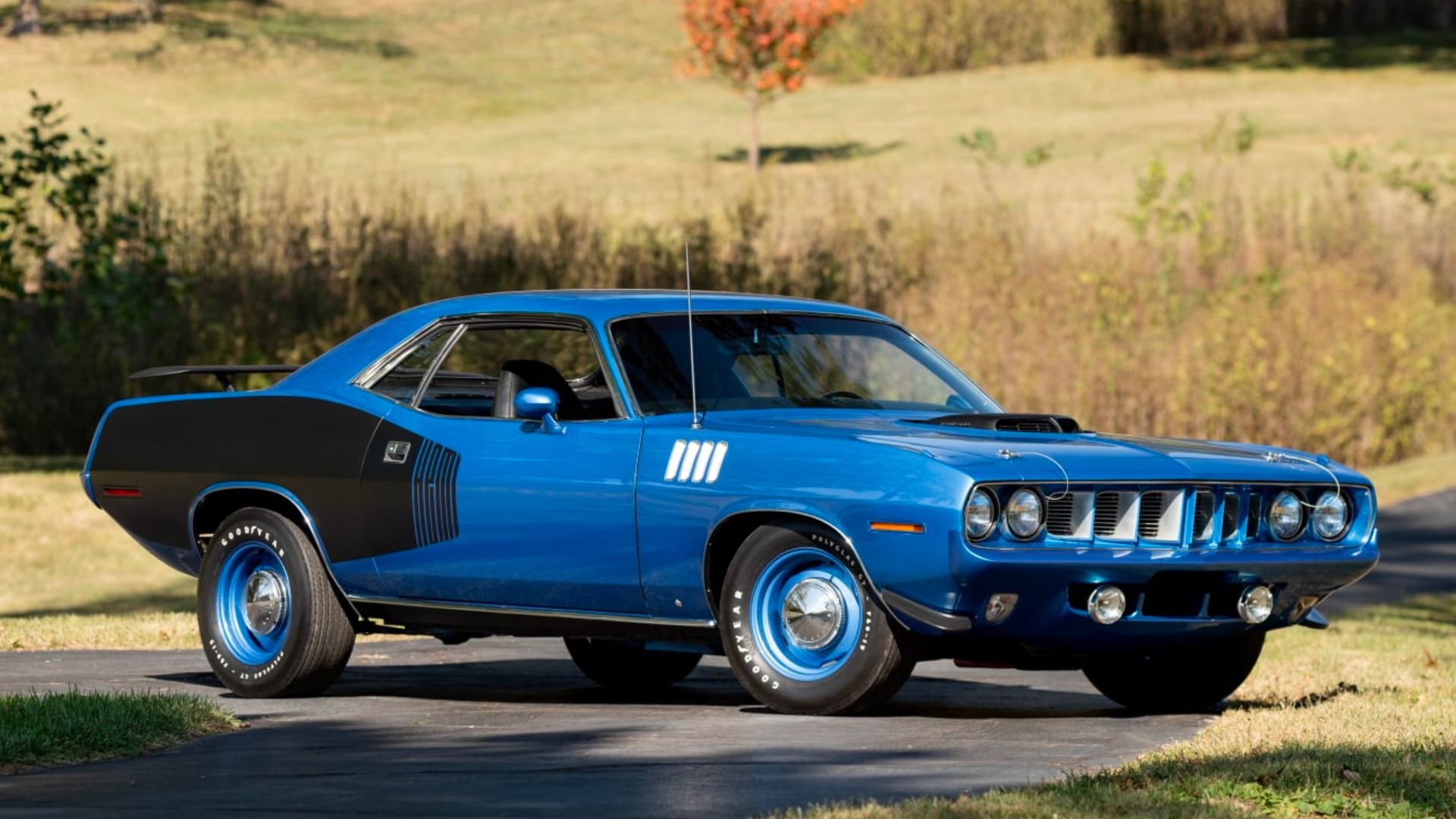
3. Plymouth Barracuda: The ‘Cuda Sleeps With the Fishes
Few realize that the Plymouth Barracuda was technically the first pony car ever sold, beating the Mustang to market by a matter of weeks. The first-generation Barracuda never matched the Mustang’s success, largely due to its awkward styling, but the nameplate steadily improved over successive generations.
By the third-generation redesign in 1970, the high-performance variant earned its own identity as the ‘Cuda, becoming one of the most feared muscle cars of the era—especially when equipped with the 426 Hemi V8. That engine was discontinued in 1971, meaning the legendary Hemi ‘Cuda existed for only two model years. Stripped of its most potent power plant, the once-fearsome nameplate faded quickly and was gone entirely by 1974.
2. AMC Rebel Machine: A One-Hit Wonder
In 1970, AMC scored a genuine hit with the Rebel Machine, but like so many one-hit wonders of the era, it lasted for a single model year and nothing more. Widely regarded as the coolest car AMC ever produced and the brand’s only true muscle car, the Rebel Machine was famous for its bold red, white, and blue color scheme—though it was actually offered in other colors too. Had it sold in greater numbers, there’s little doubt AMC would have kept the nameplate alive.
1. Pontiac GTO: From G.O.A.T. to Goat
No car on this list would exist without the Pontiac GTO, which effectively launched the entire muscle car era in 1964. As the car that sent every other automaker scrambling to compete, the GTO earned its status as the undisputed king of the classic muscle car segment.
The 1969 GTO Judge, powered by its legendary 400ci Ram Air IV V8, stood as the most potent GM muscle car of its time, and the 1970 model—now equipped with the 455 big-block—became the most powerful Pontiac ever built. But the fall came almost as fast as the rise. By 1971, sluggish Judge sales forced Pontiac to cancel the package mid-year, and 1972 marked the final year for the GTO as a standalone nameplate.
What followed was a slow, humiliating decline: in 1973 the GTO became a mere option package on the LeMans, and by 1974 it had been demoted to a trim level on the compact Ventura. Pontiac would later revive the name in 2004 by badging a rebadged Holden Monaro as a GTO—a move most enthusiasts prefer to forget.
Final Thoughts
From the AMC Javelin to the mighty Pontiac GTO, these discontinued classic muscle cars remind us just how fleeting the Golden Age of American performance really was. Tightening regulations, rising insurance costs, and shifting consumer tastes brought an abrupt end to some of the most exciting machines Detroit ever produced—many of them gone within just a few years of hitting showroom floors. Yet their legacy endures today through restorations, auctions, and the enduring passion of collectors around the world.
Which of these forgotten muscle cars would you most like to see make a comeback? Share your thoughts, and be sure to check out more classic car retrospectives to keep exploring the golden era of American performance.
References
- Chrysler Corporation historical archives.
- Ford Motor Company historical archives.
- General Motors historical archives.
- Mecum Auctions vehicle listings and historical photography.