
Fast cars have always captured our imagination. From the roaring engines in the Fast and Furious franchise to classic films like Thunder Road (1958) and Talladega Nights, cinema has celebrated the mechanical marvel of automobiles for decades. Yet behind every sleek vehicle design and high-performance engine lies the expertise of automotive engineering professionals who dedicate their careers to innovation, safety, and sustainability in the automotive industry.
If you’re passionate about designing, engineering, and building the next generation of passenger cars, trucks, motorcycles, electric vehicles, or racing machines, pursuing an education at one of the best automotive engineering schools could be your pathway to success. The automotive sector demands skilled engineers capable of addressing modern challenges—from electric vehicle development to autonomous systems and environmental sustainability.
This comprehensive guide explores the leading automotive engineering schools and colleges across the United States, outlining the degrees available, program specializations, and how to select the right institution for your career goals. Whether you’re interested in vehicle design, powertrain systems, or manufacturing excellence, understanding the distinctions between degree types and choosing the right school will set the foundation for a rewarding career in automotive engineering.
Understanding Automotive Degree Types
The automotive engineering field offers multiple educational pathways, each leading to different career opportunities. Your choice of degree depends on your career aspirations and the level of technical responsibility you envision for your future.
Certificate and Diploma Programs are ideal for individuals seeking entry-level positions in automotive service and repair shops, dealerships, and independent repair facilities. These programs provide practical, hands-on training focused on vehicle diagnostics, maintenance, and repair procedures.
Associate’s Degrees in Automotive Technology represent a two-year educational commitment, combining theoretical knowledge with lab-based instruction. Graduates typically qualify for supervisory roles in service departments or technical positions in manufacturing facilities.
Bachelor’s Degrees in Automotive Engineering Technology (AET) emphasize the intersection of practical application and engineering principles. These four-year programs prepare students for design support roles, vehicle testing, technical analysis, and management positions within automotive manufacturers and suppliers. The curriculum typically covers vehicle dynamics, powertrain systems, emissions testing, and manufacturing processes.
Bachelor’s Degrees in Automotive Engineering (B.S.) are less common but highly specialized. These programs focus exclusively on the design, manufacturing, and operation of automobiles, motorcycles, and trucks. Graduates pursue careers in research and development, product design, and advanced engineering projects.
Bachelor’s Degrees in Mechanical Engineering (B.S.) with automotive concentrations offer broader educational flexibility. This degree encompasses mechanical systems across multiple industries—aerospace, civil engineering, manufacturing, and biomedical fields—while including automotive-specific coursework. Many engineers in the automotive industry hold mechanical engineering degrees with automotive electives and internship experiences.
Master’s Degrees and PhDs in automotive engineering enable advanced specialization in areas such as vehicle dynamics, electric vehicle systems, autonomous driving technology, and advanced materials research. These graduate degrees position engineers for senior design roles, research leadership, and positions at prestigious automotive research centers.
Automotive Engineers vs. Automotive Mechanics: Key Differences
Understanding the distinction between these two automotive professionals clarifies which educational path aligns with your interests and goals.
Automotive Engineers focus on the conceptual and developmental phase of vehicle creation. They conduct research, design new vehicles and components, update existing vehicle features, develop alternative powertrain systems, and test innovative technologies. Automotive engineers work in design studios, research laboratories, and engineering offices, collaborating with cross-functional teams to bring vehicles from concept to production. These professionals typically hold bachelor’s degrees or higher in engineering disciplines.
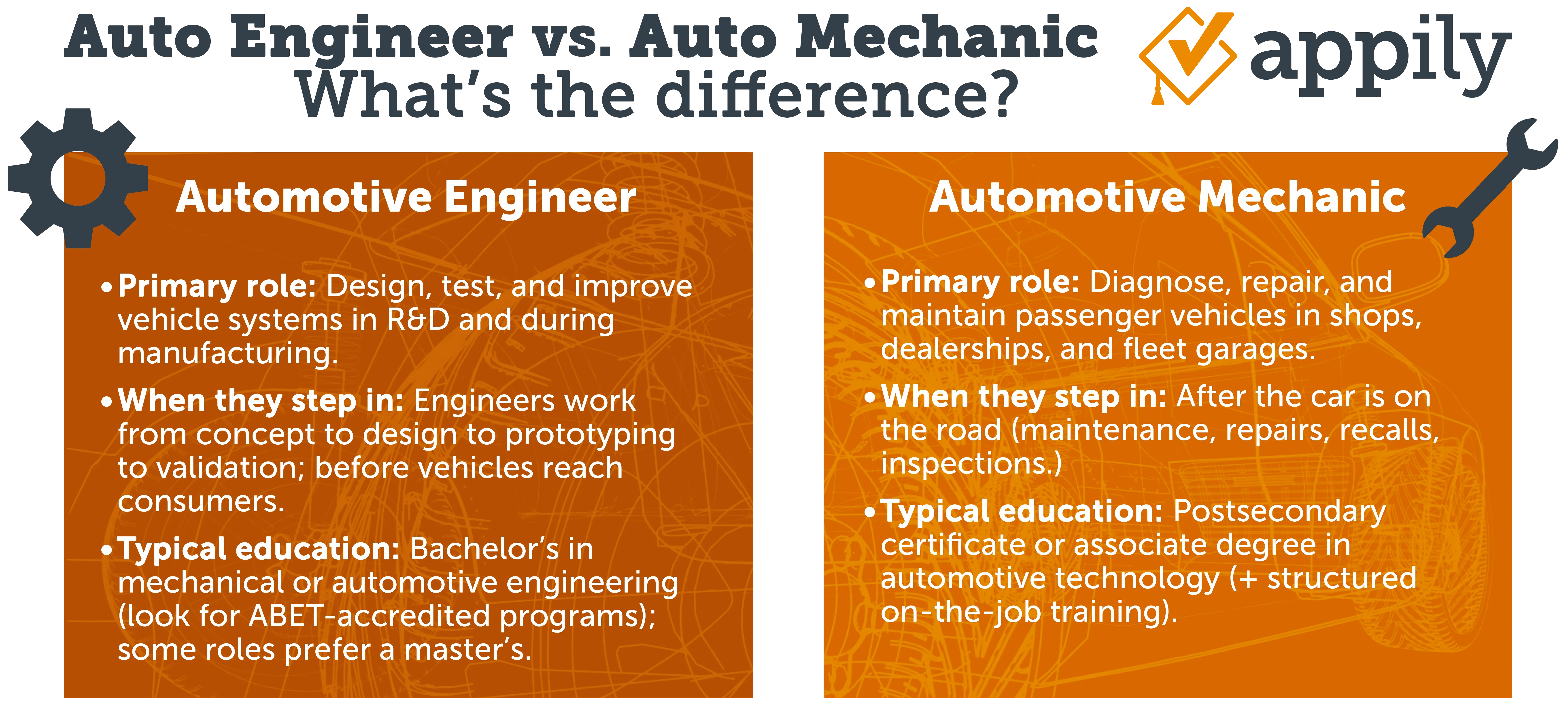
Automotive Mechanics, also called auto technicians or service technicians, become involved once vehicles reach consumers. They diagnose mechanical problems, perform repairs, conduct preventive maintenance, and ensure vehicle safety and performance. Mechanics work at dealerships, independent repair shops, quick-lube facilities, and automotive parts stores. Their expertise directly impacts customer satisfaction and vehicle longevity. Many automotive mechanics hold certificates, diplomas, or associate degrees, though some pursue bachelor’s degrees in automotive service management or automotive technology.
This fundamental distinction means automotive engineers build and innovate vehicles, while mechanics maintain and repair them. Both professions are essential to the automotive industry’s success, but they require different educational backgrounds and skill sets.
Leading Automotive Engineering Schools and Programs
The following institutions represent some of the nation’s premier automotive engineering colleges, organized by their acceptance rates. Each school brings unique strengths, facilities, and partnership opportunities to prepare the next generation of automotive professionals.
Brigham Young University–Idaho
Location: Rexburg, Idaho
BYU-Idaho’s Automotive Technology Program stands out for its comprehensive, hands-on approach to automotive engineering education. The program offers three distinct Bachelor of Science degrees: Automotive Engineering Technology, Advanced Vehicle Systems, and Automotive Technology Management. All programs are ASE-certified, meaning graduates meet industry-recognized standards for competency.
Students spend extensive time in dedicated laboratories and on test courses, gaining practical experience with real vehicles and diagnostic equipment. The program encourages participation in the SAE Supermileage Team, which competes annually in the SAE Supermileage competition held in Marshall, Michigan. This competition challenges students to design and build vehicles optimized for fuel efficiency, fostering innovation and teamwork.
For those interested in mechanical engineering, BYU-Idaho offers a Bachelor’s degree in Mechanical Engineering with the option to focus automotive interests through a minor in Automotive Technology, providing educational flexibility for students exploring multiple engineering disciplines.
Clemson University
Location: Clemson, South Carolina
Clemson University holds a distinguished place in automotive engineering history as a pioneer in offering bachelor’s degrees in this specialized field. The university awarded the first automotive engineering bachelor’s degrees, establishing itself as a leader in automotive education.
The Clemson experience centers on the “Deep Orange” framework, an immersive learning program within the Department of Automotive Engineering that places students in real-world scenarios simulating careers at original equipment manufacturers (OEMs) or automotive suppliers. This approach bridges the gap between academic learning and industry practice.
Clemson’s commitment to automotive excellence extends beyond the undergraduate level. The university offers Master of Science and PhD programs in Automotive Engineering, available at the Clemson University International Center for Automotive Research (CU-ICAR) located in Greenville. This purpose-built automotive campus features state-of-the-art research facilities and collaborative partnerships with major OEMs and suppliers, focusing on vehicle engineering, manufacturing innovation, and autonomous systems development.
Ferris State University
Location: Big Rapids, Michigan
Ferris State University has established a comprehensive automotive program portfolio addressing diverse career interests within the industry. The Bachelor of Science in Automotive Engineering Technology (AET) prepares students for technical roles in design, testing, and manufacturing. The Bachelor of Science in Automotive Management (AMGT) targets those seeking business and leadership positions within automotive companies, and this program is also available as a minor for students in other engineering disciplines.
Both bachelor’s programs provide substantial laboratory experience in specialized areas including metallurgy, mechanical testing, vehicle emissions analysis, and dynamometer testing—essential skills for modern automotive professionals. All students complete on-the-job internships, ensuring real-world experience before graduation.
Ferris State supplements its degree programs with two automotive certificate options: one specializing in motorsports technology and another in machinery operation and maintenance. These certificates provide accelerated pathways for students seeking rapid entry into the automotive workforce.
Idaho State University
Location: Pocatello, Idaho
Idaho State University’s College of Science and Engineering serves students at multiple educational levels through its automotive programs. The Associate of Applied Science Degree in Automotive Technology and the Advanced Technical Certificate in Automotive Technology provide entry-level credentials for technician positions.
Students may also pursue an Associate of Applied Science in Automotive Collision Repair and Refinishing, addressing the specialized field of vehicle restoration following accidents. Three additional certificate options—covering specific automotive systems and specializations—allow students to customize their technical education based on career interests and market demand.
Indiana State University
Location: Terre Haute, Indiana
Indiana State University’s Bachelor of Science in Automotive Engineering Technology prepares graduates for careers across the automotive industry’s diverse technical and managerial roles. The four-year curriculum emphasizes design principles, operational theory, vehicle testing methodologies, and management skills necessary for professional automotive careers.
The program’s technical focus includes vehicle dynamics testing, design support and analysis, NVH (noise, vibration, and harshness) research, and engine performance analysis. These specialized areas address critical automotive engineering challenges, particularly as the industry transitions toward electric vehicle technologies and stricter environmental regulations.
Kettering University
Location: Flint, Michigan
Kettering University offers a Mechanical Engineering Bachelor’s degree with multiple concentration options, including Automotive Engineering Design—a specialized track for students prioritizing vehicle engineering expertise. Students may also pursue concentrations in Machine Design & Advanced Materials or Alternative Energy Systems, accommodating diverse engineering interests.
The university’s dedicated research laboratories provide hands-on learning opportunities unavailable at many institutions. The Advanced Engine Research Lab enables students to study combustion, emissions, and performance optimization. The Crash Safety Center addresses vehicle safety systems and structural integrity. The Energy Systems Lab focuses on alternative propulsion technologies and efficiency improvements. These world-class facilities position Kettering students at the forefront of automotive innovation.
Kettering’s co-op program represents another significant advantage. Students alternate between classroom instruction and paid professional work experiences, graduating with approximately two and a half years of industry experience already accumulated. This advantage significantly enhances job prospects and professional networks upon graduation.
McPherson College
Location: McPherson, Kansas
McPherson College operates an entirely unique automotive program—the only one of its kind in the nation. While most automotive engineering schools focus on new vehicle design and modern technologies, McPherson specializes in historic automotive restoration and preservation.
The program emphasizes Historic Automotive Technology, Automotive Restoration Management, Automotive Communications, Automotive Restoration Design, and Automotive Restoration Technology. This specialization appeals to students passionate about classic vehicles, mechanical history, and preservation craftsmanship.
The college invested heavily in program facilities, constructing a dedicated 33,000-square-foot facility in Templeton Hall. This specialized workspace houses vintage vehicles, restoration equipment, and tools specific to historic automotive work. Students gain expertise in pre-digital engine technology, hand-crafted body work, and documentation methods essential for collector-grade vehicle restoration.
Minnesota State University–Mankato
Location: Mankato, Minnesota
Minnesota State University–Mankato’s Bachelor of Science in Automotive Engineering Technology (AET) program targets graduates seeking careers in product research, vehicle design and development, manufacturing systems, and technical sales across original equipment and aftermarket automotive sectors.
The curriculum combines engineering principles with practical application, preparing students to contribute meaningfully to automotive companies seeking to innovate and improve vehicle performance. The program encourages student participation in professional organizations including the SAE (Society of Automotive Engineers), providing networking opportunities and technical knowledge beyond the classroom.
Students may also join the MSU Drag Race Team, a competitive student organization that designs and builds high-performance vehicles. This hands-on project experience accelerates learning and demonstrates commitment to automotive passion and expertise.
Montana State University–Northern
Location: Havre, Montana
Montana State University–Northern demonstrates commitment to automotive education through multiple program options and industry partnerships. The Automotive Technology program offers Bachelor’s and Associate’s degrees, as well as a minor, all taught by Master ASE-certified technicians bringing substantial professional experience into classroom and laboratory settings.
The university’s industry-sponsored technician training partnerships with Ford, Subaru, and other manufacturers provide students with manufacturer-specific knowledge and potential employment pathways. These partnerships ensure curriculum remains current with industry practices and emerging technologies.
Montana State–Northern also offers an ABET-accredited Mechanical Engineering degree for students seeking broader engineering education with automotive applications, providing educational flexibility similar to larger research universities.
Pennsylvania College of Technology
Location: Williamsport, Pennsylvania
Pennsylvania College of Technology recognizes that the automotive industry accommodates diverse career paths and learning preferences. The institution offers three Bachelor of Science degree programs designed to align with specific career goals: Automotive Technology Management (available online for working professionals), Automotive Service, Sales, and Marketing, and Automotive Technology.
The college’s partnerships with major manufacturers—Ford ASSET, Honda PACT, and MOPAR CAP—enable students pursuing the Automotive Technology degree to specialize in manufacturer-specific systems and maintenance procedures. These credentials carry significant weight with dealerships and service centers, often accelerating career advancement.
During their studies, students earn multiple industry certifications, including the highly valued ASE (Automotive Service Excellence) certification. The college additionally offers a certificate program for Automotive Service Technicians and an Aftermarket Performance Specialist credential, supporting diverse career interests within the automotive service sector.
Pennsylvania College of Technology also serves working professionals through online degree options, allowing experienced technicians to earn bachelor’s degrees while maintaining employment.
Pittsburg State University
Location: Pittsburg, Kansas
Pittsburg State University’s Department of Technology provides automotive education through the Kansas Technology Center. The Bachelor’s degree in Automotive Technology emphasizes comprehensive vehicle knowledge, with an optional Emphasis in Automotive Mechanical Design allowing students to “dig deep into the study of automobiles from bumper to bumper.”
The program benefits from exceptional facilities: 32,000 square feet of dedicated automotive laboratory space, 40 donated training vehicles at various stages of restoration and repair, and complete tool collections. This equipment-rich environment enables hands-on learning impossible at institutions with limited resources.
Students participate in the Annual Car Show hosted by the local Society of Automotive Engineers chapter, the SAE Baja competition (competing against university teams globally), and SkillsUSA competitions. These extracurricular activities develop professional networking skills and demonstrate competency to potential employers.
Purdue University
Location: Indianapolis, Indiana
Purdue University’s School of Engineering & Technology at the Indianapolis campus offers a groundbreaking degree: the Bachelor of Science in Motorsports Engineering. Purdue holds the distinction of offering the first motorsports engineering degree program in the United States, pioneering an educational pathway for racing enthusiasts.
The curriculum blends comprehensive engineering principles with motorsports-specific expertise including vehicle dynamics, aerodynamics, data acquisition systems, and performance optimization. Graduates pursue careers with racing teams, performance automotive manufacturers, and motorsports engineering firms.
Purdue recognizes that motorsports engineering expertise translates across automotive sectors. Students may pursue a dual degree in Motorsports and Mechanical Engineering through an additional 26 credit hours, enhancing career flexibility and deepening technical competency in both specialized and general mechanical engineering domains.
Southern Adventist University
Location: Collegedale, Tennessee
Southern Adventist University provides aspiring automotive mechanics with an exceptional advantage: a full-service auto shop serving the campus and surrounding community. This real-world facility allows students to diagnose, repair, and maintain vehicles for actual customers while supervised by experienced instructors and professionals.
This authentic service environment accelerates skill development and builds professional confidence. Students earn industry-standard certifications, including the ASE certification, through rigorous testing and competency verification. Graduates enter the workforce with proven repair experience, customer service skills, and industry credentials.
Southern Illinois University–Carbondale
Location: Carbondale, Illinois
Southern Illinois University–Carbondale combines theoretical engineering knowledge with practical hands-on application through its Bachelor of Science in Automotive Technology. The university invested in state-of-the-art facilities, including the Transportation Education Center and a fleet of 90 late-model training vehicles representing the diversity of vehicles students will encounter in professional careers.
The program creates a comprehensive learning community. Students join the Automotive Technology Organization for professional networking, the Women in Automotive Transportation Technology (WATT) group promoting gender diversity in automotive careers, and the Off-Road Club—a student organization that received a donated Jeep Cherokee as a project vehicle for hands-on learning and competition.
SUNY Morrisville
Location: Morrisville, New York
SUNY Morrisville distinguishes itself as one of the few institutions nationally offering a B.Tech (Bachelor of Technology) in Automotive Technology. This unique degree designation prepares students for technical and supervisory-level positions within the automotive industry, filling a specific educational niche.
The program emphasizes skills and knowledge required for leadership roles in automotive service operations, manufacturing facilities, and technical departments, making it particularly attractive to students seeking career advancement into management positions.
University of Central Missouri
Location: Warrensburg, Missouri
The University of Central Missouri’s Bachelor’s degree in Automotive Technology Management (ATM) acknowledges that modern automotive careers require business acumen alongside technical expertise. The program organizes learning around three interconnected areas: Automotive Technology (technical systems and repair), Design Technology (vehicle design principles and CAD), and Service Management (leadership and business operations).
Students spend several hours weekly in laboratory settings, working directly with university-owned vehicles. This consistent hands-on engagement ensures technical competencies remain sharp while theoretical understanding deepens. The university additionally offers an Advanced Vehicle Systems Certificate and Automotive Technology minor for students in other majors seeking automotive knowledge.
University of Northwestern Ohio
Location: Lima, Ohio
The University of Northwestern Ohio provides multiple pathways through the College of Applied Sciences and College of Occupational Professions. Students may earn diplomas, associate’s degrees, or bachelor’s degrees in Automotive Technology, with all instruction delivered by ASE-certified and Master ASE-certified professionals.
The institution recognizes specialized career interests by offering major options in Automotive Management and High-Performance Automotive Technology, allowing students to tailor education to specific automotive sectors. This flexibility attracts students with diverse automotive passions and career aspirations.
University of Michigan–Ann Arbor
Location: Ann Arbor, Michigan
The University of Michigan’s Mechanical Engineering program maintains ABET accreditation, the gold standard for engineering education. The undergraduate degree provides comprehensive mechanical engineering education while incorporating courses specific to automotive systems and technologies.
Beyond coursework, the university maintains an extensive research program dedicated to automotive innovation and sustainability. Multiple student design teams enable hands-on project participation, allowing engineering students to apply classroom knowledge to real challenges. The automotive research initiatives position the university at the forefront of vehicle technology innovation.
The University of Texas at Arlington
Location: Arlington, Texas
The University of Texas at Arlington offers mechanical engineering education focused on designing cars, autonomous vehicles, and advanced robotic systems through its Mechanical and Aerospace Engineering Department. The Bachelor’s degree provides broad mechanical engineering knowledge applicable across industries while emphasizing automotive applications.
The Arnold E. Petsche Center for Automotive Engineering offers an Automotive Engineering Certificate, allowing students to formally recognize and emphasize automotive coursework and expertise. The Co-op/Internship Office facilitates placement in automotive companies, providing practical experience and networking. Students may also join the UTA Racing Formula SAE team, competing against university teams in designed-and-built race car competitions.
Utah Valley University
Location: Orem, Utah
Utah Valley University’s Department of Transportation Technologies offers automotive education across multiple program levels and specializations. The curriculum covers Auto Technology, Collision Mechanics (vehicle restoration following accidents), Street Rod restoration (custom and classic vehicles), and Power Sports (motorcycles and recreational vehicles).
The department awards associate degrees, certificates, and diplomas, accommodating diverse educational goals and timelines. This programmatic diversity attracts students with varying automotive interests and career aspirations, from technician roles to specialized restoration work.
The university hosts an annual Auto Expo, a major automotive showcase event that generates scholarship funding for Department of Transportation Technologies students, creating direct financial support for program participants.
Walla Walla University
Location: College Place, Washington
Walla Walla University stands among only 15 institutions nationally offering a Bachelor’s degree in Automotive Technology or Automotive Management, making it exceptionally selective in its focus. The university differentiates itself through an on-campus repair shop—University Auto—where students gain paid work experience while serving the campus and community.
Students enjoy unrestricted access to the automotive laboratory and specialized equipment, enabling extended study and skill development beyond formal coursework. The combination of paid work experience, comprehensive facility access, and bachelor’s degree education creates an advantageous learning environment.
Walla Walla also offers an ABET-accredited Mechanical Engineering undergraduate degree with “Depth Electives” including Alternative Energy Systems, Manufacturing Systems, and Optimization, though the mechanical engineering program does not offer an automotive concentration.
Weber State University
Location: Ogden, Utah
Weber State University’s Department of Automotive Technology provides educational flexibility through multiple degree and certificate options. Students may pursue Bachelor’s degrees in Field Service Operations or Advanced Vehicle Systems, addressing specific automotive career paths. Associate’s degree options include Independent Shop ATESP (Automotive Technician Education Standards Program) and Heavy Duty Trucks, serving students seeking two-year credentials.
The department awards two certificates: Automotive Service Technology (entry-level technician certification) and Industry Hybrids (hybrid and electric vehicle specialization). The hybrid certification addresses the automotive industry’s rapid transition toward electric propulsion, positioning Weber State graduates for the evolving automotive landscape.
Selecting the Right Automotive Engineering School
Choosing the right automotive engineering school requires thoughtful consideration of multiple factors aligned with your personal goals and circumstances.
Career Goals: Define your intended career path before selecting a school. Are you targeting research and development roles? Design positions? Manufacturing? Service engineering? Field testing? Career aspirations significantly influence whether an automotive engineering degree, automotive engineering technology degree, or mechanical engineering degree best serves your objectives.
Geographic Location: Consider whether you prefer remaining near home or relocating for education. School location affects cost of living, networking opportunities, potential internships, and quality-of-life factors. Some regions—particularly Michigan, Indiana, and Ohio—concentrate automotive manufacturing and supplier facilities, providing abundant internship and employment opportunities.
Program Structure and Philosophy: Examine whether schools emphasize theory, hands-on learning, or balanced approaches. Some programs prioritize laboratory and shop experience, while others stress engineering principles and design software. Your learning preferences should align with institutional philosophy.
Facilities and Resources: Evaluate laboratory quality, equipment availability, training vehicle fleets, and facility newness. Institutions with superior facilities provide competitive advantages in hands-on skill development and modern technology exposure.
Industry Partnerships: Research manufacturer and supplier relationships. Partnerships with Ford, Honda, GM, and other major companies provide industry-specific training, potential employment pathways, and curriculum alignment with actual industry practices.
Certification Opportunities: Investigate whether programs provide pathways to ASE certification or manufacturer-specific credentials. These industry-recognized credentials significantly enhance employment prospects and earning potential.
Cost and Financial Aid: Compare tuition, living expenses, scholarship availability, and financial aid options. Some schools offer robust financial support specifically for automotive students. Calculate total educational cost relative to expected career earnings.
Accreditation: Verify ABET accreditation for engineering degrees, ensuring educational quality and employer recognition. ASE and manufacturer certifications add significant value.
Student Life and Extracurriculars: Examine student organizations, competitions (SAE Supermileage, SAE Baja, Formula SAE, Drag Racing), and community. These experiences build professional networks and develop leadership skills.
Alumni Networks: Strong alumni networks in the automotive industry facilitate job placement, mentorship, and career advancement. Research graduate employment outcomes and corporate relationships.
Frequently Asked Questions About Automotive Engineering Education
What distinguishes automotive engineering from automotive technology and mechanical engineering?
Automotive engineering (AE) represents design-focused engineering emphasizing vehicle dynamics, powertrain systems (traditional and electric), control systems, and technology validation. This specialization applies engineering principles specifically to automobile design and innovation.
Mechanical engineering (ME) encompasses broader mechanical systems spanning multiple industries—aerospace, civil infrastructure, manufacturing, and biomedical applications. Many automotive professionals hold mechanical engineering degrees, often with automotive concentrations or electives supplementing core curriculum.
Automotive engineering technology and automotive technology programs emphasize applied, hands-on learning focusing on vehicle diagnostics, testing, calibration, manufacturing processes, and service engineering. These programs prioritize laboratory and workshop skills alongside theoretical knowledge, preparing graduates for technical implementation roles rather than purely design positions.
What educational credentials are required for automotive engineering or automotive industry careers?
A bachelor’s degree in mechanical engineering, electrical engineering, or automotive engineering represents the standard requirement for automotive engineering positions. Many roles, particularly those involving specialization or leadership responsibility, benefit from or require master’s degrees. Advanced degrees enable expertise in specialized areas such as autonomous vehicle systems, electric propulsion, and advanced materials.
Which degree best prepares for automotive engineering careers?
For research, development, and design roles: Bachelor of Science in Mechanical Engineering (with automotive concentration or electives) or Bachelor of Science in Automotive Engineering where available. These degrees provide the theoretical foundation for innovative engineering work.
For applied roles in vehicle testing, service engineering, manufacturing, and field operations: Bachelor of Science in Automotive Engineering Technology or Associate’s Degree supplemented with industry certifications. These programs emphasize practical application and manufacturing realities.
Do automotive programs exist outside dedicated engineering frameworks?
Yes. Many universities offer automotive technology, high-performance automotive systems, collision repair and refinishing, diesel technology, and automotive management programs at associate and bachelor levels. Examples include Weber State University, University of Northwestern Ohio, Utah Valley University, and Montana State University–Northern. These institutions serve students seeking specialized automotive education without comprehensive engineering programs.
Is automotive engineering offered as a major at every university?
No. Automotive engineering represents a specialized field less common than general mechanical engineering. Most universities without dedicated automotive engineering programs allow students to major in mechanical engineering and emphasize automotive interests through course selection, electives, internships, and project participation. This approach provides educational flexibility while enabling automotive specialization.
Start Your Automotive Engineering Journey Today
The automotive industry stands at a transformative moment, with electric vehicles, autonomous driving technology, and sustainability initiatives reshaping vehicle design and engineering. Schools featured in this guide prepare students to lead this transformation, combining rigorous academic instruction with practical experience and industry partnerships.
Whether your passion lies in classic vehicle restoration, cutting-edge electric vehicle development, motorsports engineering, or service operations management, the educational pathways outlined here offer genuine opportunities to build a rewarding automotive career. Take time to research schools aligned with your goals, visit campuses when possible, speak with current students and alumni, and carefully consider how each institution’s strengths match your aspirations.
The automotive engineering professionals shaping tomorrow’s vehicles are in the classrooms and laboratories of these institutions today. Your education begins with selecting the right school—one where your passion for automotive excellence finds institutional support, expert mentorship, and the resources necessary to launch a successful career. Begin your research today, and take the first step toward joining the next generation of automotive engineering leaders.